Chawanmushi
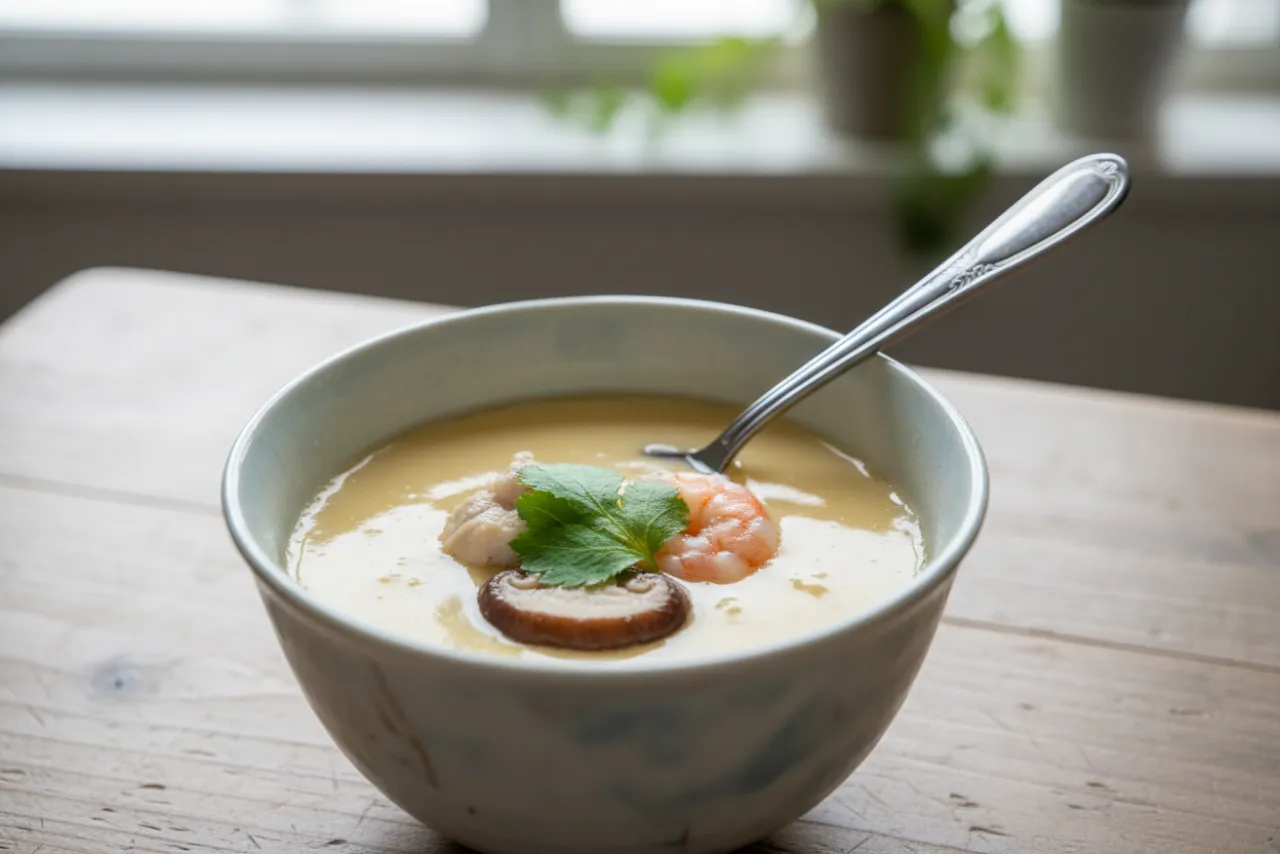
Silky savoury egg custard steamed in cups with dashi, chicken, shrimp, and shiitake.
Ingredients
- 3 Egg
- 5 g Kombu (dried kelp)
- 8 g Katsuobushi (bonito flakes)
- 1 tsp Japanese light soy sauce (usukuchi)
- 1 tsp Mirin
- ¼ tsp Salt
- 100 g Chicken thighs
- 8 Shrimp
- 2 Dried shiitake
- 1 Scallions (optional)
Method
- Rehydrate the dried shiitake in warm water, then lift them out and slice thin.
- Soak the kombu in cold water to cover.
- Bring the kombu water over medium-low to about 70C (160F), then lift the kombu out. Take off the heat, add the bonito flakes, let them steep briefly, then strain. Let the dashi cool to room temperature.
- Dice the chicken into small pieces. Peel and devein the shrimp. Slice the scallions thin.
- Beat the eggs gently without frothing. Stir in the cooled dashi (about three parts dashi to one part egg), the soy, mirin, and salt. Strain through a fine sieve into a jug.
- Distribute the chicken, shrimp, and shiitake between four heatproof ramekins. Pour the custard over carefully to fill three-quarters. Cover each with foil.
- Bring the steamer up to a gentle steam. Place the ramekins inside and cover with the lid ajar (a small gap) so the custards don't get scrambled by violent steam.
- Steam gently until a skewer inserted comes out with clear (not cloudy) liquid. The top should jiggle just slightly when nudged.
- Lift the ramekins out carefully and uncover. Scatter scallions on top. Serve hot with small spoons.
Tap “Start cooking” for live timers that flag what to get ahead on while something simmers.
About Chawanmushi
Chawanmushi is a savory Japanese egg custard, steamed and served in a lidded cup as an appetizer or part of a multi-course meal. Its name means 'steamed in a tea bowl,' and unlike a Western custard it is unsweetened, set softly around a base of dashi so it trembles and slips rather than slices. It is one of the few Japanese egg dishes served with a spoon, and its restrained elegance makes it a staple of kaiseki and home cooking alike.
Everything depends on the dashi and the ratio: kombu and bonito are steeped gently to draw out clean umami without bitterness, then combined roughly three parts dashi to one part egg and strained so the custard sets glass-smooth. Hidden in each cup are small treasures — diced chicken thigh, shrimp, and rehydrated shiitake — that season the custard from within as it steams. The result is silky and delicate, savory and faintly sweet from the mirin, light in calories yet rich in protein. Served warm, it is soothing rather than filling, a quiet course meant to be eaten slowly with a spoon, often at the start or middle of a Japanese meal.
Chawanmushi: frequently asked questions
How many calories are in Chawanmushi?
A serving has about 161 calories — 18.5g protein, 2.6g carbs, 8.2g fat, 0.3g fiber. Figures are estimated from the ingredient amounts and will shift with your portions and brands.
Is Chawanmushi gluten-free?
As written, no — it contains Japanese light soy sauce (usukuchi). You'd need a certified gluten-free swap for that ingredient to make it gluten-free.
How long does Chawanmushi take to make?
About 55 minutes start to finish, but only around 20 of those are hands-on — the rest is largely unattended cooking time you can step away from. In the Homecooked app the timers and parallel steps are sequenced for you so the hands-on part feels even shorter.
Do I need every ingredient to make Chawanmushi?
The core ingredients are essential, but you can leave out scallions — they're optional and mainly there for extra flavor or finish.
How many servings does Chawanmushi make?
This recipe makes 4 servings. In the app you can scale it up or down and the ingredient amounts adjust automatically.