Panang Curry
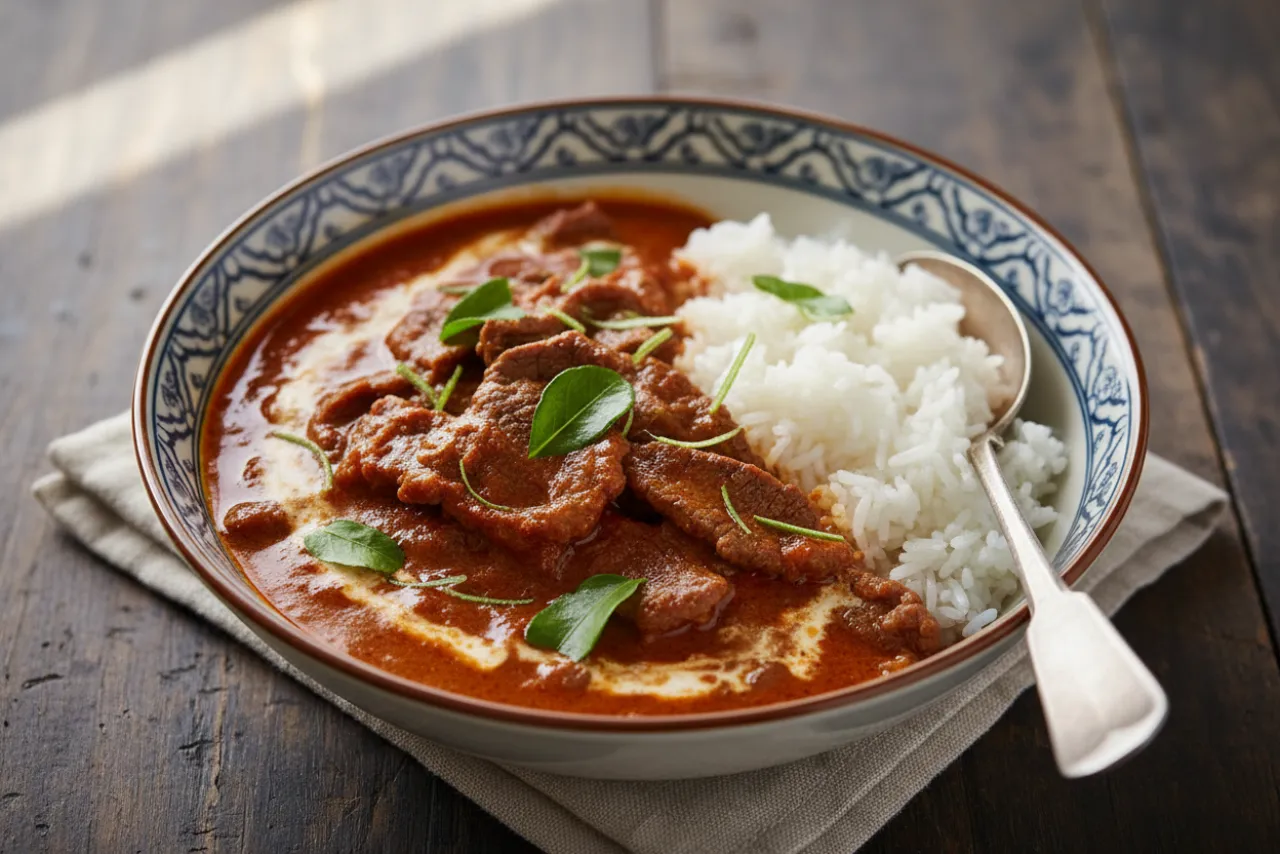
Thick, rich red curry with beef and kaffir lime.
Ingredients
- 500 g Beef flank steak
- 4 tbsp Red curry paste
- 2 tin Coconut milk
- 40 g Peanuts
- 6 Kaffir lime leaves
- 2 tbsp Fish sauce
- 1 bunch Thai basil (optional)
- 2 tbsp Palm sugar (optional)
- 500 g Jasmine rice (optional)
Method
- Rinse the rice and cook it in twice its volume of water, covered, until tender and the water is absorbed, about 15 minutes.
- While the rice cooks, slice the beef flank thin against the grain and crush the peanuts.
- Spoon the thick cream from the top of one tin of coconut milk into a wide pan over medium heat and simmer until the oil separates out, then fry the red curry paste and peanuts in it until thick and fragrant.
- Add the beef, a little more coconut milk, and the kaffir lime leaves and simmer gently over low heat until the beef is tender.
- Balance the sauce with the fish sauce and palm sugar, keeping it thick and glossy.
- Take the pan off the heat and tear in the Thai basil so it just wilts.
- Spoon into bowls and serve with the jasmine rice.
Tap “Start cooking” for live timers that flag what to get ahead on while something simmers.
About Panang Curry
Panang curry is one of the thicker, richer members of the Thai curry family, closer to a clinging sauce than a soupy bowl, and it is traditionally milder and sweeter than a standard red curry. Its signature is ground peanuts worked into a red curry paste, which give it body and a nutty depth, along with the citrus perfume of kaffir lime leaf. This version uses thin-sliced beef flank simmered gently until tender, finished with fish sauce and palm sugar to hit the salty-sweet balance Thai cooking prizes, and served over jasmine rice. The overall effect is intensely savory and creamy, with warm spice rather than sharp heat, and a fragrant lift from lime leaf and Thai basil.
The technique that defines the dish is cracking the coconut cream. Rather than dumping in the whole tin, you spoon off the thick cream from the top and simmer it until the oil separates out, then fry the curry paste and crushed peanuts in that hot fat until they turn thick and deeply fragrant, the step that builds the curry's flavor foundation. The beef and lime leaves are then simmered slowly in the loosened sauce until tender, and the whole thing is balanced at the end with fish sauce and palm sugar so it is neither too salty nor too sweet. Because the rice cooks alongside, the dish is ready in about thirty-five minutes. Spoon it over the jasmine rice with a scatter of torn basil and crushed peanuts.
Panang Curry: frequently asked questions
What's the difference between panang curry and red curry?
Both start from a red chili-based curry paste, but panang curry paste adds ground peanuts (and often more roasted spices like cumin and coriander), giving it a nuttier, milder, slightly sweeter flavor. Panang is also thicker and drier, made with less coconut milk and typically no vegetables, whereas Thai red curry is thinner, soupier, spicier, and usually loaded with vegetables like bamboo shoots, bell peppers, and Thai eggplant.
What's the difference between panang curry and massaman curry?
Panang (phanaeng) is a thick, relatively dry Thai curry built on a red-curry-style paste enriched with ground peanuts and finished with coconut cream and kaffir lime, giving it a rich, mildly sweet, nutty flavor—and it is generally one of the milder, sweeter Thai curries rather than a notably hot one. Massaman is a mild, stew-like curry of Persian/Indian-Muslim-influenced origin that leans on warm dried spices uncommon in other Thai curries (cinnamon, cardamom, cloves, star anise, cumin) plus potatoes, onions, peanuts, and tamarind, and is typically simmered longer with beef or chicken. In short: panang is thick, peanut-forward, and sweet-rich, while massaman is soupier, tangy-sweet, and dominated by aromatic warm spices.
How many calories are in Panang Curry?
A serving has about 782 calories — 33.1g protein, 26.4g carbs, 64.3g fat, 6.7g fiber. Figures are estimated from the ingredient amounts and will shift with your portions and brands.
Is it high in protein?
Each serving has about 33.1g of protein, roughly 17% of its calories.
Is Panang Curry gluten-free?
Based on its ingredients, Panang Curry has no gluten-containing components, so it's naturally gluten-free — as always, check that any packaged ingredients you use are certified gluten-free to be safe.
How long does Panang Curry take to make?
About 35 minutes start to finish, but only around 17 of those are hands-on — the rest is largely unattended cooking time you can step away from. In the Homecooked app the timers and parallel steps are sequenced for you so the hands-on part feels even shorter.
Do I need every ingredient to make Panang Curry?
The core ingredients are essential, but you can leave out thai basil, palm sugar, jasmine rice — they're optional and mainly there for extra flavor or finish.
How many servings does Panang Curry make?
This recipe makes 4 servings. In the app you can scale it up or down and the ingredient amounts adjust automatically.