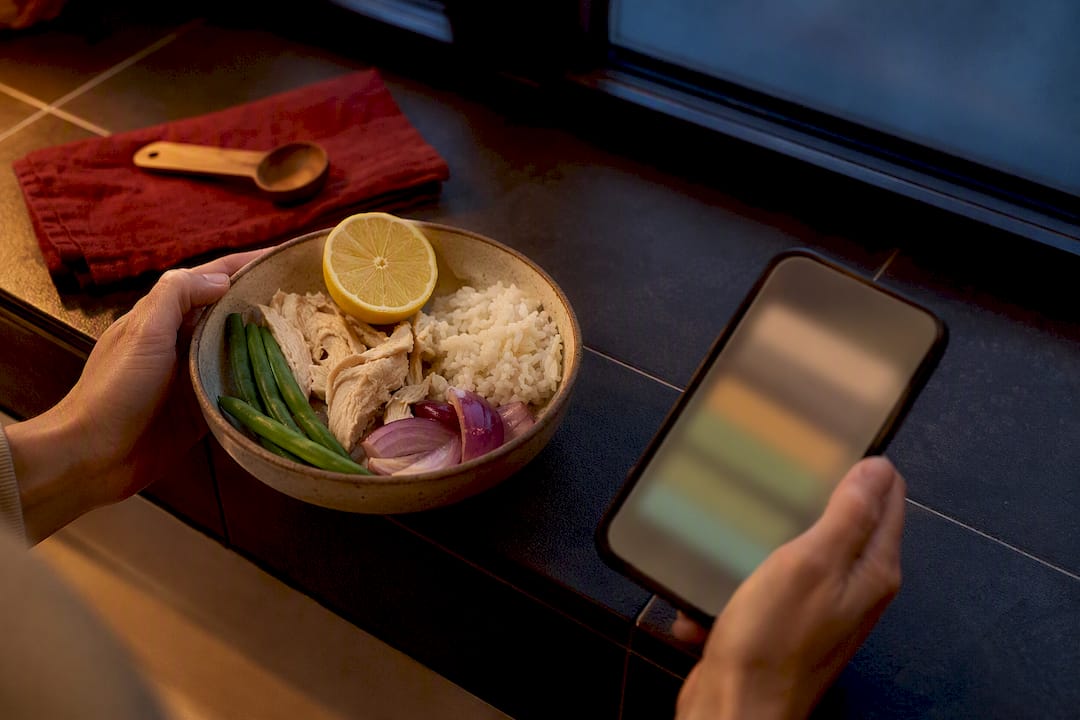
AI for cooking means software that turns whatever ingredients you have, plus your dietary needs, into usable recipes, weekly meal plans, and shopping lists. It saves you the “what’s for dinner” scramble and cuts food waste by working around what’s already in your fridge. The fastest way to see the payoff is to open a meal-planning app or type a specific, constraint-rich prompt into a recipe generator tonight.
TL;DR:
- Many AI cooking tools now generate recipes from ingredient lists, photos, or voice inputs, but their accuracy heavily depends on prompt specificity.
- Features like pantry tracking, meal planning, customized shopping lists, and nutrition estimates enhance practicality but require careful privacy management.
- Using detailed, constraint-rich prompts improves recipe relevance, including specifying equipment, dietary needs, and timing to match actual kitchen conditions.
- The most useful tools over time are those integrating meal plans with shopping and pantry management, reducing decision fatigue and routine chores.
- AI-generated nutrition data remains approximate and should not replace medical advice, especially for managing health conditions.
Table of Contents
- What Can AI for Cooking Actually Do Right Now?
- Core Features to Look for in AI Cooking Tools
- How to Turn Ingredients Into a Reliable Recipe With AI
- How Do You Choose the Right AI Cooking Tool?
- Privacy, Limitations, and Realistic Expectations
- The Community Side of AI Cooking Platforms
- How Homecooked Approaches AI Cooking
- Why Try Homecooked for AI-Powered Meal Plans and Recipes
- The Real Gap Between AI Cooking Hype and Kitchen Reality
- Sources
What Can AI for Cooking Actually Do Right Now?
Feed a handful of ingredients into a recipe generator and it will hand back a full recipe, complete with steps, cook times, and measurements, sometimes even from a photo of your open fridge. The output quality depends heavily on what you put in, which is why the best tools push you toward specifics rather than vague requests.
Beyond single recipes, most platforms now build out full weekly meal plans and generate the shopping list to match, so you’re not standing in the cereal aisle trying to remember what Tuesday’s dinner needed. Several specialist systems go further, tracking your pantry inventory and caching recipes for offline use, which keeps you from burning through food that’s about to expire.
Here’s what a solid AI cooking tool typically covers:
- Ingredient-to-recipe generation, including photo-based ingredient recognition
- Weekly meal plans built around your goals or restrictions
- Automated, editable shopping lists
- Pantry tracking that flags what needs to be used soon
- Rough nutrition estimates (calories, macros) per serving
That last one deserves a caveat: nutrition estimates from AI are approximations, not clinical data. If you’re managing diabetes, a heart condition, or another medical diet, run the numbers past a registered dietitian before treating them as gospel.
Core Features to Look for in AI Cooking Tools
Not every app does the same job, so it helps to know which features actually move the needle for how you cook.
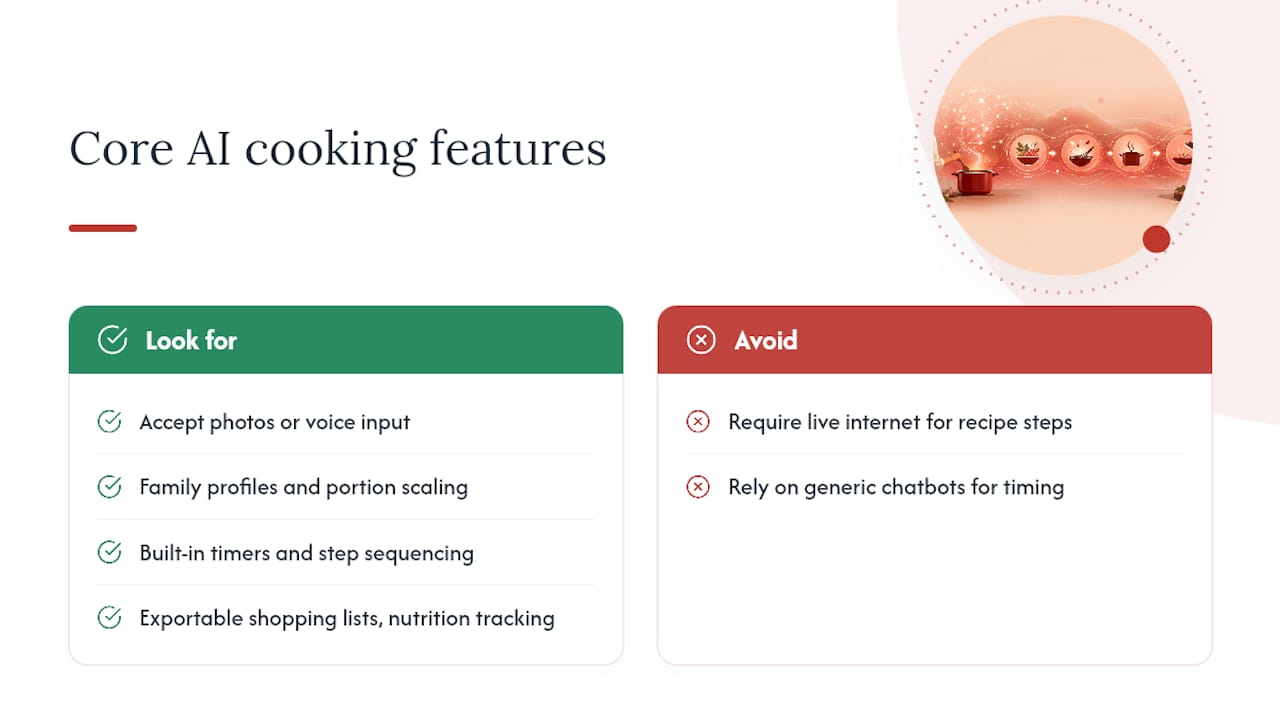
Prompt flexibility matters more than people expect. Some tools only accept typed ingredient lists, while others take photos or even voice input, which is genuinely useful when your hands are covered in flour.
Meal planner depth varies a lot too. Look for family profiles that account for different eaters in one household, portion scaling that adjusts a recipe from 2 servings to 6 without you doing math, and shopping lists you can actually export or sync to a phone.
Interactive cooking support is where a lot of generic AI chatbots fall short. A dedicated cooking app should give you built-in timers, guidance for running two steps in parallel, and clear sequencing so you’re not scrambling eggs and burning toast at the same time. One recurring theme in feature roundups of AI recipe generators is that the strongest tools cluster around five categories: recipe generation, meal planning, shopping lists, nutrition tracking, and smart kitchen integration.
Finally, check for diet controls (keto, low sodium, allergen exclusions), offline caching for spotty kitchen Wi-Fi, and a clear data export option.
Pro Tip: *Before you commit to any app, test its offline mode. A recipe that needs a live internet connection to show step 4 is a problem the moment your Wi-Fi drops mid dinner."
How to Turn Ingredients Into a Reliable Recipe With AI
Vague prompts get you vague recipes. Specific prompts get you something you can actually cook tonight. Practical prompting guidance from AI recipe tools consistently points to the same fix: add constraints, don’t remove them.
Use this four-step template every time:
- List your ingredients exactly, including quantities if you know them (“2 chicken thighs, half a red onion, one can of diced tomatoes”).
- State dietary constraints up front (gluten-free, no dairy, low sodium) so the AI doesn’t have to guess or, worse, ignore them.
- Name your equipment and time budget (cast-iron skillet, 30 minutes, no oven) so the recipe matches your actual kitchen.
- Specify servings and how you want it finished (serves 4, family-style, or plated).
Push further by asking explicitly for oven temperature, pan size, and exact timing rather than accepting “cook until done.” Also ask for a substitution list and what to do if something goes sideways, like the sauce breaking or the dough not rising. That failure-mode request is what separates a usable recipe from a frustrating one.
A full workflow looks like this: pull your current pantry list, generate a recipe from it, ask the tool for a prep-to-serve timeline, then export the ingredients you’re missing into a shopping list.
Pro Tip: If a generated recipe feels off, ask the AI to explain its reasoning for a step. A vague or contradictory answer is often the first sign the recipe wasn’t grounded in real cooking logic.
How Do You Choose the Right AI Cooking Tool?
Start by naming the actual job you want done, because “AI cooking tool” covers three very different use cases. Are you after quick inspiration for tonight’s dinner, a structured weekly meal plan, or serious nutrition tracking tied to a health goal? Each of those points toward different features.
Run through this checklist before you commit to one:
- Does it match your primary job (inspiration vs. planning vs. nutrition tracking)?
- Can you review and adjust privacy settings before saving allergy or medical dietary details?
- Does it work with your devices, whether that’s a phone, a smart display, or offline in the kitchen?
- What’s the actual cost structure: free tier, time-limited trial, or a paid subscription billed monthly versus annually?
Budget deserves real scrutiny here. Some tools give you a workable free tier forever, others front-load a generous trial and then gate meal planning or shopping lists behind a subscription. Annual plans are usually cheaper per month than paying monthly, but only worth it once you know you’ll actually use the app weekly, not just the first excited week. If your household has multiple eaters with different needs, a family-focused meal planner that scales portions will save you more time than a bare-bones recipe generator ever will.
Privacy, Limitations, and Realistic Expectations
AI-generated recipes aren’t infallible, and knowing where they slip helps you catch problems before dinner goes wrong. Common errors include mismatched measurements (a recipe calling for a tablespoon of baking soda instead of a teaspoon) or steps listed out of logical order. A quick sanity check, comparing quantities against a recipe you already trust, catches most of these before you start cooking.
- Cross-check unusual measurements or ratios against a familiar recipe
- Treat nutrition estimates as approximate, not medical-grade
- Review what data the app stores (dietary profile, pantry contents, allergy notes) and adjust sharing settings accordingly
- Lean on curated, tested recipes for baking, fermentation, and anything with real food-safety stakes
Most platforms store your dietary profile and pantry list to personalize future suggestions, which is convenient but worth reviewing in the privacy settings before you add sensitive medical information. And if you’re managing a therapeutic diet for a diagnosed condition, a generated meal plan is a starting point for conversation with a clinician, not a replacement for one.
The Community Side of AI Cooking Platforms
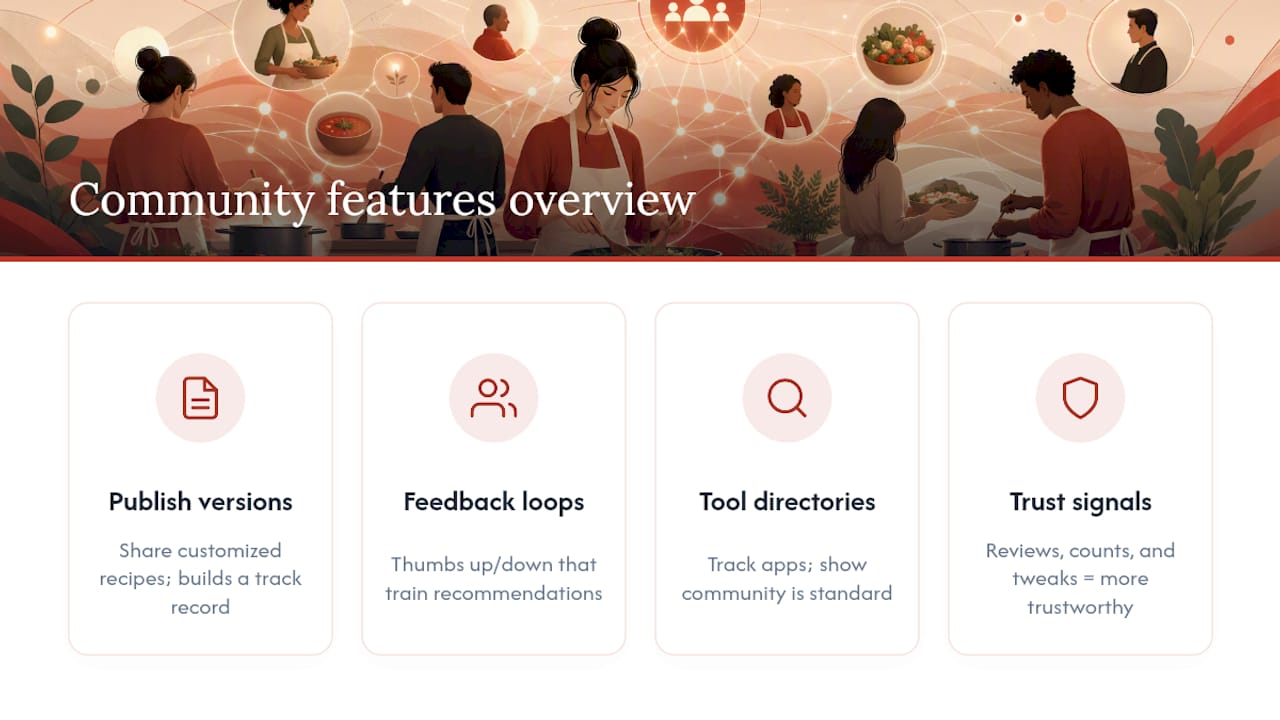
The tools themselves are only half the story. Most AI cooking platforms now build in ways for cooks to share what they made, swap tweaks to a generated recipe, or rate outputs so the system improves over time. That community layer solves a real problem: AI recipes can feel sterile on their own, missing the “I added extra garlic and it was better” wisdom that makes a recipe actually good.
Some platforms let you publish your customized version of an AI-generated recipe for others to try, turning a one-off output into something with a track record. Others focus on lighter feedback loops, like thumbs up or down on a suggestion, which quietly trains the recommendations to match your actual taste over time rather than a generic average. Tool directories tracking emerging cooking apps show this community layer becoming a standard feature rather than a nice-to-have extra, right alongside recipe generation itself.
For home cooks, the practical upside is straightforward: a shared recipe with real reviews and tweaks from other people is almost always more trustworthy than a fresh AI output with zero track record. If a platform lets you see how many people made a dish and how they modified it, treat that signal seriously. It’s the closest thing AI cooking has to a trusted recommendation from a friend.
How Homecooked Approaches AI Cooking
Homecooked builds its meal plans around your actual health goals and dietary preferences, then automates the parts that eat up your evening: the shopping list, the pantry tracking, the recipe steps with built-in timers. A typical week might look like batch-cooking Sunday with three timers running at once, guided step by step, then leaning on the shopping list Homecooked generated from that plan. The same privacy and medical-diet caution from earlier applies here too: review what you share, and treat any nutrition guidance as a starting point, not a prescription.
Why Try Homecooked for AI-Powered Meal Plans and Recipes
Some apps replace the mental math of “what do I have, what should I make, what do I need to buy” with one automated flow. They build meal plans tied to health goals, turn those plans into shopping lists automatically, and provide step-by-step recipe guidance with integrated timers.
Some apps run on a free trial before rolling into a paid subscription, allowing you to test whether the workflow fits your week before paying. Getting started typically involves answering a few questions about your goals and preferences, after which the app generates your first plan and shopping list automatically. If you want a concrete starting point, try a plan built around something like the cottage cheese protein bowl, a straightforward, high-protein recipe that shows the guided, timer-based cooking experience in action. Start your trial and see your first weekly plan generated in minutes.
The Real Gap Between AI Cooking Hype and Kitchen Reality
Most coverage of AI cooking tools treats them like a novelty, a fun way to use up leftover kale. That undersells what’s actually happening. The real shift isn’t that AI can write a recipe; it’s that pairing recipe generation with pantry tracking and automated shopping lists finally closes the loop between “what do I have” and “what do I eat,” which is the actual friction point in weekly cooking, not recipe inspiration.
Where I’d push back on the conventional wisdom: people treat AI-generated nutrition numbers with far more confidence than they deserve, while treating AI-generated recipes with far more suspicion than they deserve. Flip that. A recipe is forgiving. If the AI says 20 minutes and it takes 25, dinner still works. A calorie estimate feeding into a medical decision is not forgiving in the same way. Calibrate your trust accordingly: loose with the cooking steps, strict with anything that touches a diagnosed health condition.
The tools that will matter most over the next few years aren’t the ones generating the flashiest recipes. They’re the ones quietly reducing the number of decisions you make per week, folding meal planning, pantry awareness, and shopping into one habit instead of three separate chores.
— 0xmaglev
Sources
A few resources are worth bookmarking if you want to dig deeper. Venice AI’s recipe generator guidance is a solid primer on prompting technique, especially for getting specific measurements and failure-mode advice out of an AI. Fritz.ai’s roundup of AI recipe generators breaks down recurring feature categories across tools, useful when you’re comparing options. FutureTools’ cooking-app listings are handy for scanning what’s new. For a practical, kitchen-tested angle on folding meal prep into a busy week, Wild Foodz’s holiday meal-prep guide is worth a read. Cross-check any privacy or feature claim against a tool’s own settings page before trusting it fully.