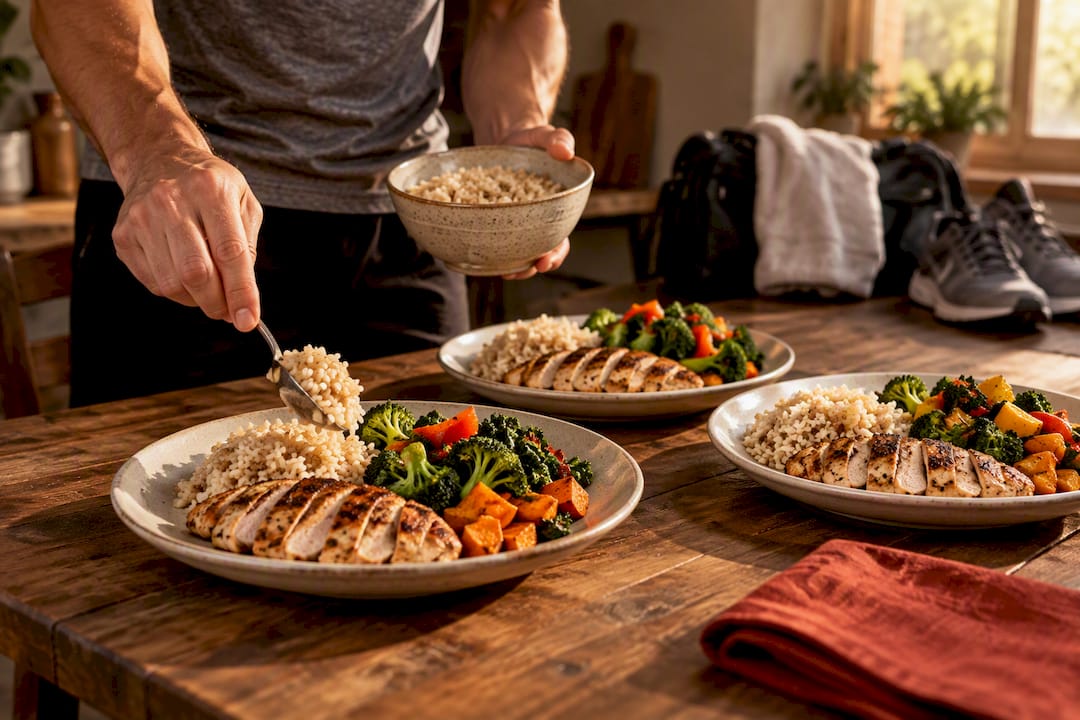
An athlete meal plan matches calories, macros, and meal timing to your weekly training load, not a fixed daily number. Start by mapping every session on your calendar and labeling each day easy, moderate, or hard. Once you know your week’s shape, you assign the right athlete plate and portion size to each day, and the rest of the plan builds itself around that.
TL;DR:
- Athletes should base their carbohydrate intake and meal portions on weekly training load, with higher carbs on hard days and reduced intake on rest days.
- Maintaining a consistent protein level supports muscle recovery regardless of training intensity, while carb and calorie adjustments are made according to session difficulty.
- Planning should start by mapping training sessions, classifying each day, and assigning corresponding plate types to optimize fueling and recovery.
- Using pantry staples and batch-cooking simplifies meal prep, reduces decision fatigue, and helps sustain adherence to the plan over time.
- Automated meal planning apps can personalize weekly menus, manage portion scaling, generate grocery lists, and streamline cooking, improving adherence and reducing effort.
Table of Contents
- What Is Athlete Meal Planning, Exactly?
- How Do You Turn a Training Week Into a Meal Plan?
- Sample Meal-Plan Templates You Can Copy This Week
- When Should You Eat Around Training?
- How Do You Build a Meal Prep System That Actually Sticks?
- When Does a Generic Plan Stop Being Enough?
- Why Automation Changes the Adherence Math
- Homecooked: Turning the Map-Plate-Menu Method Into a Weekly Plan
- Sources
- FAQ
What Is Athlete Meal Planning, Exactly?
Athlete meal planning is the practice of adjusting your food intake, especially carbohydrates, around how hard and how often you train, rather than eating the same meals every day regardless of workload. It’s a different mindset than typical diet planning, because the goal isn’t weight loss or a fixed macro target. It’s fueling performance and recovery on a schedule that shifts week to week.
The backbone of this approach is the Athlete’s Plate method, a visual system built around three plate types:
- Easy day plate: About half vegetables and fruit, a quarter lean protein, a quarter whole grains or starch.
- Moderate day plate: Vegetables and starch move closer to even proportions, protein stays steady.
- Hard day plate: Starch and carb-dense foods take up roughly half the plate, protein stays consistent, vegetables shrink slightly to make room.
Notice what doesn’t change: protein. Consistent protein intake, spread across meals, supports muscle repair regardless of training intensity. Carbohydrate is the lever you pull up or down based on the day’s demand.
For sport-specific macro ranges, Kaiser Permanente’s nutrition guidance notes that endurance athletes may need carbs at up to 70% of total calories during heavy training blocks, while strength and power athletes often do better closer to 50% carbs with a slightly higher protein share. Team-sport athletes usually land in between, since their training mixes short bursts of power with longer aerobic demands.
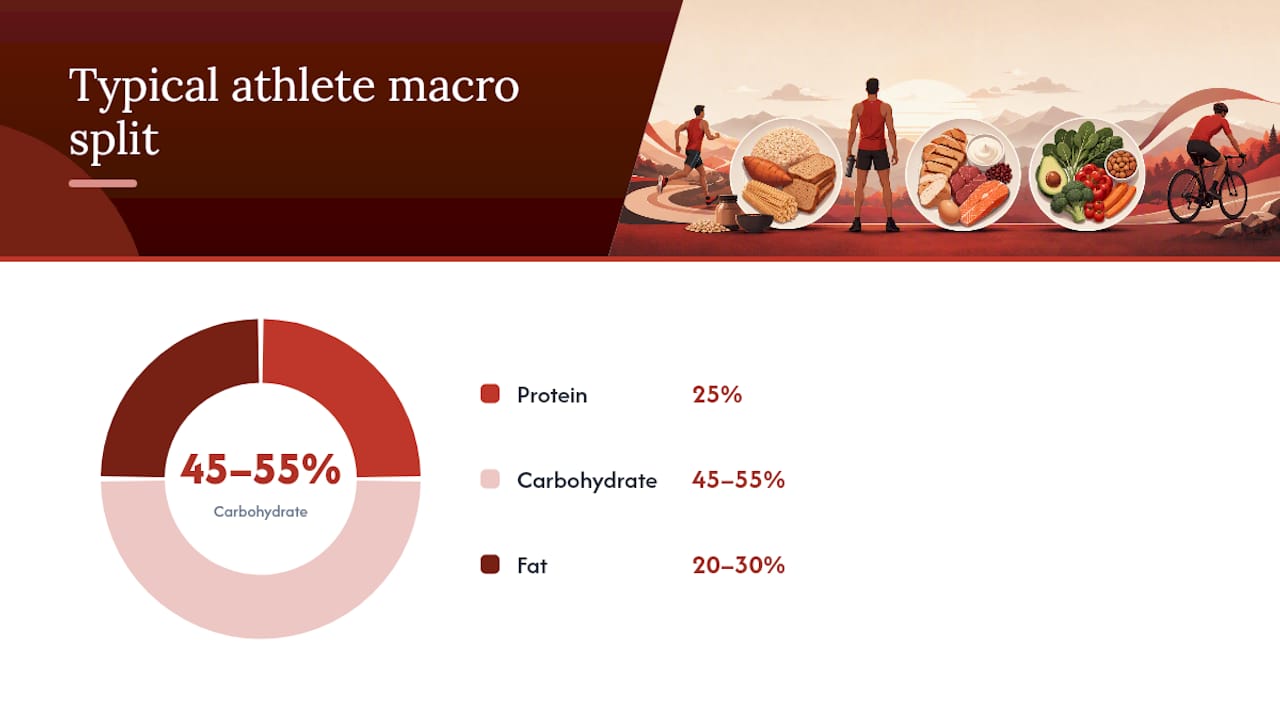
To estimate a baseline calorie target, most coaches start with body weight, training hours per week, and sport type, then adjust from there. A reasonable starting macro split for many athletes is 25% protein, 45 to 55% carbs, and 20 to 30% fat, with endurance athletes pushing carbs higher and strength athletes nudging protein toward 30% when body composition goals call for it. Carbs get prioritized on hard training days because glycogen, your muscles’ primary fuel source, depletes fastest during high-intensity work and needs replenishing to support the next session.
How Do You Turn a Training Week Into a Meal Plan?
The most effective strategy isn’t picking a diet and forcing your training around it. It’s the reverse: map your training first, then let the calendar dictate your eating.
- Calendar every session. Write out the week, including duration and intensity, not just “run” or “lift,” but “60-minute tempo run” or “heavy squat day.”
- Classify each day. Label sessions easy, moderate, or hard based on duration and intensity, not how you feel about them.
- Set carb and calorie targets per day. Coaches typically calculate total weekly training load first, then funnel extra carbohydrate calories toward the longest or hardest sessions rather than spreading them evenly across every day.
- Apply a scaling rule. On rest or light days, cut carbs by roughly 50 to 100 grams or drop total calories by 300 to 500 kcal, while holding protein steady.
- Assign a plate type to each meal slot. Breakfast, lunch, dinner, and snacks all follow the plate matching that day’s classification.
- Build your grocery list from the week, not the day. Buy for the whole cycle so hard-day carb sources are already in the pantry when you need them.
Here’s what that looks like for a runner training six days a week: Monday easy (recovery jog) gets the easy plate. Tuesday interval workout and Thursday long run both get hard plates with extra rice, potatoes, or oats. Wednesday and Friday cross-training days land as moderate. Saturday is a race simulation, hard plate with a carb boost the evening before. Sunday is full rest, easy plate, calories trimmed slightly. Six days, three plate types, one grocery list.
Sample Meal-Plan Templates You Can Copy This Week
Templates work because they remove decision fatigue. You’re not inventing meals from scratch every night, you’re rotating through a structure that already accounts for training load.
A practical 5-day balanced template built around a moderately active athlete, roughly 2,300 kcal per day, might look like this:
Meal ideas that fit each slot: oatmeal with berries and a scoop of peanut butter for breakfast, a grain bowl with grilled chicken and roasted vegetables for lunch, and a salmon or ground turkey dinner with rice or potatoes. On hard days, add a second starch serving at lunch and dinner, or an extra piece of fruit at breakfast.
For a full training week, a rotating 7-day template built around a 3,200 kcal target for a larger or higher-volume athlete adds a fourth meal slot, typically a pre-bed snack with casein-rich dairy or a protein bowl, to support overnight recovery.
Scaling notes matter here. A lighter athlete, say 130 pounds, training moderately might sit closer to 2,000 to 2,200 kcal on easy days and 2,400 on hard days. A heavier or higher-volume athlete, 190 pounds and above, often needs 2,800 to 3,200 kcal baseline, with hard days pushing past 3,500. The plate proportions stay the same. Only the portion sizes and total volume shift.
For plant-forward athletes, swap options keep the same macro logic intact:
- Replace chicken or beef with lentils, tempeh, or tofu, and add a scoop of pea protein if hitting protein targets gets difficult on lower-calorie days.
- Swap dairy-based recovery snacks for fortified soy or pea-protein yogurt.
- Use quinoa or farro instead of rice for a small protein bump alongside the carbs.
A full vegetarian meal planning guide walks through a complete week if you want a plant-based structure built specifically around these swaps, and a high-protein meal plan is worth a look if muscle gain is the priority alongside training volume.
When Should You Eat Around Training?
Timing rules are simpler than they sound once you anchor them to the clock rather than vague “before and after” advice.
Pre-workout (0 to 120 minutes before): if you’re eating more than 90 minutes out, a solid meal with carbs, moderate protein, and low fat works well. Inside 60 minutes, switch to a quick-digesting carb snack, like a banana or a slice of toast with honey, so you’re not training on a heavy stomach.
Post-workout: aim for 20 to 40 grams of protein paired with carbohydrate within the window after training to kickstart glycogen replenishment and muscle repair. A go-to combination is chocolate milk plus a piece of fruit, or a protein shake with a bagel.
Intra-workout: sessions longer than 90 minutes benefit from carb intake during the session itself, sports drinks, gels, or dried fruit, along with electrolytes to offset sweat losses.
Hydration matters more than most athletes think. Sweat rates during intense training can reach 1 to 3 liters per hour, and a body-weight loss of just 2% from dehydration is enough to measurably impair endurance and cognitive sharpness.
Game-day checklist:
- Eat your last full meal 3 to 4 hours before competition.
- Increase carbohydrate intake in the 48 to 72 hours before a major event, then taper fiber and fat in the final 24 hours to avoid gut distress.
- Keep a fast-digesting carb snack on hand for the hour before start time.
How Do You Build a Meal Prep System That Actually Sticks?
The plan on paper only matters if you cook it. Pantry-first planning flips the usual grocery routine. Instead of browsing recipes and buying whatever they call for, you build your week’s menu around staples you already stock, rice, oats, canned beans, frozen vegetables, and shop to fill gaps rather than start from zero.
Batch-cooking works differently depending on your schedule. Some athletes cook full meals in bulk on Sunday and reheat all week. Others prep components separately, a big batch of grains, a tray of roasted vegetables, a few proteins, then assemble fresh combinations each night. Neither approach is wrong; pick whichever keeps you consistent.
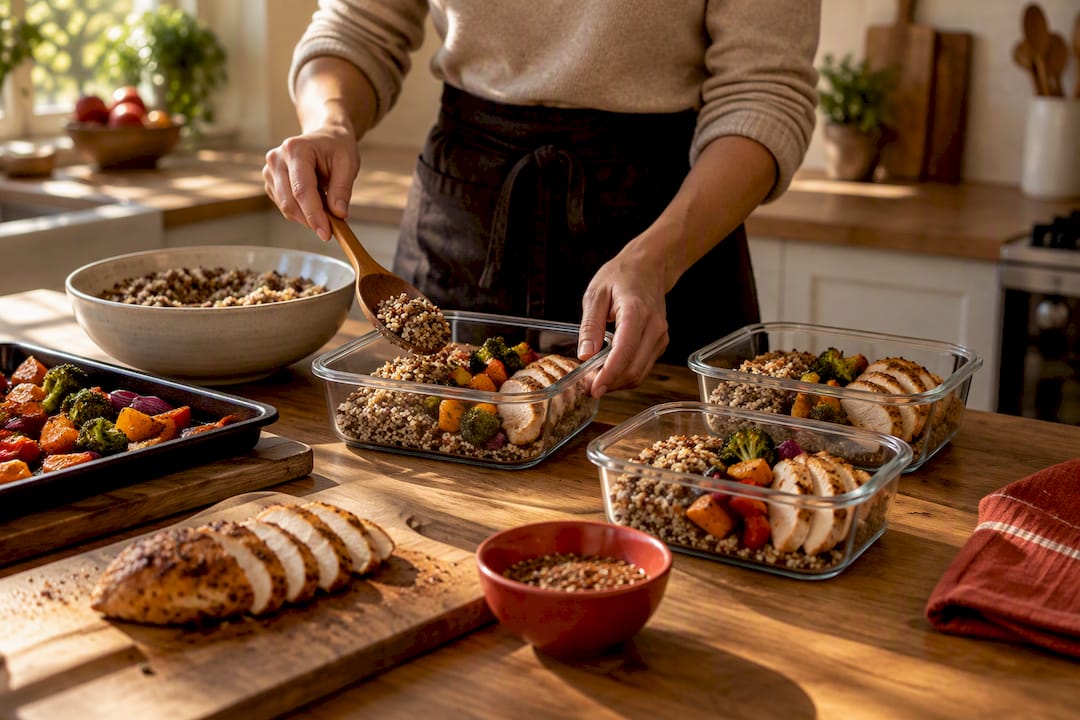
A grocery list organized by macronutrient, rather than by store aisle, makes hard-day shopping faster: carbs first (rice, potatoes, oats, fruit), then proteins (chicken, eggs, tofu, fish), then fats and extras. It matches how you’re already thinking about the week.
Pro Tip: Keep three “backup” hard-day meals on rotation that use only pantry staples, canned tuna and pasta, eggs and toast, frozen stir-fry veggies with rice, so a missed grocery trip never derails your carb intake on the day it matters most.
To avoid menu boredom, rotate two or three protein sources and swap sauces or spice blends weekly rather than reinventing the whole meal. Small variety, low effort. A meal planning guide for busy schedules covers more of these time-saving workflows if prep time is your biggest obstacle.
When Does a Generic Plan Stop Being Enough?
Templates work for most training cycles, but some signals mean it’s time to talk to a registered dietitian or physician rather than adjusting the plan yourself. Persistent fatigue that doesn’t improve with rest, menstrual irregularity in female athletes, or unexplained weight loss despite steady or increasing training load are all signs of relative energy deficiency, sometimes called RED-S, and they deserve professional evaluation rather than a bigger breakfast.
Supplements get oversold. Most athletes eating a well-structured plan don’t need much beyond what food already provides. Creatine and caffeine have the strongest evidence behind them for performance; a daily multivitamin can help fill small gaps, especially iron for endurance athletes and vitamin D for anyone training mostly indoors. Beyond that, most powders and blends on store shelves are unnecessary for someone already hitting protein and carb targets through meals.
Personalizing your plan doesn’t require a lab. Track energy levels, sleep quality, and training performance for two weeks, then adjust one variable at a time, more carbs on hard days, an earlier post-workout snack, and see what changes.
Dehydration deserves a repeat mention here specifically: even mild fluid loss around 2% of body weight measurably slows you down, so hydration belongs in your safety checklist alongside sleep and injury prevention, not as an afterthought.
Why Automation Changes the Adherence Math
Most athletes don’t fail at meal planning because they lack information. They fail because manually recalculating carbs and calories for six different training days, week after week, is tedious enough to abandon after two weeks. Automation solves a real problem here, not a manufactured one.
A pantry-first, guided approach keeps variety high without adding decision fatigue, because the system handles the scaling math while you handle the cooking. If you’re using an app to manage this, expect it to personalize targets to your training load, automate the grocery list, and guide you through the recipe steps. Anything less is just a spreadsheet with better fonts.
Homecooked: Turning the Map-Plate-Menu Method Into a Weekly Plan
Everything covered above, mapping training days, assigning plate types, scaling calories, and building a pantry-first grocery list, is exactly the workflow Homecooked was built to automate.
Instead of manually recalculating carb targets every time your training schedule shifts, a meal-planning app can build a personalized meal plan around your health goals and dietary preferences, then adjust portions and macros as your week changes. It can generate a matching shopping list, prioritize pantry staples to cut waste and cost, and guide you through recipes with built-in timers to simplify cooking after a long training session. Rotating recipes regularly can also help prevent boredom that causes many manual meal-prep plans to fail.
If mapping your training week and building matching meals sounds useful in theory but exhausting in practice, that’s the gap Homecooked fills. Visit the Homecooked landing page to see how the app builds your plan from your first training week onward.
This article is general information, not a substitute for advice from a qualified doctor. Consult a qualified healthcare professional about your own circumstances before acting on anything here.
Sources
- Athlete guide to meal planning | Franciscan Health
- Eat like an athlete: A guide to nutrition planning | Kaiser Permanente
- 7-Day Meal Plan For Athletes — New England Nutrition & Exercise
- Meal Prep for Athletes: A Tool for Nutrient Timing & Performance · Victorem
- Athlete Meal Plan Template for Coaches (Free 3,200 kcal Plan) | ProMealPlan
FAQ
What Is the 4-2-1 Rule for Athletes?
The 4-2-1 rule is a plate-proportion guideline: four parts carbohydrate-rich foods, two parts protein, one part fat or vegetables, typically applied on higher-intensity training days. It’s a simplified variation of the same plate-scaling logic behind the Athlete’s Plate method, where carb proportion rises with training intensity.
What Is the 3-3-3 Rule for Meal Prep?
Definitions vary across sources, but a common version refers to prepping three meals, in roughly three batches, over about three days to keep food fresh while covering most of the week. It’s less a strict formula than a rough structure for balancing bulk cooking against food freshness.
What Is the Best Diet Plan for Athletes?
There’s no single best diet, because effective athlete nutrition scales with training load rather than following one fixed macro ratio. A plan built on the Athlete’s Plate method, roughly 25% protein, 45 to 55% carbs, and 20 to 30% fat as a starting point, adjusted up or down by sport and training day, works for most athletes better than any single named diet.
How Do I Set Daily Calories for My Body Size?
Start with your body weight, weekly training hours, and sport type, then use hard, moderate, and easy day classifications to scale up or down from that baseline. Heavier or higher-volume athletes typically land in the 2,800 to 3,500+ kcal range on hard days, while lighter or lower-volume athletes often sit closer to 2,000 to 2,200 kcal, with protein held steady across all training days.
Can an App Actually Build My Weekly Meal Plan?
Yes. Homecooked generates a personalized weekly meal plan based on your health goals and dietary preferences, then builds a matching shopping list and guides you through each recipe with built-in timers, removing the manual math involved in scaling meals to training load. Current pricing details are available on the Homecooked site.