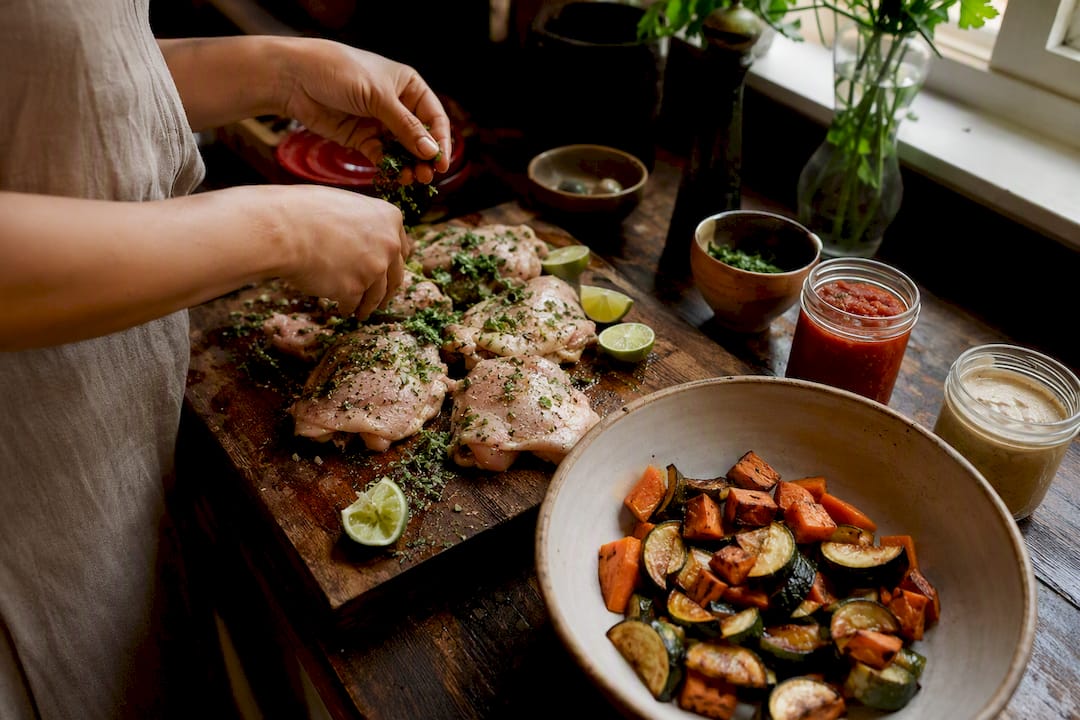
A batch cooking meal plan means spending one focused session, roughly two to three hours, preparing versatile components like a protein, a grain, and a sauce so that weeknight dinners take 10 to 20 minutes to assemble instead of an hour. This differs from generic meal planning because you’re not cooking finished dishes; you’re stocking building blocks. Homecooked uses this exact logic to turn one grocery run into a week of dinners that don’t taste like leftovers.
TL;DR:
- Using the core four approach, prepare two proteins, one grain, one vegetable, and three to four sauces to maximize variety and minimize boredom.
- A batch-cooking session typically takes 2 to 2.5 hours and involves parallel tasks like roasting and simmering to optimize time and effort.
- Storage containers should be labeled with cooking dates and portioned appropriately, with safety guidelines suggesting a 3 to 6-day fridge life for most cooked foods.
- Batch-cooked foods like chicken thighs and grains stay safely fresh for up to six days, and reheating microwaves retain more nutrients compared to stovetop methods.
- Implementing a sustainable system with smaller prep sessions prevents burnout and increases consistency, and apps like Homecooked automate planning and shopping.
Table of Contents
- What Is a Batch Cooking Meal Plan, Really?
- The Core Four Game Plan for Batch Cooking
- Sample 5-Day Batch-Cooking Meal Plan and Shopping List
- How Do You Time a Batch-Cooking Prep Day?
- What Equipment Actually Makes Batch Cooking Easier?
- How Long Does Batch-Cooked Food Actually Stay Safe?
- The Most Dependable Foods for Batch Cooking
- Three Assembly Templates to Beat Flavor Fatigue
- Customizing Batch Cooking for Vegetarian, Gluten-Free, and Keto Diets
- How Batch Cooking Cuts Down on Food Waste
- Does Batch Cooking Actually Save Money?
- Why a Sustainable System Beats a Marathon Prep Day
- Let Homecooked Run the Plan for You
- Sources
What Is a Batch Cooking Meal Plan, Really?
Meal planning tells you what to eat each night. Batch cooking is the execution method that gets you there faster: one cooking session, multiple meals, minimal daily effort. The distinction matters because a lot of home cooks confuse the two and end up writing a beautiful weekly menu they still have to cook from scratch every single evening.
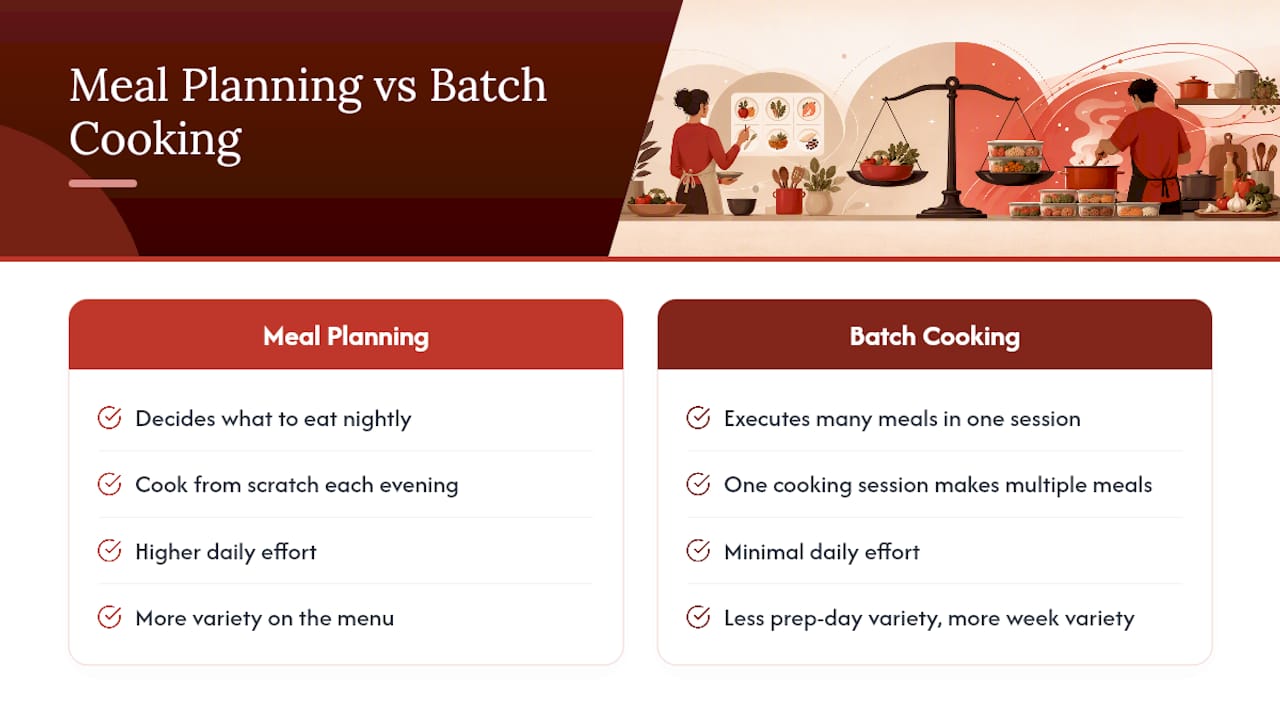
The method that gets cited most often for this approach is Cassy Joy Garcia’s Cook Once, Eat All Week, which centers on batch cooking one protein and one vegetable or starch, then turning those two components into three distinct dinners across the week. The genius of the system isn’t the cooking, it’s the restraint. You make less variety on prep day so you have more variety on Tuesday.
That’s the core trade batch cooking asks you to make, and once it clicks, it changes how you shop.
The Core Four Game Plan for Batch Cooking
Forget planning seven separate dinners. Build four categories instead: a protein, a grain or starch, a vegetable, and a sauce. Cook two or three versions of each, then mix and match all week. This is what separates sustainable batch cooking from the burnout version where you make seven identical meal-prep containers and get bored by Wednesday.
Here’s the basic build:
- Protein — two options (like shredded chicken thighs and seasoned ground turkey)
- Grain or starch — one or two options (rice, quinoa, roasted potatoes)
- Vegetable — one or two roasted or sautéed options
- Sauce — three to four rotating flavors (more on this below)
Quantity rules are simple: plan for one cup of protein, one cup of grain, and one to one and a half cups of vegetables per adult per meal. Kids usually eat about half that. Substitutions are flexible as long as you stay within category, swap ground turkey for ground beef, swap quinoa for farro, without disrupting the math.
Before you start cooking, run through this checklist:
- Menu drafted with which components pair with which nights
- Shopping list organized by store section
- Containers washed and staged on the counter
- Oven and stovetop tasks mapped so nothing sits idle
Pro Tip: Cook your grain first and let it cool uncovered on a sheet pan. Sealing hot rice or quinoa in a container traps steam and turns it mushy by day three.
Sample 5-Day Batch-Cooking Meal Plan and Shopping List
Here’s a concrete week built on the Core Four. Prep two proteins (garlic lime chicken thighs and turmeric black beans), one grain (brown rice), one vegetable (roasted broccoli and bell peppers), and three sauces (chimichurri, tahini, and a quick peanut sauce).
Three ways to use the chicken alone: a rice bowl with chimichurri, a lettuce wrap with tahini drizzle, or a sheet-pan bake with the roasted vegetables and peanut sauce spooned over the top. The beans work the same way, swapped into grain bowls or folded into a quick taco night.
Shopping list by category:
- Proteins: 2 lbs chicken thighs, 2 cans black beans (or 1 lb dried)
- Produce: broccoli, bell peppers, garlic, limes, cilantro, romaine
- Pantry: brown rice, tahini, peanut butter, soy sauce, olive oil, cumin, turmeric
Container math depends on household size. For one or two people, plan on six to eight containers in the 1 to 2 cup range for individual grain, protein, and vegetable portions, plus two or three larger 3 to 4 cup containers for sauces or casserole-style leftovers. A family of four typically needs closer to 12 of the 1 to 2 cup size and 6 of the 3 to 4 cup size to cover a full week without repacking mid-week. Label each lid with the contents and the date you cooked it, not the date you plan to eat it, since that’s the number that actually matters for food safety.
How Do You Time a Batch-Cooking Prep Day?
The trick to a prep day that doesn’t eat your whole Sunday is running tasks in parallel instead of sequentially. A well-sequenced session can wrap in 2 to 2.5 hours total, with only 30 to 45 minutes of actual hands-on work; the rest is passive oven and stovetop time you can use for chopping, dishes, or making sauces.
Here’s a workable sequence for a two-protein, one-grain, one-vegetable week:
- 0:00 — Preheat oven, start rice in a rice cooker or on the stovetop (passive)
- 0:05 — Season chicken thighs, place in oven to roast (passive, 30 to 35 minutes)
- 0:10 — Chop vegetables while chicken roasts
- 0:20 — Start beans simmering on the stovetop if using dried, or heat canned beans with spices
- 0:35 — Pull chicken, tent to rest; slide vegetables into the same oven to roast
- 0:45 — Whisk sauces while vegetables roast (passive, 20 minutes)
- 1:05 — Shred chicken, pull vegetables, portion rice
- 1:15 to 1:45 — Cool everything on sheet pans or in shallow layers before sealing containers
Pro Tip: Set a timer for each passive step instead of hovering over the oven. That’s the whole trick behind parallel cooking with timers: you’re managing three clocks at once, not standing over one pot.
If you’re cooking for one or two people, cut protein and grain quantities in half and you’ll likely finish in under 90 minutes. Families of four or more should keep the full schedule but expect the active-time window to stretch closer to an hour.
What Equipment Actually Makes Batch Cooking Easier?
You don’t need a fully equipped restaurant kitchen. You need a short list of tools that let you cook multiple components without babysitting each one.
- Sheet pans (two, minimum) for roasting vegetables and proteins simultaneously
- A rice cooker or Instant Pot to free up stovetop space for sauces or beans
- A large mixing bowl for tossing vegetables in oil and seasoning before roasting
- A sharp chef’s knife, since dull knives are the single biggest reason prep takes twice as long as it should
For containers, glass reheats more evenly and doesn’t absorb sauce stains or odors the way plastic does, though budget-friendly BPA-free plastic works fine if you’re just starting out. Stack containers by day rather than by ingredient in the fridge, and use the freezer door shelves for anything you won’t touch until week two.
How Long Does Batch-Cooked Food Actually Stay Safe?
Food safety is where most batch-cooking plans quietly fall apart. The FDA’s food safety guidance defines the “danger zone” as 40°F to 140°F, the temperature range where bacteria multiply fastest. Cooling hot food in shallow containers and refrigerating it within 30 to 45 minutes of cooking keeps everything out of that zone.
Storage windows worth memorizing:
- Cooked chicken or turkey: 3 to 4 days refrigerated, up to 4 months frozen
- Cooked ground beef: 3 to 4 days refrigerated, up to 4 months frozen
- Cooked grains (rice, quinoa): 4 to 6 days refrigerated, up to 6 months frozen
- Sauces and dressings: 5 to 7 days refrigerated, most freeze well for 2 to 3 months
When reheating, microwaving preserves more water-soluble vitamins than a long stovetop reheat, so it’s the better default for grains and vegetables. Add a splash of water before microwaving to prevent drying out, and heat everything to at least 165°F for safety. Save the stovetop for proteins where you actually want a re-crisped edge.
The Most Dependable Foods for Batch Cooking
Some ingredients simply hold up better across five days in the fridge than others. Build your rotation around these:
- Chicken thighs — more forgiving than breasts, they don’t dry out during reheating
- Ground meats (turkey, beef, or a plant-based crumble) — cook fast and freeze in flat portions
- Lentils and beans — durable, high-fiber staples that reheat without turning mushy
- Roasted broccoli, carrots, and bell peppers — sturdy vegetables that don’t wilt like leafy greens
- Brown rice, quinoa, and farro — grains that reheat cleanly with a splash of water
Five starter recipes to build your first week around: garlic lime chicken thighs, turmeric black beans, sheet-pan roasted vegetables, chimichurri sauce, and a base pot of brown rice. Homecooked’s batch-friendly recipe collection has variations on all five if you want a place to start without writing your own recipe from scratch.
Three Assembly Templates to Beat Flavor Fatigue
The same four components can become a different dinner every night if you rotate how you assemble them, not just what’s in the fridge.
- The bowl — grain base, protein, roasted vegetables, sauce drizzled on top
- The wrap or taco — protein and vegetables folded into a tortilla or lettuce leaf with sauce as the binder
- The bake — protein and vegetables combined in a dish, topped with sauce, and reheated together in the oven for a hot, cohesive meal
Rotate through three to four sauces across the week, chimichurri, tahini, peanut sauce, and a basic vinaigrette cover most flavor profiles, so the same chicken thighs taste like four different meals depending on which sauce lands on top. If you’re staring down leftovers on day five, remix rather than repeat: shred the last of the chicken into a soup base, or fold extra rice and vegetables into a fried rice skillet.
Customizing Batch Cooking for Vegetarian, Gluten-Free, and Keto Diets
The Core Four framework flexes easily once you know which category to swap.
For vegetarian plans, replace the protein slot with lentils, chickpeas, tofu, or tempeh. Lentils and beans hold their texture through a week of reheats better than most plant proteins, which makes them the safer bet for beginners. Double up on the grain and vegetable portions slightly since plant proteins are often lighter in calories per cup.
For gluten-free plans, swap wheat-based grains for rice, quinoa, or millet, all of which batch cook and freeze exactly like their gluten-containing counterparts. Double-check sauces, since soy sauce and some pre-made dressings sneak in wheat. Tamari or coconut aminos solve that problem without changing the flavor much.
For keto plans, drop the grain slot entirely and double the vegetable and healthy fat portions instead. Roasted low-carb vegetables (zucchini, cauliflower, broccoli) and a fattier sauce, think a garlic butter or a full-fat ranch, replace the volume the grain used to provide. Ground meats and fattier cuts of chicken thigh work better than lean proteins here since keto relies on fat for satiety.
In every case, the schedule and container math from earlier stays the same. Only the ingredients inside each slot change.
How Batch Cooking Cuts Down on Food Waste
Batch cooking naturally reduces waste because you’re buying with a specific plan instead of grabbing whatever looks good and hoping it becomes dinner. Still, a few habits make the difference between an efficient week and a fridge full of forgotten produce.
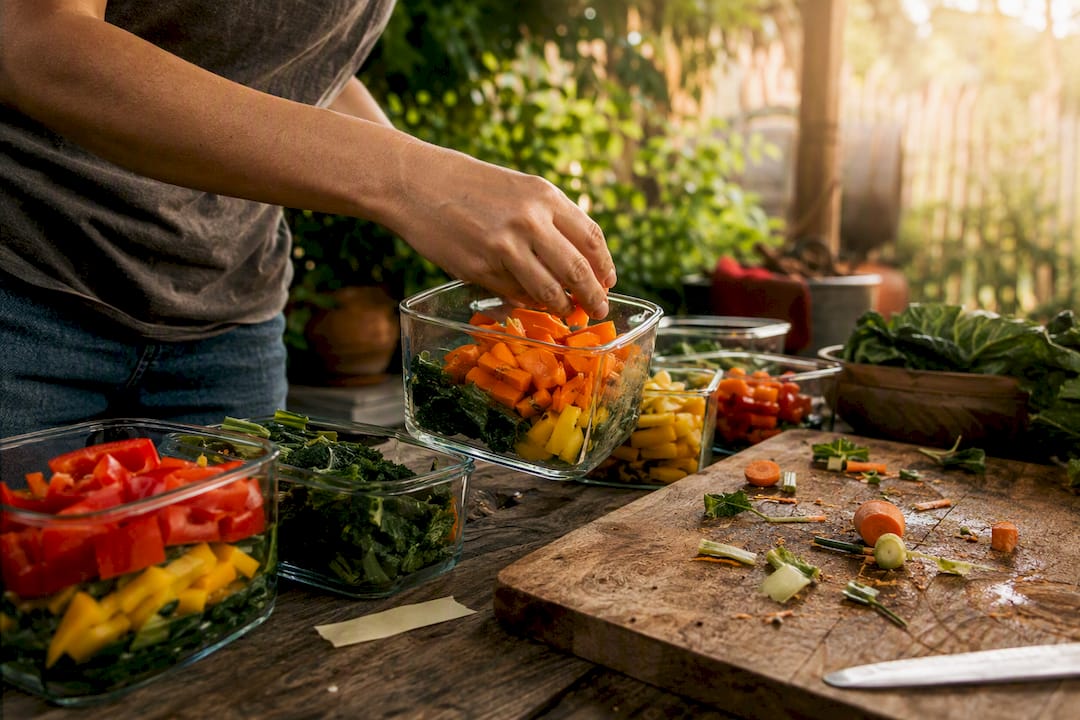
Buy vegetables in the quantity your plan actually calls for, not the quantity that looks like a good deal. A five-pound bag of carrots sounds economical until three pounds of it liquefies in the crisper drawer. Roast vegetables that are starting to soften rather than tossing them; a slightly wilted bell pepper roasts just as well as a firm one.
Freeze in portions you’ll actually use. A single two-pound block of frozen ground turkey means thawing the whole thing for one meal. Portioning into half-pound flat packs before freezing lets you pull exactly what a recipe calls for.
Label everything with the date it was cooked. Unlabeled containers are the number one reason food gets thrown out, not because it spoiled, but because nobody remembered how old it was and erred on the side of caution. A simple piece of tape and a marker solves a problem that costs households real money every month.
Finally, plan a “clean out the fridge” meal for day five or six, a soup, stir-fry, or grain bowl that absorbs whatever’s left. It turns your least glamorous ingredients into the easiest dinner of the week.
Does Batch Cooking Actually Save Money?
Batch cooking saves money in three concrete ways: fewer takeout orders, less waste, and better use of bulk pricing.
Buying two pounds of chicken thighs at once is almost always cheaper per pound than buying a half-pound three separate times during the week. The same logic applies to grains and canned goods, buying in bulk quantities you’ll actually use before they expire is one of the few grocery habits that reliably lowers your per-meal cost.
The bigger savings usually come from what batch cooking prevents. A stocked fridge of ready components removes the 6 p.m. moment where takeout starts looking like the only realistic option. If a five-day batch-cooking session replaces even two takeout dinners a week, that’s typically $20 to $40 saved without any change to what you’re actually eating.
Budgeting for batch cooking works best when you shop with your Core Four categories already decided. Walk in knowing you need one protein, one grain, one vegetable, and sauce ingredients, and you’ll spend less time wandering the store buying items that don’t connect to an actual meal.
Why a Sustainable System Beats a Marathon Prep Day
Most batch-cooking advice pushes the four-hour Sunday marathon that produces twenty-one identical containers. That approach burns people out by week three. A smaller, repeatable system, two proteins, one grain, a rotating sauce, done in under three hours, is what actually sticks. Homecooked builds its weekly planning guidance and step timers around that same principle: consistency beats intensity every time.
— 0xmaglev
Let Homecooked Run the Plan for You
Homecooked turns everything in this guide into an automated weekly system instead of a spreadsheet you have to maintain yourself. The app builds a personalized meal plan around your goals and dietary needs, then generates an automated shopping list sorted the same way the sample list above was, by protein, produce, and pantry staples, so you’re not standing in the store trying to remember the Core Four from memory.
Step timers built into each recipe handle the parallel-cooking sequence for you: start the rice, get a prompt to season the chicken, get another prompt when it’s time to roast the vegetables, so nothing overcooks while you’re chopping something else. If you want a quick way to see how the system works before committing to a full week, try the cottage cheese protein bowl recipe, a five-minute assembly that uses the same bowl-template logic covered above. A free trial gets you a personalized plan built around your own pantry and goals, no marathon Sunday required.