
The most reliable diet progress tracking system is also the simplest: daily weigh-ins, daily food logging, weekly tape measurements, monthly photos, and a five-minute weekly review to decide what changes next. It draws on the same math behind the NIDDK Body Weight Planner and portioning principles from ChooseMyPlate. This routine works best for anyone who has tried tracking before and quit because it felt like homework.
TL;DR:
- Regular weight tracking should use a 7-day rolling average to reduce fluctuations caused by water retention and other temporary factors.
- Tape measurements and progress photos provide insights into body composition changes that the scale alone cannot reveal, especially during muscle building.
- Consistent measurement protocols, such as weighing in the same clothing and conditions each day, are crucial for trustworthy trend analysis.
- Using a spreadsheet or app depends on whether you prefer control or automation; linking food intake with sleep, activity, and hydration offers better progress insights.
- Maintaining rough but consistent food logs over several months often yields better results than obsessing over perfect accuracy for short periods.
Table of Contents
- What metrics should you track for diet progress?
- How do you log food accurately without burning out?
- How do you measure weight, body size, and photos consistently?
- Should you use an app or a spreadsheet to track progress?
- How do you know when to change your calories or macros?
- Why do sleep, activity, and hydration matter for tracking?
- What does a weekly diet review look like step by step?
- What Homecooked resources support this tracking system?
- What actually separates people who stick with tracking from those who quit?
- Ready to make tracking effortless? Here’s your next step
- Where to go for deeper reading on diet tracking
- Sources
What metrics should you track for diet progress?
Weight alone lies to you constantly. It swings with sodium, hydration, hormones, and how much food is still sitting in your gut, which is exactly why a single scale reading on a Tuesday morning tells you almost nothing. What tells you something is a pattern, and patterns require a small set of consistent inputs.
Body weight (daily). Weigh yourself every morning and calculate a 7-day rolling average instead of reacting to any single number. Smoothing out daily readings this way cuts through the noise from water retention and reveals the actual trend days faster than a once-a-week weigh-in ever could.
Tape measurements (weekly). Weight doesn’t tell you where the change is happening. Waist, hips, chest, arms, and thighs fill that gap, especially for anyone building muscle while losing fat, where the scale can sit still for weeks while your body visibly changes shape. The Mayo Clinic notes that body composition, not just total weight, is what determines real health risk from abdominal fat.

Progress photos (monthly). Photos catch what the tape misses: posture, muscle definition, the way clothes fit differently. Monthly is frequent enough to notice change without obsessing over it.
Food log essentials (daily). At minimum, track calories, protein, carbs, and fat. Micronutrients matter for specific clinical situations, like iron for someone with anemia, but adding them by default just increases the odds you abandon the whole log by week two.
Adherence score (weekly). A measure of adherence, reflecting how many planned meals you actually ate as planned, is one of the most underused metrics in diet progress tracking. It often explains a stalled trend better than any macro breakdown does.
Here’s the recommended cadence and what each frequency actually answers:
- Daily: weight, food log — catches trend direction and day-to-day intake accuracy
- Weekly: tape measurements, adherence score — confirms whether the trend is real and whether behavior matches the plan
- Monthly: progress photos — shows composition changes the scale can’t capture
How do you log food accurately without burning out?
Log as you eat, or at a fixed checkpoint like right before dinner. Waiting until bedtime to log the whole day is the single most common way entries get forgotten, and a forgotten snack can quietly erase a 300-calorie deficit.
Three logging methods cover almost every situation:
- Barcode scanning is fastest and most accurate for packaged food, since the database pulls exact nutrition data instead of an estimate.
- Manual search works for homemade meals and restaurant dishes, but accuracy depends entirely on picking the closest matching entry, not just the first one that pops up.
- Photo plus AI estimation is the fastest option for freshly cooked meals but the least precise on its own, since the software has to guess volume from a flat image.
Pro Tip: Place a fork, a hand, or a coin next to your plate before you photograph a meal for AI logging. Research on AI food image analysis found that photo-based calorie estimates get noticeably more accurate once the software has a reference object to judge scale against.
For portion estimation without a scale, measuring cups and visual cues (a palm-sized portion of protein, a fist of vegetables) get you close enough for daily use. Save the food scale for foods where density varies a lot, like nut butters or oats.
Track macros for the long haul; save micronutrient tracking for specific goals, like iron during a low-calorie phase or fiber if digestion is an issue. Piling on every possible metric from day one is the fastest route to quitting the whole system in three weeks.
How do you measure weight, body size, and photos consistently?
Comparable data depends entirely on measuring the same way every time. Sloppy protocol is why so many people swear their tracking “doesn’t work,” when really their inputs are just too inconsistent to reveal a trend.
- Weigh yourself first thing in the morning, after using the bathroom and before eating or drinking, in minimal clothing, on the same hard-floor spot every day.
- Calculate a 7-day rolling average rather than judging progress off any single reading; this is the single change that makes weight data trustworthy.
- Take tape measurements once a week, at the same time of day, using consistent landmarks: waist at the navel, hips at the widest point, chest at nipple line, arms and thighs at the midpoint between joints.
- Keep tension consistent by wrapping the tape snug against skin without pulling it tight enough to compress tissue.
- Shoot progress photos monthly from the same distance, in the same lighting (natural light near a window works well), wearing the same or similar outfit, in front, side, and back poses.
- Log every entry with a date and label so nothing gets misfiled when you go back to compare month three against month one.
- Review all three data streams together rather than in isolation. A stalled scale next to shrinking measurements and a leaner photo is still progress, whatever the number on the scale says.
Consistency in method matters more than precision in any single reading. A slightly imperfect measurement taken the same way every week beats a “perfect” one taken under different conditions each time.
Should you use an app or a spreadsheet to track progress?
Pick the app when you want automation, and pick the spreadsheet when you want control. Barcode scanning, connected scales, and AI photo estimation only exist in app form, so if speed matters most, an app wins outright. A spreadsheet wins on privacy (your data never leaves your device), customization (track literally anything you want), and offline access.
Minimum viable spreadsheet setup, buildable in about 20 minutes:
- One row per day, columns for calories, protein, carbs, fat, morning weight, and adherence score (as a percentage)
- A separate weekly section for tape measurements, so the daily sheet doesn’t get cluttered
- A rolling 7-day average formula next to the raw weight column
- A simple line chart plotting the rolling average over time, since eyeballing a trend line beats scanning a column of numbers
Microsoft publishes free templates for tracking health and fitness goals in Excel, including chart layouts you can copy instead of building from scratch.
App checklist for reliable tracking, whichever app you choose:
- Turn on automatic cloud backups so a lost phone doesn’t erase months of history
- Connect a smart scale if you own one, since manual weight entry is the step people skip most
- Set a daily reminder notification tied to a habit you already have, like brushing your teeth
- Export your data periodically, both as a backup and so you can review long-term trends outside the app’s own charts
If your tracking already runs on a structured meal plan, aligning weekly meal planning with your logging routine cuts out a huge chunk of manual entry, since the same meals repeat and the macros are already known.
How do you know when to change your calories or macros?
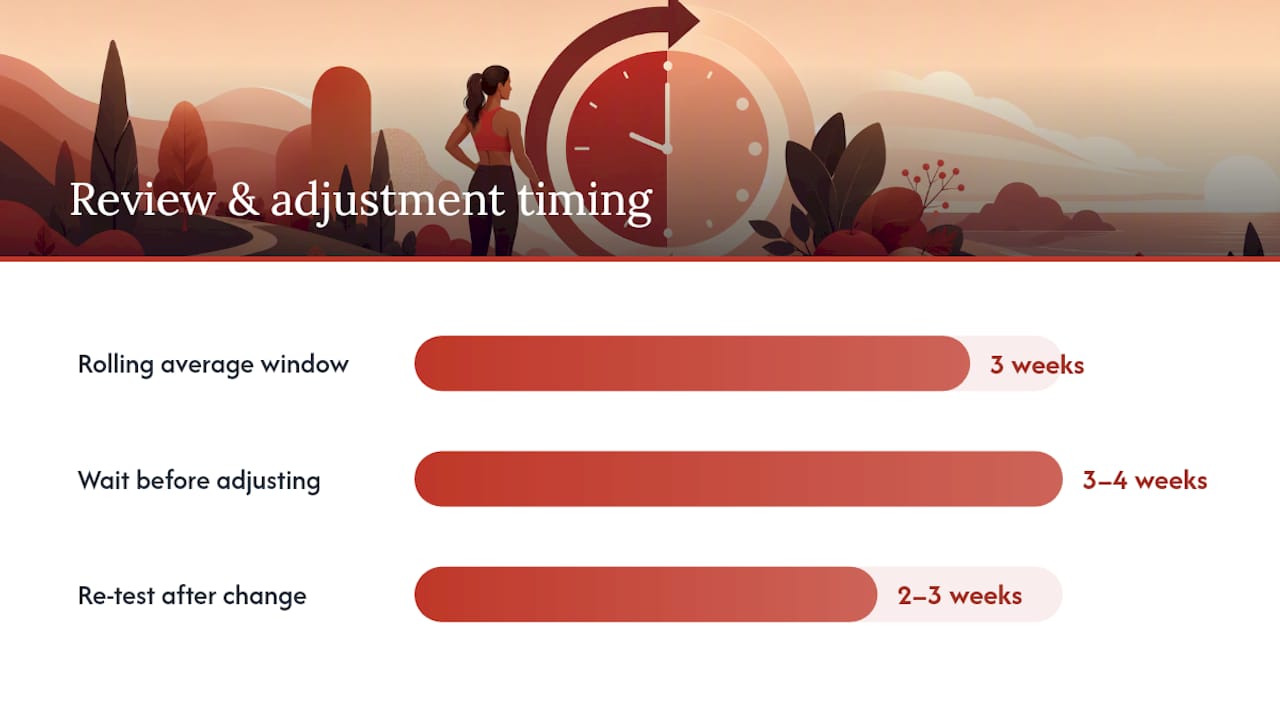
Trust the trend, not the day. A single high or low reading rarely means anything on its own; what matters is whether weight, measurements, and photos are all moving the same direction over three to four weeks.
The decision rule:
- If your 3-week rolling average is moving toward your goal, and measurements agree, keep the plan exactly as it is.
- If the average has been flat for 3 to 4 straight weeks with no change in measurements, adjust: reduce calories by roughly 10% or add a modest amount of activity, like an extra 2,000 steps a day.
- Re-test for another two to three weeks before making a second adjustment. Stacking changes on top of changes makes it impossible to know what actually worked.
Google Health’s guidance on nutrition tracking recommends connecting food intake with sleep, exercise, and hydration data rather than judging progress off diet numbers in isolation, since the fuller picture catches causes a food log alone would miss.
Common pitfalls that derail good tracking:
- Logging some meals but skipping “off plan” ones, which quietly inflates your real intake without you noticing
- Mistaking a sodium-driven water spike for fat gain after a salty restaurant meal
- Overreacting to a single bad or great weigh-in instead of waiting for the weekly average to confirm it
- Ignoring measurements and photos entirely because the scale is easier to check
Cleveland Clinic’s guidance on interpreting weight changes during new exercise routines makes a similar point: judging progress off one signal, especially right after starting a new training program, routinely leads people to abandon plans that were actually working.
Why do sleep, activity, and hydration matter for tracking?
Diet doesn’t operate in a vacuum, and a food log that ignores everything else in your life will eventually mislead you. A handful of extra data points, tracked briefly, explain most confusing plateaus.
- Sleep affects hunger hormones directly; a few nights of poor sleep tends to spike appetite and can shift the scale up temporarily, independent of anything you ate.
- Steps and active minutes account for calories burned outside formal workouts, and a big drop in daily movement can stall progress even with perfect food logging.
- Hydration matters both for interpreting weight swings and for appetite control, since mild dehydration is frequently mistaken for hunger.
- Medication logs, including GLP-1 medications, matter because dosage changes can shift appetite and digestion enough to distort a food log’s meaning.
UCLA Health’s guidance on tracking exercise alongside nutrition points out that qualitative notes, how you actually feel day to day, carry real weight alongside the numbers. A heavy training week that spikes water retention, or a stressful week that wrecks sleep, deserves a one-line note in your weekly review so you don’t mistake temporary noise for a real stall.
What does a weekly diet review look like step by step?
Run this same sequence every week, ideally on the same day, so it becomes routine instead of a chore you have to think through from scratch.
- Check your 7-day rolling weight average against last week’s average.
- Compare this week’s tape measurements to your last recorded set.
- Glance at your monthly photo if this happens to be photo week.
- Calculate your adherence percentage: planned meals actually eaten as planned.
- Note anything unusual in sleep, activity, stress, or medication changes.
- Decide on exactly one variable to change, or decide to hold steady.
- Write down whatever experiment you’re running so next week’s review has something to compare against.
| Review step | What it tells you |
|---|---|
| Weight trend | Direction of change, smoothed over noise |
| Measurements | Whether composition is shifting, even if weight isn’t |
| Adherence % | Whether stalls are a plan problem or a consistency problem |
| One change, time-boxed | Prevents stacking untested variables |
Document the experiment itself, not just the result. “Cut 150 calories starting this week” written down now means you’ll actually remember what caused next month’s progress, instead of guessing after the fact.
What Homecooked resources support this tracking system?
Homecooked was built around the idea that tracking should fit into your week, not compete with it. Personalized meal plans remove the guesswork from daily macros, since every meal already has known calories and protein built in before you log a single bite. Pantry tracking and automated shopping lists cut the friction that usually causes people to abandon a plan mid-month, and recipe-integrated portion guidance means the numbers in your food log actually match what’s on the plate.
A few practical next steps worth bookmarking: personalized meal planning walks through building a plan around your specific macro targets, and turning a meal plan into a smart grocery list shows how automation removes one more manual step from your week. For anyone managing a specific condition alongside general tracking, the low sodium meal planning guide is worth a look too. Export your weekly meal plan into your log ahead of time, and your weekly review becomes a comparison exercise instead of a reconstruction project.
What actually separates people who stick with tracking from those who quit?
Perfect logging for two weeks loses to mediocre logging sustained for six months, every single time. Most tracking advice sells precision as the goal, but the coaching pattern that actually plays out is different: the people who see real change are the ones who kept a rough log going long enough for a trend to show up, not the ones who nailed every gram of protein for ten days before burning out.
Repeatable meal templates do more for tracking consistency than any freshly prepared meals option can offer. When breakfast is basically the same five meals on rotation, logging becomes recognition instead of research, and the weekly review turns into a five-minute habit rather than a dreaded task. Batch-cooking on Sunday and presetting two or three go-to meals removes the exact decision fatigue that causes most tracking abandonment by Thursday of week two.
The psychological trap worth naming directly: one “bad” day on the scale feels like failure, and that feeling is what makes people quit, not the data itself. Frame every setback as one data point in a rolling average, and the whole system gets a lot easier to stay with.
— 0xmaglev
Ready to make tracking effortless? Here’s your next step
Homecooked turns everything in this guide into something you don’t have to build from scratch. Personalized meal plans arrive with calories and macros already calculated, automated shopping lists remove the weekly grocery guesswork, and portioned, recipe-integrated guidance means the number you log actually matches what’s on your plate.
If preset meals and batch-cooking are what keep you consistent, as the tracking data above suggests, a cottage cheese protein bowl is a good example of what a Homecooked recipe looks like: high protein, already portioned, and easy to log because the macros are built in before you even start cooking. Busy weeks are exactly where tracking usually falls apart, and Homecooked’s approach to meal planning for people short on time is designed around that exact failure point.
Start a free trial, build your first personalized meal plan, and run your first weekly review this Sunday. The first week’s win isn’t weight loss. It’s simply making it to day seven with a complete log.
Where to go for deeper reading on diet tracking
The NIDDK Body Weight Planner models how calorie changes map to realistic timelines, useful for setting expectations before you start. ChooseMyPlate offers government-backed portioning guidance that pairs well with any macro target. Google Health’s guidance on connecting nutrition with sleep and hydration data explains why single-metric tracking falls short. Microsoft’s Excel health tracking templates are a solid starting point for anyone building a spreadsheet system, and the PMC research on AI food-scanner accuracy backs up the reference-object trick for photo logging.
Sources
- About the Body Weight Planner - NIDDK
- Track your health and fitness goals in Excel
- PMC article on AI food image analysis