
Here is a sample day that reaches roughly 30 grams of fiber and takes less than 30 minutes of active cooking. Breakfast is overnight oats made with ½ cup rolled oats, 2 tablespoons chia seeds, and ½ cup raspberries (about 10 g fiber). Lunch is a lentil-quinoa salad with ½ cup each of cooked lentils and quinoa, plus a handful of spinach and cherry tomatoes (about 12 g). Dinner is two black bean tacos on whole-wheat tortillas with avocado and shredded cabbage (about 9 g). A mid-afternoon snack of an apple with almond butter adds more fiber, landing the day at a total that supports a high-fiber intake. The USDA Dietary Reference Intakes set a general fiber target of 25–38 g per day depending on age and sex; aiming for 30 g is a practical floor that most adults can reach with the right meal structure.
Three swap rules keep the plan repeatable without losing the fiber target:
- Legume swap: Replace lentils with black beans, chickpeas, or edamame cup-for-cup. All land in the 12–15 g fiber range per cooked cup.
- Whole-grain swap: Swap quinoa for farro, barley, or brown rice. Each delivers 5–6 g of fiber per cooked cup and holds up well in salads and bowls.
- Fruit/veg swap: Trade raspberries for blackberries or pears; swap spinach for kale or arugula. The fiber totals stay close enough that you will not fall short of your daily goal.
Homecooked builds these swap rules directly into its personalized meal plans, so you never have to do the math yourself.
Table of Contents
- Why a high-fiber diet actually changes how you feel
- How much fiber do you need, and how do you get there safely?
- Your flexible 7-day high-fiber meal plan
- What to buy and keep stocked for the whole week
- Recipes that make the plan cookable
- How to batch-cook the plan in 90 minutes on Sunday
- What the research says about legumes, fiber variety, and your gut
- Key Takeaways
- The part most fiber advice gets wrong
- Homecooked makes your fiber goal automatic
- Useful sources for further reading
Why a high-fiber diet actually changes how you feel
The benefits show up faster than most people expect. Within a week of consistently hitting 30 g of fiber per day, most people notice they stay full longer after meals, experience fewer mid-afternoon energy crashes, and feel more regular. Those are not coincidences.
Dietary fiber supports satiety, blood sugar stability, and gut health by slowing digestion, blunting glucose spikes after meals, and feeding the gut bacteria that produce short-chain fatty acids (SCFAs). SCFAs, particularly butyrate, help regulate appetite hormones and reduce low-grade gut inflammation. You do not need to understand the biochemistry to feel the difference; you just need to eat enough fiber consistently.
Statistic callout: Dietitian-created meal plans commonly target 30–32 g of fiber per day because that range reliably produces satiety and metabolic benefits across a wide range of calorie levels.
Heart health is another quiet win. Soluble fiber from oats, beans, and fruit binds to cholesterol in the digestive tract and helps carry it out of the body. Pair that with the blood sugar steadying effect of insoluble fiber from whole grains and vegetables, and a fiber-rich meal plan becomes one of the most efficient dietary tools available for metabolic health. No supplements required.
How much fiber do you need, and how do you get there safely?

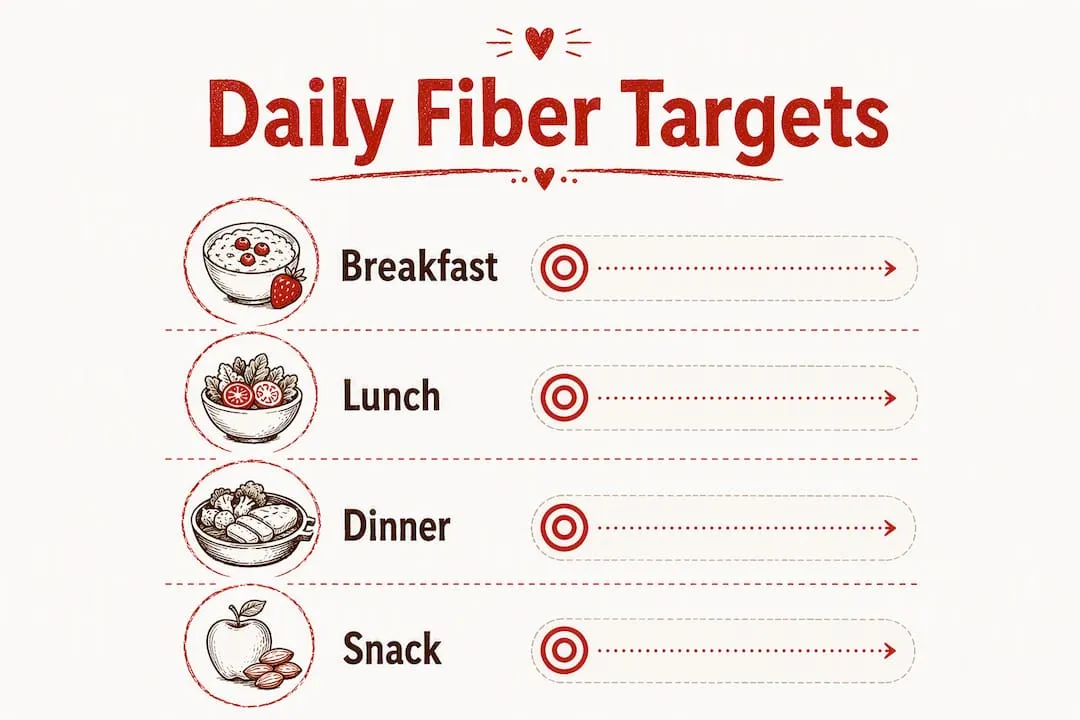
The practical target is a moderate daily fiber amount. The FiberGoal meal-builder framework breaks that into meal slots: aim for 8–10 g at breakfast, 10–12 g at lunch, and 10–12 g at dinner, with snacks filling any remaining gap. That approach eliminates the need to track cumulative grams all day.
A stepwise plan to increase fiber without the discomfort
If you are currently eating 10–15 g of fiber per day, jumping straight to 30 g will likely cause gas and bloating. Gradual increases over days to weeks give your gut microbiome time to adapt. Here is a four-week ramp-up:
-
Week 1: Add one high-fiber food per day (a serving of beans, a piece of fruit, or a swap to whole-grain bread). Target +3–5 g above your current baseline.
-
Week 2: Add a second high-fiber food per day and introduce a fiber-rich snack. Target +5–8 g above baseline.
-
Week 3: Build toward the meal-slot targets. Aim for 8 g at breakfast and 10 g at lunch. Dinner can still be moderate.
-
Week 4: Hit all three meal slots consistently. You should be at or near 30 g by the end of this week.
Hydration and gas: the two things people forget
Fiber and fluid work together. As you add fiber, it is important to increase water intake suitably to support digestion. Without enough fluid, fiber can slow digestion rather than support it, which is the opposite of what you want.
A few practical tips to reduce gas as you ramp up:
- Rinse canned beans thoroughly before cooking. This removes some of the fermentable sugars that cause bloating.
- Choose well-cooked legumes over raw or undercooked ones. Softer cell walls mean less fermentation in the colon.
- Steam or roast vegetables rather than eating them raw in large quantities early in the ramp-up.
- If you have IBS or known FODMAP sensitivity, the Monash University FODMAP Diet app is the standard clinical resource for identifying which high-fiber foods you can tolerate and at what serving sizes.
Your flexible 7-day high-fiber meal plan
Dietitian-created plans consistently prioritize beans, lentils, whole grains, fruits, and vegetables because these foods reliably deliver high fiber per serving and combine easily. The plan below uses that same logic, targeting a daily fiber intake around the recommended level. Swap options are included so you can adapt to what is in season or already in your pantry.
| Day | Breakfast (~9 g) | Lunch (~11 g) | Dinner (~10 g) | Snack (~4 g) | Daily Total | Swap Option |
|---|---|---|---|---|---|---|
| Mon | Overnight oats + chia + raspberries | Lentil-quinoa salad + spinach | Black bean tacos + cabbage + avocado | Apple + almond butter | ~30 g | Swap lentils for chickpeas |
| Tue | Whole-wheat toast + avocado + hemp seeds | Chickpea and roasted veggie bowl | Barley and white bean soup | Pear + walnuts | ~32 g | Swap barley for farro |
| Wed | High-fiber smoothie (banana, spinach, flaxseed, oat milk) | Black bean and brown rice burrito bowl | Lentil vegetable curry + brown rice | Edamame (½ cup) | ~30 g | Swap brown rice for quinoa |
| Thu | Steel-cut oats + blueberries + flaxseed | Tuna and white bean salad on whole-wheat pita | Stuffed bell peppers with quinoa and black beans | Orange + pistachios | ~30 g | Swap tuna for chickpeas (vegan) |
| Fri | Chia pudding + mango + shredded coconut | Lentil soup + whole-grain roll | Shrimp stir-fry with broccoli, snap peas, brown rice | Hummus + carrot sticks | ~30 g | Swap shrimp for tofu |
| Sat | Veggie omelet + whole-wheat toast + side of berries | Farro and roasted beet salad + walnuts | Black bean and sweet potato chili | Kiwi + pumpkin seeds | ~32 g | Swap farro for barley |
| Sun | Whole-grain pancakes + banana + nut butter | Quinoa tabbouleh + chickpeas + cucumber | Baked salmon + roasted Brussels sprouts + lentils | Apple + cashews | ~30 g | Swap salmon for tempeh |
A few notes on using this plan: treat it as inspiration rather than a rigid script. Calories and macronutrients will vary depending on portion sizes and specific brands. If you are managing a low-sodium goal alongside fiber, choose no-salt-added canned beans and low-sodium broth. Pairing protein with fiber at each meal, as this plan does, maximizes satiety and helps preserve muscle during weight changes. For more high-fiber dinner ideas beyond what is listed here, the Homecooked recipe library has 25 options ready to slot in.
What to buy and keep stocked for the whole week
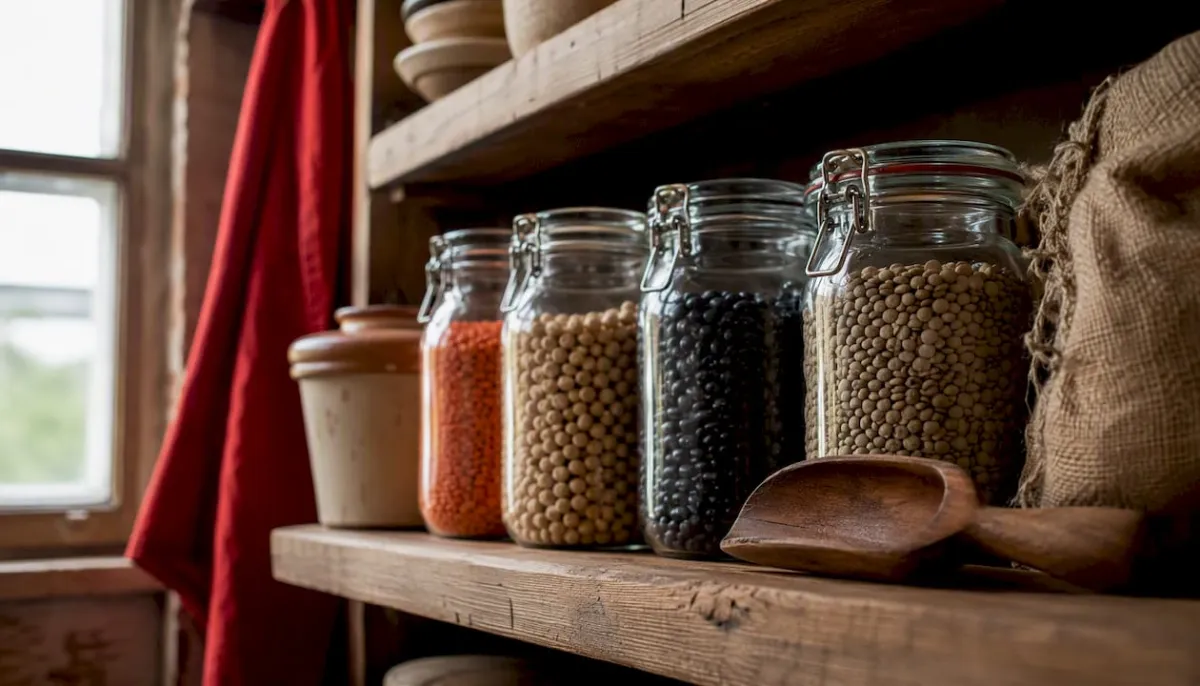
A single, well-organized shopping trip makes the difference between a plan you follow and one you abandon by Wednesday. Dietitian-created plans consistently recommend stocking these categories:
Legumes
- Canned black beans, chickpeas, and white beans (no-salt-added where possible)
- Dried red lentils and green lentils (faster to cook than dried beans, no soaking needed)
- Edamame (frozen, shelled)
Whole grains
- Rolled oats and steel-cut oats
- Quinoa, farro, and brown rice
- Whole-wheat tortillas and whole-grain bread
Fresh produce
- Avocados, bananas, apples, pears, kiwi, mango
- Spinach, kale, Brussels sprouts, broccoli, snap peas, bell peppers, beets, cabbage
Frozen produce
- Raspberries, blueberries, mango chunks (frozen fruit is just as fiber-rich as fresh and far cheaper in winter)
- Frozen broccoli and edamame for quick weeknight dinners
Nuts, seeds, and extras
- Chia seeds, flaxseed (ground), hemp seeds, pumpkin seeds
- Almond butter, walnuts, pistachios, cashews
- Hummus (store-bought or homemade)
Pantry staples
- Canned diced tomatoes, low-sodium vegetable broth, coconut milk
- Spices: cumin, smoked paprika, turmeric, garlic powder
Dried lentils are worth buying in bulk. One pound costs around $2–3 and yields roughly 8 cups cooked, enough for multiple lunches and dinners. Frozen produce is equally strategic: it requires no washing or chopping and keeps for months. For a step-by-step guide to turning this list into a zero-waste grocery run, the Homecooked post on building a smart grocery list walks through the full process. The Homecooked app also generates your shopping list automatically once you lock in a meal plan, which removes the manual list-building step entirely.
Recipes that make the plan cookable
These five recipes cover the core meals in the 7-day plan. Each one is designed for home cooks who want real food, not complicated technique.
Overnight oats bowl
Fiber: ~9 g per serving | Prep time: 5 minutes (refrigerate overnight)
Combine ½ cup rolled oats, 2 tablespoons chia seeds, ¾ cup oat milk, and a pinch of cinnamon in a jar. Refrigerate overnight. Top with ½ cup raspberries or blackberries in the morning.
- Swap raspberries for sliced banana + 1 tablespoon flaxseed for a similar fiber total.
- Makes 1 serving; double or triple the batch for the week.
- Keeps refrigerated for up to 4 days.
Pro Tip: Add the fruit topping in the morning rather than the night before. Berries release liquid overnight and can make the oats watery.
Lentil-quinoa salad
Fiber: ~12 g per serving | Prep time: 10 minutes | Cook time: 20 minutes
Cook ½ cup dry red lentils in 1 cup water until just tender (about 12 minutes). Cook ½ cup quinoa separately. Combine with 2 cups spinach, cherry tomatoes, cucumber, and a lemon-tahini dressing (2 tablespoons tahini, juice of 1 lemon, 1 garlic clove, water to thin).
- Swap lentils for canned chickpeas (drained and rinsed) to cut cook time to zero.
- Batch: this recipe scales to 4 servings easily. Store undressed in the fridge for up to 5 days.
Black bean tacos
Fiber: ~9 g for 2 tacos | Prep time: 10 minutes | Cook time: 5 minutes
Warm one 15-oz can of black beans (drained and rinsed) in a skillet with cumin, smoked paprika, and a splash of water. Mash lightly with a fork for better texture in the taco. Serve in two whole-wheat tortillas with shredded cabbage, avocado slices, and salsa.
- Rinsing canned beans removes excess sodium and reduces fermentable sugars.
- Swap black beans for pinto beans or lentils without changing the fiber count meaningfully.
- Leftover bean mixture keeps for 4 days and works as a burrito bowl base.
Hearty vegetable and lentil soup
Fiber: ~11 g per serving | Prep time: 10 minutes | Cook time: 30 minutes
Sauté one diced onion, 2 carrots, and 2 celery stalks in olive oil until soft. Add 1 cup dried green lentils, one 14-oz can diced tomatoes, 4 cups low-sodium vegetable broth, and 1 teaspoon each of cumin and turmeric. Simmer 25 minutes until lentils are tender.
- Batch yield: 6 servings. Freezes well for up to 3 months.
- Add a handful of kale or spinach in the last 2 minutes for an extra gram of fiber per bowl.
High-fiber smoothie
Fiber: ~8 g per serving | Prep time: 5 minutes
Blend 1 cup oat milk, 1 banana, 1 cup frozen mango, 1 cup spinach, 1 tablespoon ground flaxseed, and 1 tablespoon chia seeds until smooth.
- Swap mango for frozen raspberries for a slightly higher fiber count (~9 g).
- Drink immediately or refrigerate for up to 24 hours; shake before drinking.
For more high-fiber salads, bowls, and smoothies that fit the same meal-slot targets, Homecooked has a dedicated recipe collection worth bookmarking.
How to batch-cook the plan in 90 minutes on Sunday
Batch cooking is the single most reliable way to stay consistent with a fiber-rich eating pattern. Here is a realistic Sunday prep session:
- 0:00–0:15 Cook a large pot of grains. Start brown rice or farro first since it takes the longest (35–45 minutes). While it cooks, move to the next tasks.
- 0:15–0:30 Cook a batch of lentils. Red lentils take 12–15 minutes; green lentils take 20–25 minutes. Season lightly with salt and bay leaf.
- 0:30–0:50 Roast vegetables. Toss broccoli, bell peppers, and Brussels sprouts with olive oil and smoked paprika. Roast at 425°F for 20 minutes. These become dinner sides and lunch bowl toppings all week.
- 0:50–1:10 Assemble overnight oats for Monday and Tuesday. Portion into jars, refrigerate.
- 1:10–1:30 Make a double batch of lentil soup or chili. Portion into containers: 2 servings in the fridge, the rest in the freezer.
Leftover conversions that actually work:
- Sunday’s lentil soup becomes Monday’s lunch by adding a handful of fresh spinach and a squeeze of lemon.
- Roasted vegetables from Sunday dinner go into a grain bowl for Tuesday lunch with a tahini drizzle.
- Leftover black bean taco filling becomes a burrito bowl base with rice and avocado.
Storage guidance: cooked grains and legumes keep for 5 days in the fridge. Soups and chili freeze for up to 3 months. Label containers with the date so nothing gets lost. For a full weekly meal planning workflow that fits around a busy schedule, Homecooked’s planning guide covers the timing in detail.
What the research says about legumes, fiber variety, and your gut
One cup of cooked lentils or black beans is a highly efficient source of fiber, providing a substantial portion of a daily fiber target in a single serving.
But efficiency is only part of the story. Fiber diversity matters just as much as total grams. Different gut bacteria feed on different types of fiber: the soluble fiber in oats and beans feeds one set of microbes, the insoluble fiber in whole grains and vegetables feeds another, and the resistant starch in cooked-and-cooled legumes feeds a third. A gut microbiome that is fed a variety of fiber types produces a broader range of SCFAs, which supports satiety, reduces inflammation, and improves metabolic markers.
The practical implication: do not just eat more beans. Combine legumes with whole grains at lunch, add a fruit or vegetable at every meal slot, and rotate your choices across the week. The 7-day plan above is built on exactly this principle. Each day pairs at least one legume source with a whole grain and at least two servings of fruit or vegetables, which is why the fiber totals stay consistently above 30 g without requiring any tracking. For more gut health recipes built around this diversity principle, Homecooked’s collection covers 18 fiber-rich options.
High-fiber recipes to hit 30 g a day
These plant-forward mains each pack 12g+ of fiber per serving — the easiest way to close the daily gap without thinking about it.
1Three-Bean Chili
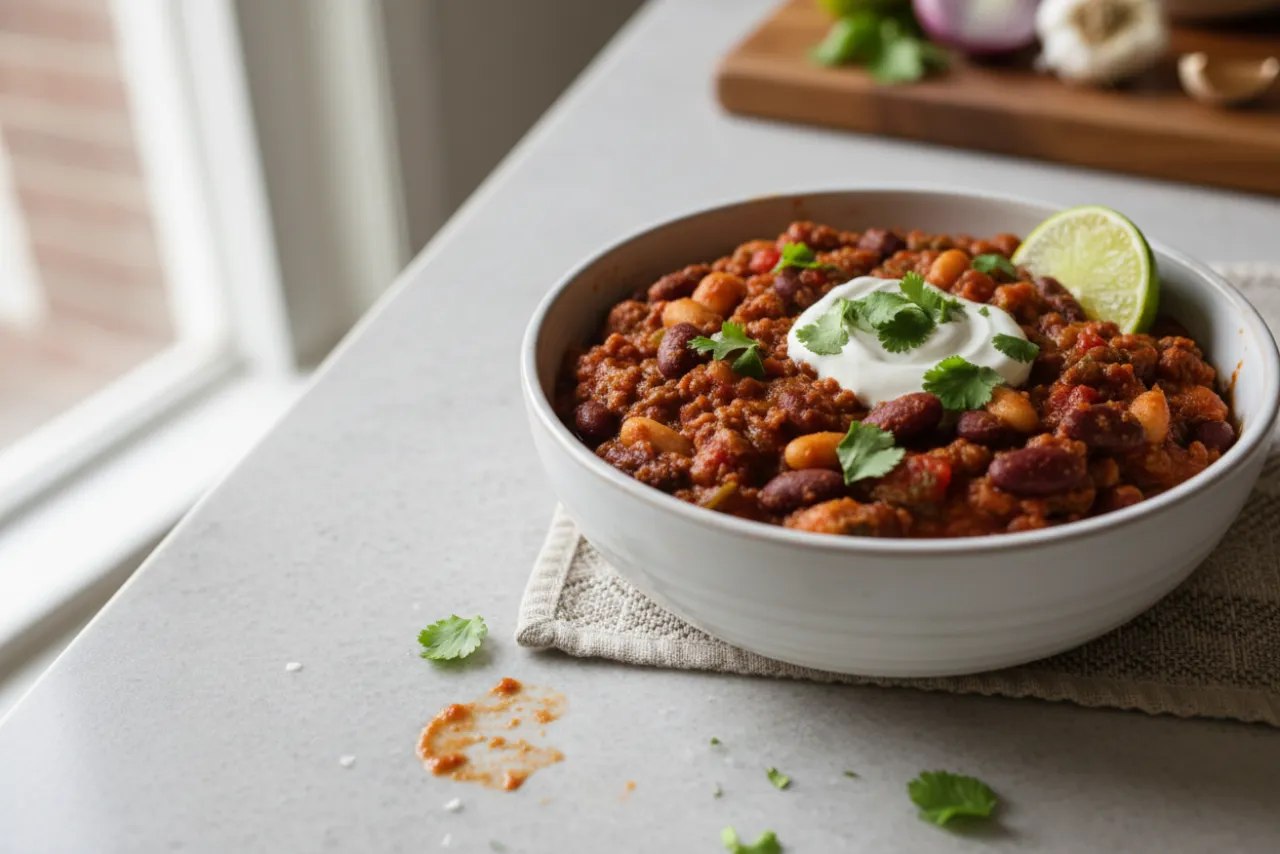
Mexican40 min19g fiber19g protein
Three kinds of bean simmered with tomato and warm spices into a thick, smoky chili — a vegan main with over twenty grams of fiber a bowl.
View recipe →2Crispy Chickpea Buddha Bowl
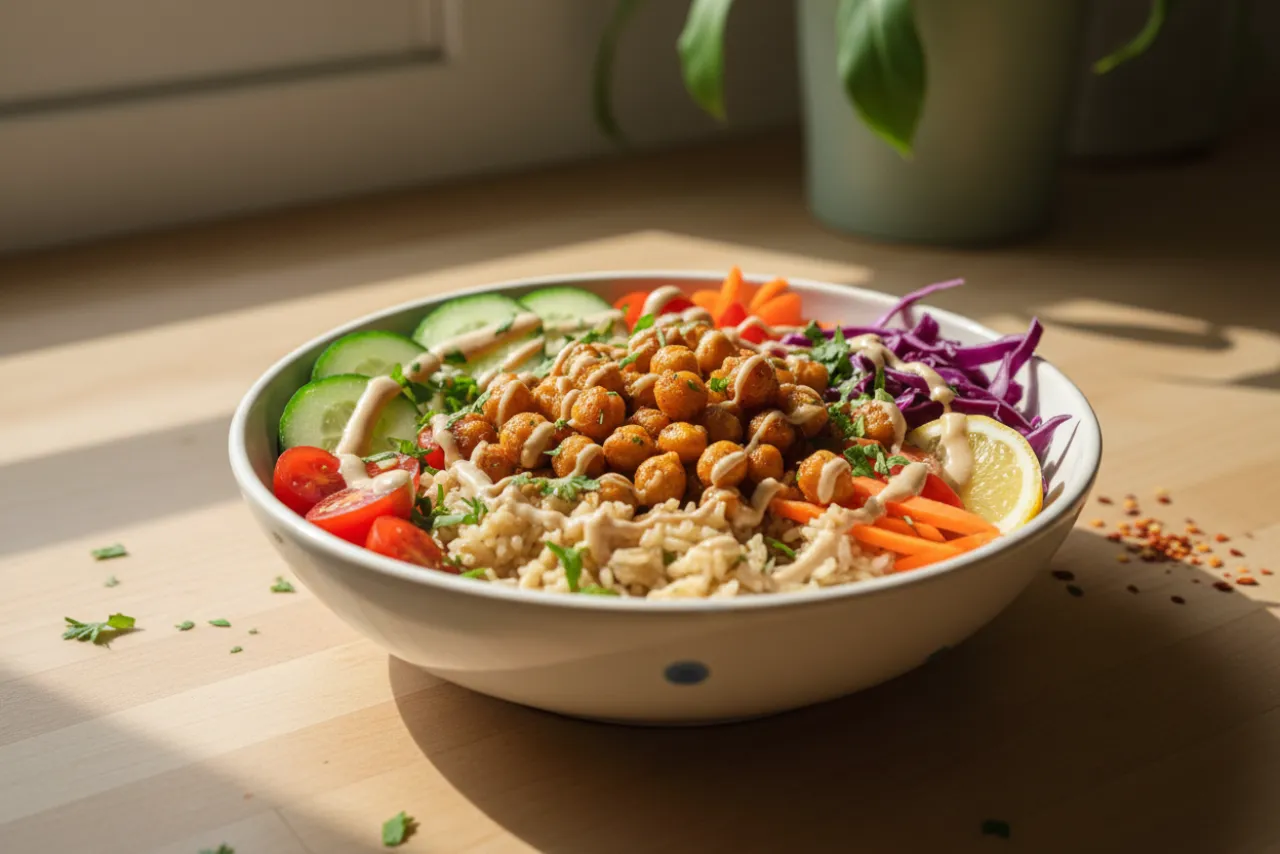
Mediterranean45 min18g fiber22g protein
Roasted chickpeas, brown rice, and raw vegetables with a tahini drizzle — a colorful, plant-based bowl packed with fiber.
View recipe →3Coconut Chickpea Curry
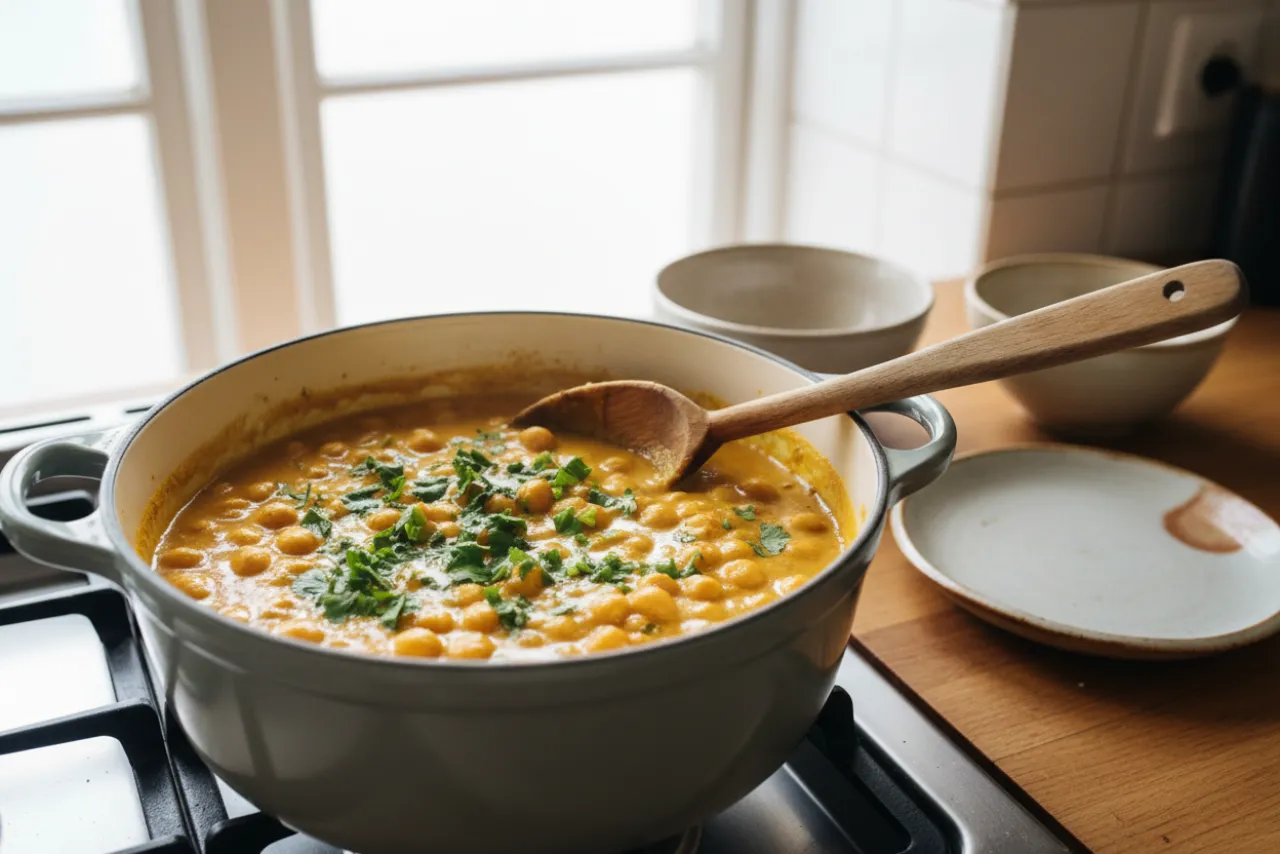
Indian30 min18g fiber19g protein
Chickpeas in a golden coconut gravy — a pantry curry that tastes like you tried much harder.
View recipe →4Koshari (Egyptian Lentils, Rice & Pasta)

Middle Eastern60 min15g fiber27g protein
Egypt's national street food — lentils, rice, and pasta under spiced tomato and crisp onions. A carb-and-fiber monument.
View recipe →5Chicken Quinoa Power Bowl
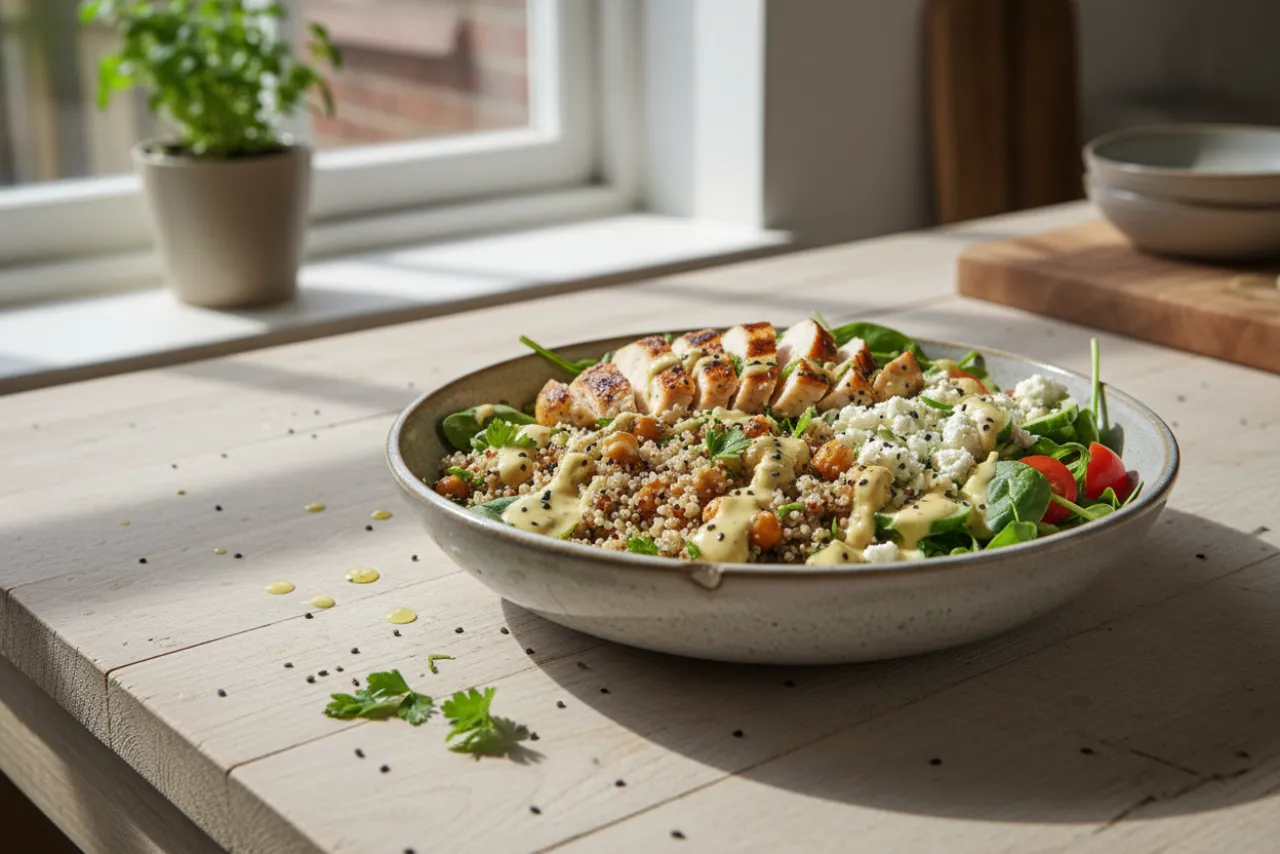
Mediterranean30 min15g fiber54g protein
Quinoa, grilled chicken, chickpeas, and greens with a lemon-tahini drizzle — a forty-gram-protein lunch bowl built for meal prep.
View recipe →6Lentil & Walnut Salad
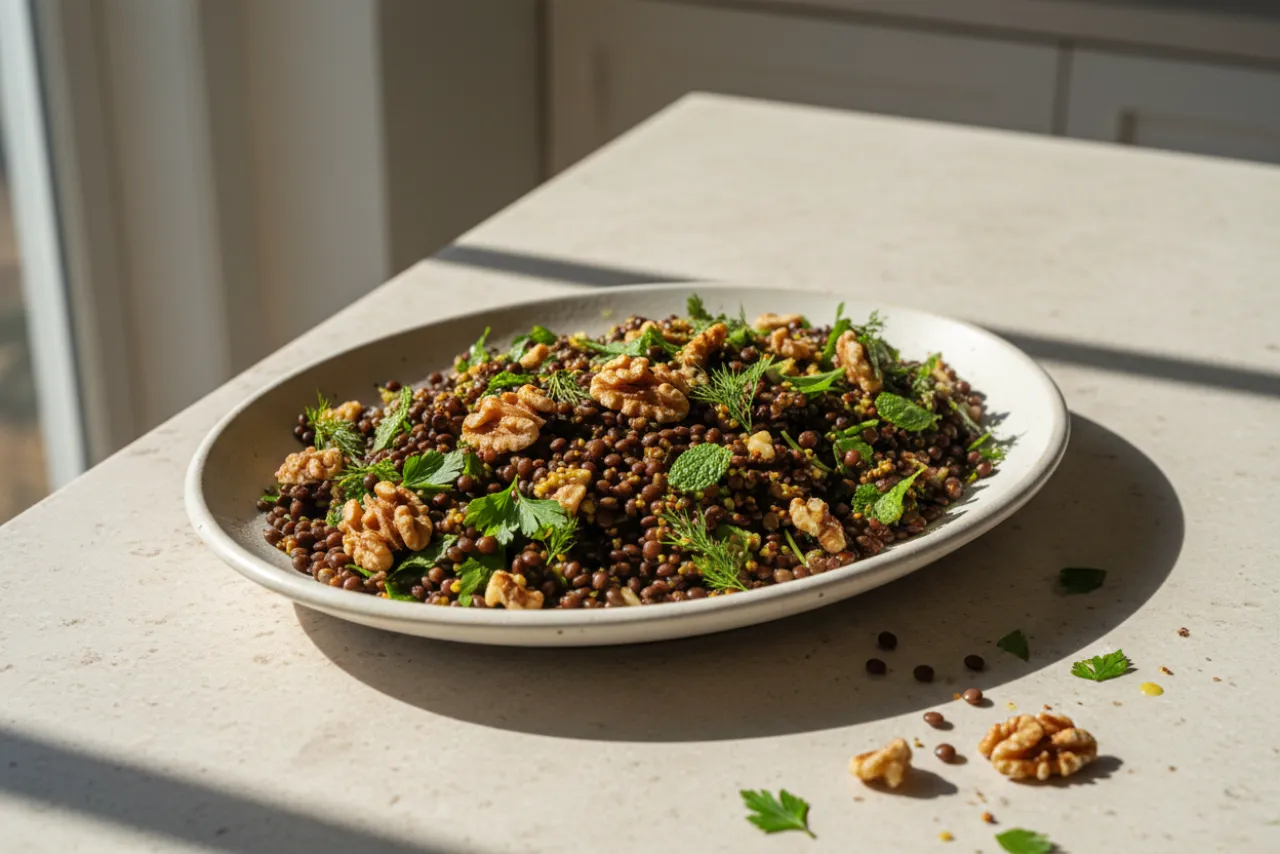
Mediterranean30 min10g fiber20g protein
Puy lentils with walnuts, herbs, and a mustard-olive-oil dressing — fiber, plant protein, and omega-3 in a hearty salad.
View recipe →Key Takeaways
A structured meal-slot approach, targeting 8–10 g at breakfast, 10–12 g at lunch, and 10–12 g at dinner, is the most practical way to hit 30 g of fiber per day without tracking every gram.
| Point | Details |
|---|---|
| Daily fiber target | Aim for approximately 30 g per day; the USDA Dietary Reference Intakes set a range of 25–38 g depending on age and sex. |
| Meal-slot framework | Target 8–10 g at breakfast, 10–12 g at lunch, and 10–12 g at dinner to reduce tracking burden. |
| Legumes are the anchor | One cup of cooked lentils or black beans provides roughly 15 g of fiber, covering half the daily target in one ingredient. |
| Increase gradually and hydrate | Add 3–5 g of fiber per week over 2–4 weeks, and increase water intake suitably to support digestion to avoid discomfort. |
| Homecooked automates the plan | The Homecooked app generates personalized high-fiber meal plans and automated shopping lists so you can follow the plan without manual tracking. |
The part most fiber advice gets wrong
The conventional framing around high-fiber eating treats it as a discipline problem. Eat more beans. Track your grams. Be consistent. What that framing misses is that most people do not fail because they lack willpower; they fail because the plan is too rigid to survive a real week.
The meal-slot approach works in actual kitchens because it gives you a target per meal, not a daily total to obsess over. If breakfast lands at 9 g and lunch lands at 11 g, you know dinner just needs to hit 10 g. That is a much easier mental model than watching a running tally all day. And when you miss a meal, you do not blow the whole day.
The swap rules matter for the same reason. A plan that tells you to eat lentil soup on Tuesday is a plan you will abandon when you are out of lentils. A plan that tells you any legume in roughly the same quantity will work is a plan you can actually keep. Flexibility is not a compromise on the fiber goal; it is what makes the goal sustainable.
One thing worth saying plainly: if you have IBS or significant digestive sensitivity, the standard high-fiber ramp-up may not work for you without modification. The Monash University FODMAP Diet app is the most clinically grounded tool for navigating that situation. It does not replace a registered dietitian, but it gives you a solid starting framework.
The fiber goal is not complicated. It just requires a structure that fits your actual life, not a perfect version of it.
Homecooked makes your fiber goal automatic
Hitting 30 g of fiber every day is straightforward when the plan is already built for you. Homecooked generates personalized meal plans based on your health goals and dietary preferences, so you get a fiber-rich weekly menu without building one from scratch.
Every plan comes with an automated shopping list that maps directly to your meals, pantry tracking so you know what you already have, and step-by-step guided recipes with built-in timers. If you want to swap a meal, the app suggests alternatives that keep your fiber targets intact. The plans are built around dietitian-vetted meal structures, so the nutritional balance is already accounted for.
Whether you are starting from scratch or refining a plan you already follow, try Homecooked free and see how much easier the week gets when the planning is handled for you.
Useful sources for further reading
These sources back the claims in this article and are worth bookmarking for meal inspiration, fiber numbers, and special-diet adjustments.
- FiberGoal Meal Plan Builder: The meal-slot framework (breakfast 8–10 g, lunch 10–12 g, dinner 10–12 g) and the 15 g legume statistic both come from this tool. Use it to build custom fiber targets around your calorie level.
- EatingWell: 7-Day High-Fiber, No-Sugar Meal Plan: Covers satiety benefits, SCFA production, gradual increase guidance, and hydration. A solid reference for the science behind the plan.
- EatingWell: 30-Day High-Fiber Meal Plan: Dietitian-created plan targeting 30–32 g per day with practical meal-prep tips. Good for extending beyond the 7-day plan.
- EatingWell: 7-Day High-Fiber Meal Plan by a Dietitian: Covers staple food groups, batch-cooking steps, and meal-prep timing. Useful for editors verifying the shopping list and prep session structure.
- EatingWell: 5-Day High-Protein, High-Fiber Meal Plan: Explains why pairing protein with fiber maximizes satiety. Reference for the protein-pairing notes in the 7-day plan.
- Monash University FODMAP Diet App: The standard clinical resource for IBS and FODMAP-sensitive readers who need to modify high-fiber eating. Includes food ratings, serving size guidance, and over 80 low-FODMAP recipes.
- Dr. Meet Parikh, DO: How Fiber Shapes Digestion: Clinical perspective on fiber’s role in satiety and blood sugar control from a gastroenterology practice. Useful for readers who want a deeper explanation of the digestive mechanisms.
- Homecooked: High-Fiber Foods List (40 Foods Ranked): A ranked list of high-fiber foods with per-serving fiber counts. Use it to verify swap options and find additional pantry staples.