
Macro meal planning means designing your meals around specific daily targets for protein, carbohydrate, and fat instead of just counting calories or picking recipes at random. The fastest path to a working weekly plan is app-first: let a tool like Homecooked calculate your targets and build the menu, or follow this three-step DIY version yourself.
- Calculate your daily calorie need, then split it into protein, carb, and fat grams.
- Pick two proteins, two bases, and one sauce, and rotate them across seven days.
- Build your grocery list from that rotation, then batch-cook the base components.
If you’d rather skip the spreadsheet entirely, Homecooked generates a personalized plan and shopping list based on your goals in a few minutes.
Key Takeaways
Macro meal planning works because it targets protein, carbs, and fat directly instead of relying on calories alone, and a repeatable weekly structure is what makes it stick.
| Point | Details |
|---|---|
| Calculate before cooking | Estimate calories with a tool like the USDA’s calculators, then split into protein, carb, and fat grams. |
| Prioritize protein | Aim for 1.6 to 2.2g per kilogram of bodyweight if active, and front-load it at breakfast and lunch. |
| Repeat, don’t reinvent | Rotate two proteins, two bases, and one sauce across the week to cut prep time and decision fatigue. |
| Use plate-based portions | Palm of protein, cupped hand of carbs, thumb of fat, and fist of vegetables works without a scale. |
| Let an app do the math | Homecooked generates a personalized macro plan, grocery list, and guided recipes from your goals in minutes. |
Table of Contents
- What Does Macro Meal Planning Actually Mean?
- How Do You Calculate Your Daily Macro Targets?
- How Do You Build a Weekly Macro-Balanced Meal Plan?
- What Are the Most Common Macro Splits and Sample Menus?
- Which Tools Help You Build a Macro Meal Plan Faster?
- What Does the Evidence Say About Protein and Portions?
- Ready to Skip the Math and Start Cooking?
- Sources
What Does Macro Meal Planning Actually Mean?
Macros are the three nutrients that supply calories: protein, carbohydrate, and fat. Macro meal planning means setting daily gram targets for each one, then building meals that add up to those numbers instead of just watching a single calorie total.
Each macro plays a different role on your plate:
- Protein builds and repairs muscle, and it keeps you full longer than the other two macros.
- Carbohydrate fuels workouts and brain function, and it’s the macro most people over or under eat without noticing.
- Fat supports hormone production and helps you absorb certain vitamins.
Calorie-only planning treats a donut and a chicken breast as equals if they match in calories. A macro-based meal plan doesn’t. It forces protein into the equation on purpose, which is why people trying to lose fat or build muscle tend to get better, more sustainable results with it.
How Do You Calculate Your Daily Macro Targets?
Getting from “I want to eat healthier” to actual numbers on a plate takes four steps.
- Estimate your daily calorie need using an established formula or a tool like the USDA’s calculators and counters.
- Pick a macro split based on your goal (more on common splits below).
- Multiply your calorie total by each macro percentage, then divide by 4 for protein and carbs, or 9 for fat, to get grams.
- Round to the nearest 5 grams per meal so the numbers stay usable, not obsessive.
Here’s a worked example: someone eating 2,000 calories on a 40/30/30 split (protein/carb/fat) would land at gram targets for protein, carb, and fat daily, with roughly even protein distribution across meals.
Pro Tip: Evidence summaries on protein intake generally put active adults in the range of 1.6 to 2.2 grams of protein per kilogram of bodyweight. If you weigh 70kg and lift weights regularly, that’s 112 to 154g daily. Start at the higher end if fat loss is the goal, since protein preserves muscle while you’re in a deficit.
How Do You Build a Weekly Macro-Balanced Meal Plan?
Once you know your numbers, the real work is turning them into a plan you’ll actually cook. The most reliable system repeats a small number of components instead of reinventing every meal.
- Choose two or three proteins for the week (chicken thighs, ground turkey, tofu, eggs).
- Pick two bases (rice, quinoa, roasted potatoes) and two vegetables you can prep in bulk.
- Map each meal to your macro targets, adjusting portions rather than swapping entire dishes.
- Build your grocery list by category (protein, produce, pantry) before you shop.
- Batch-cook the components that hold up in the fridge, and assemble fresh items daily.
A few things make this stick during a real week:
- Shop the perimeter of the store first, since that’s where most of your proteins and produce live.
- Keep one “emergency” quick meal on hand (a pre-cooked protein plus microwave rice) for the night your schedule falls apart.
- Batch-cook grains and proteins on Sunday; leave sauces, dressings, and fresh vegetables for daily assembly so nothing gets soggy.
- If allergies or a tight schedule limit your options, swap the base protein or grain, not the whole structure.
Homecooked’s guide to meal planning for busy people walks through this same repeat-and-rotate logic in more detail, and turning your plan into a grocery list covers the shopping side.
What Are the Most Common Macro Splits and Sample Menus?
Three splits show up constantly in macro-based meal plans, and each fits a different goal.
- 40/30/30 (protein/carb/fat): a balanced default for general fitness and moderate fat loss.
- 40/40/20: favors more carbs for people training hard or doing endurance work.
- 3-3-3 rule: a simpler heuristic aiming for roughly 30g protein, 30g carb, and a thumb-sized portion of fat per meal, useful for beginners who don’t want to do math at every meal.
Sample one-day menu, 40/30/30 (2,000 calories): eggs and oats for breakfast (~30g protein), grilled chicken with rice and broccoli for lunch (~45g protein), and salmon with quinoa and roasted vegetables for dinner (~40g protein), plus a Greek yogurt snack.
Sample one-day menu, 40/40/20 (endurance focus): oatmeal with protein powder and banana for breakfast, turkey wrap with extra rice for lunch, and pasta with lean ground beef for dinner.
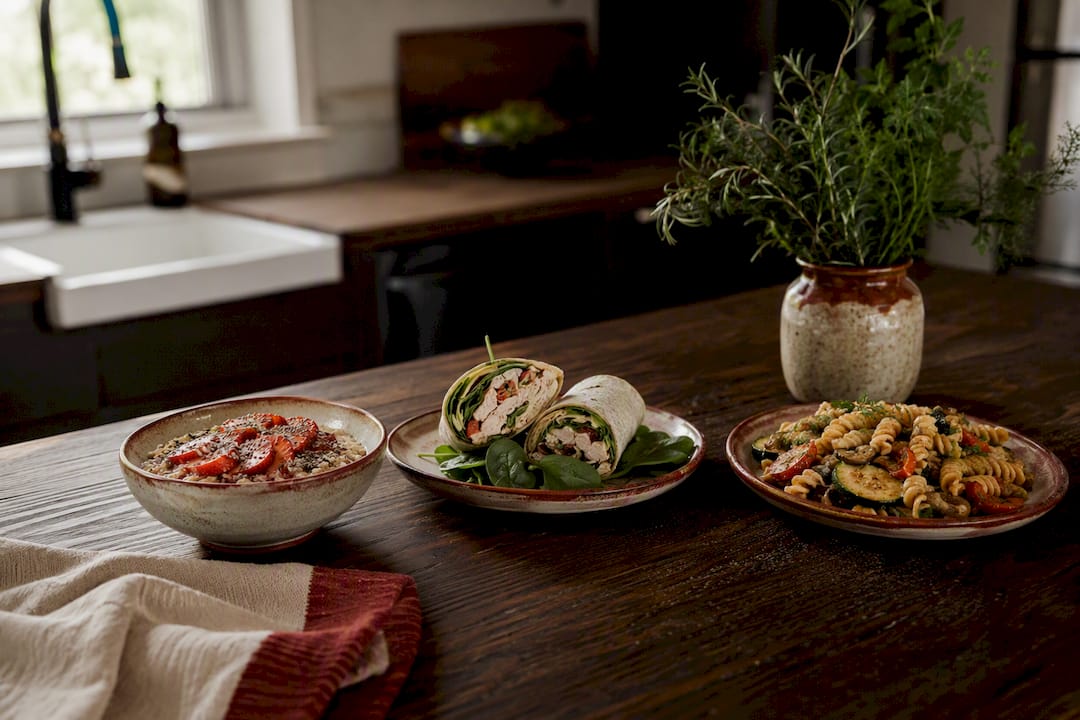
Vegetarian swap: replace chicken and turkey with tofu, tempeh, or Homecooked’s cottage cheese protein bowl style combinations, and lean on lentils and edamame to hit protein numbers without meat. Research on low-fat versus low-carb approaches shows that when calories match, both strategies produce similar weight-loss results, so don’t stress over the exact carb-to-fat ratio.
Which Tools Help You Build a Macro Meal Plan Faster?
An app-first approach saves the two biggest time sinks in macro meal planning: doing the math and building the grocery list. Homecooked calculates your targets from your goals and preferences, then generates a plan with a synced shopping list, pantry tracking, and step-by-step guided recipes with built-in timers, which turns “figure out dinner” into “follow the steps.”
Other automated generators exist in this space. Tools like Eat This Much, once described by the Washington Post as a kind of virtual nutritionist, along with Prospre and StrongrFastr, generate meal plans around macro inputs with varying degrees of customization. A DIY spreadsheet still works fine if you enjoy the process or have very specific recipes you already love.
When comparing any macro meal planner app, check for:
- Best for: busy cooks, athletes, weight loss, or muscle gain.
- Pricing: free tier or free trial availability before you commit.
- Customization: macro targets, dietary preferences, and allergy filters.
- Grocery automation: does it generate a categorized, shoppable list?
- Recipe quality: are the recipes actually cookable, with clear steps?
- Platform: web, iOS, Android, or all three.
What Does the Evidence Say About Protein and Portions?
Protein gets prioritized in most macro meal plans because it does double duty: it supports muscle repair and it’s the macro most linked to feeling full, according to evidence summaries on protein intake. Eating enough protein at breakfast and lunch tends to reduce the urge to overeat later in the day.
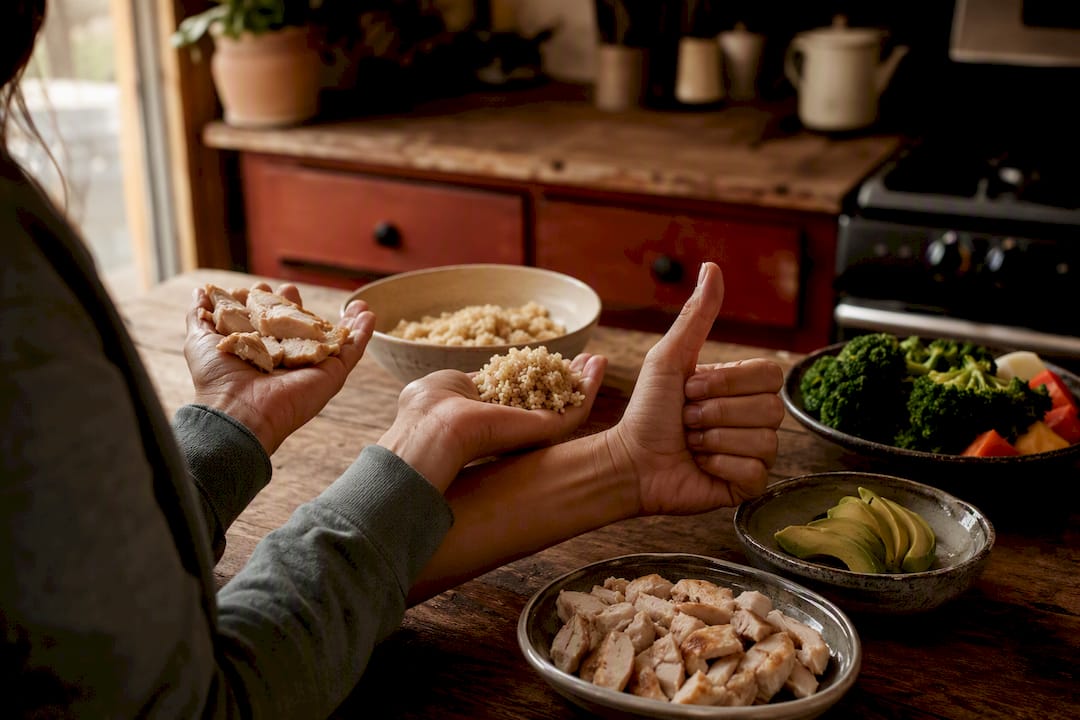
For portion sizing without a scale, the USDA’s plate-based guidance supports a simple visual system: a palm-sized portion of protein, a cupped-hand of carbs, a thumb of fat, and a fist of vegetables per meal.
Pro Tip: If you have a medical condition, are pregnant, or are considering a calorie intake under 1,200 per day, talk to a doctor or registered dietitian before starting a macro-based plan.
A Practical Note on Repetition and Variety
Repeating two proteins, two bases, and one sauce across a week isn’t a shortcut, it’s the system that makes macro meal planning sustainable. Rotate your produce inside that structure so micronutrients don’t get crowded out by macro math.
Ready to Skip the Math and Start Cooking?
If everything above sounds useful but you’d rather not build a spreadsheet, that’s exactly the gap Homecooked closes. The app builds your personalized macro-based meal plan from your goals and dietary preferences, then automates the grocery list, tracks your pantry, and walks you through each recipe with built-in timers so you’re not guessing at portions on a Tuesday night.
You can try a free trial to see your first week’s plan before committing to Homecooked Pro. If you want a sense of what a macro-friendly recipe actually looks like inside the app, start with the cottage cheese protein bowl, a high-protein option that plugs straight into a weekly rotation. Open the app, enter your goals, and let it build the plan while you go shop.
Sources
- USDA Food and Nutrition Information Center — Calculators and counters
- Examine — Protein intake guide