
Design adherence into the meal plan itself: assess barriers before you write a single meal, build if-then substitution scripts for the moments willpower fails, and layer in low-friction digital tracking. A controlled-feeding trial hit 94% adherence to planned food consumption when researchers built orientation, flexibility, and frequent check-ins into the protocol. There are apps designed to make that same structure available at home. This week, pick one barrier your client mentions most and write a specific substitution rule for it before your next session.
TL;DR:
- Focusing on specific adherence behaviors such as meal completion, substitution fidelity, and portion accuracy helps tailor interventions more effectively than overall compliance.
- Conducting barrier assessments at multiple points, especially before planning and revisiting at weeks two and six, significantly reduces barriers and improves metabolic outcomes.
- Personalization should prioritize clients’ preferences, schedules, and constraints over genetic or highly granular meal customization, which often overpromise adherence benefits.
- Implementing pre-planned, specific if-then scripts and permitted flexibility within the meal plan enhances resilience during high-stress periods and social situations.
- Using a multi-level adherence dashboard to track key behaviors weekly allows targeted interventions and helps distinguish slips from patterns requiring plan adjustments.
Table of Contents
- What Meal Plan Adherence Actually Means
- Find the Barriers Before You Write the Plan
- Personalization, Implementation Intentions, and Permitted Flexibility
- What Self-Monitoring and Feedback Can Realistically Do
- Digital Supports That Remove Friction, Not Just Add Features
- A Multi-Level Metrics Dashboard You Can Actually Use
- Why the First Two Weeks and Every Weekend Are High-Risk
- Copy-Ready Templates for Your Next Client Visit
- How the Evidence and Homecooked’s Feature Set Line Up
- The Psychology Behind Why Plans Succeed or Fail
- Family, Work, and the Social Web Around Every Meal
- Handling a Slip Without Letting It Become a Collapse
- Why Adherence Is the Metric That Actually Predicts Outcomes
- Building Plans Around Culture and Preference, Not Around Them
- Keeping It Going Long After the Plan Feels Automatic
- Where Clinicians Consistently Go Wrong
- Put This Playbook to Work With Homecooked
- Sources
- FAQ
What Meal Plan Adherence Actually Means
Meal plan adherence isn’t a single yes-or-no checkbox. It’s a cluster of related behaviors, and treating it as one number is why so many clinicians misdiagnose why a client is struggling. Diet plan compliance breaks down into at least five separate behaviors, each with its own failure points and its own fix.
A client can nail portion sizes but eat dinner two hours later than planned. Another can hit every planned meal but quietly swap in less appropriate substitutions three times a week. Lumping these into “compliant” or “non-compliant” hides exactly where the plan is breaking down, and it wastes your intervention time on the wrong lever.
The components worth tracking separately:
- Meal completion: Did the client eat the planned meal, a substitution, or nothing at all?
- Substitution fidelity: When they swapped, did the substitute match the plan’s macros and intent, or drift far from it?
- Portion fidelity: Did serving sizes match the plan, especially for calorie-sensitive goals?
- Timing: Relevant for time-restricted eating, glucose management, or medication-timed meals; irrelevant for others.
- Logging consistency: Is the client recording behavior often enough to give you usable data?
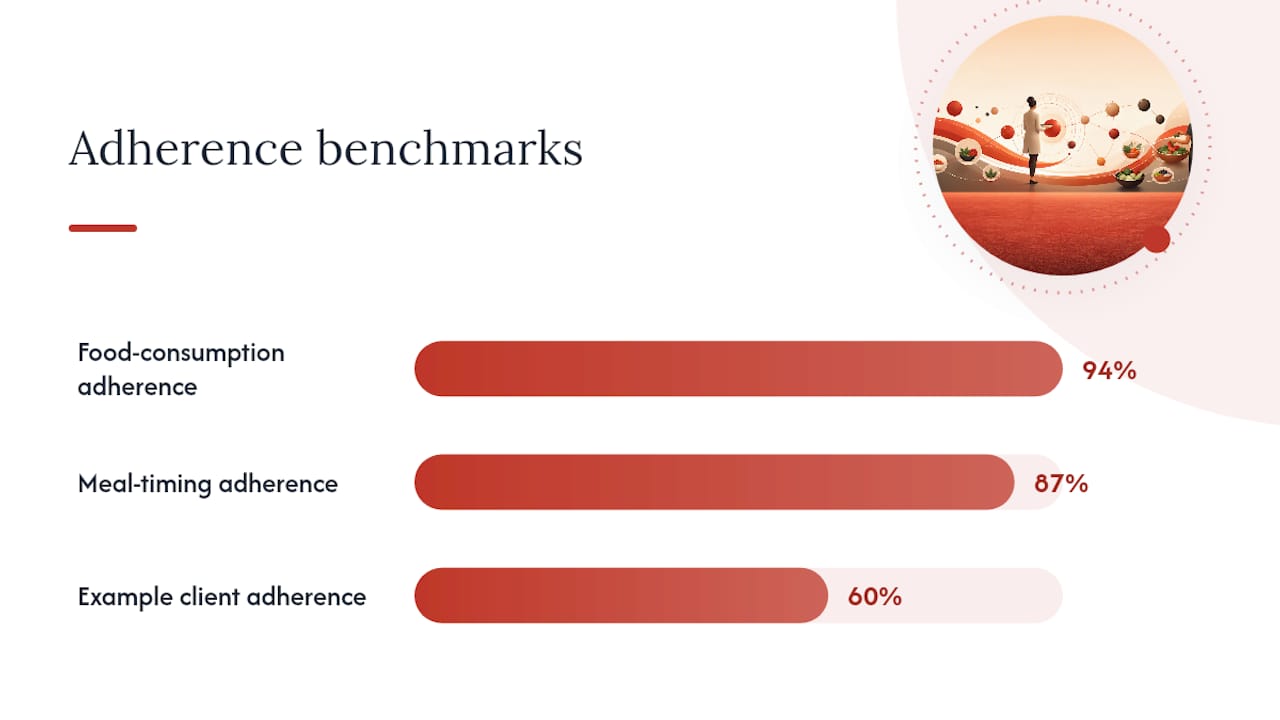
The same controlled-feeding trial gives a useful benchmark for how good “good” really is: participants achieved perfect meal-timing adherence on 87% of participant-days and perfect food-consumption adherence on 94% of participant-days over 12 weeks, in a population that had orientation sessions, permitted flexibility, and daily contact. That’s a ceiling worth knowing. If your client is at 60% and the trial’s best-supported participants topped out around 87 to 94%, you’re not dealing with a moral failure. You’re dealing with a gap in structure.
Which metric matters most depends entirely on the treatment goal. For weight loss, portion fidelity and total meal completion carry more weight than exact timing. For glucose control, timing and carbohydrate-matched substitutions matter more than hitting every single planned meal. For someone rebuilding a healthier eating pattern after years of takeout, meal completion and logging consistency, just showing up and writing it down, matter most in the early months. Pick the one or two metrics that map to the actual clinical goal, and don’t ask a client to track everything at once.
Find the Barriers Before You Write the Plan
The single biggest planning mistake clinicians make is writing a meal plan before finding out what’s actually going to derail it. A cohort study on people with type 2 diabetes found that structured barrier assessment cut reported barriers by 37% over two years, and that persistent, unaddressed barriers tracked with worse metabolic control throughout the follow-up period. Barrier work isn’t a soft add-on to the clinical plan. It is the clinical plan.
Barriers cluster into a handful of predictable domains: knowledge gaps, time scarcity, cost, eating away from home, motivation dips, physical access to food, social context, and medical complexity (multiple conditions, medications, or restrictions stacking on top of each other).
A five-minute intake can surface most of what you need. Ask these directly:
- On a typical weekday, how much time do you realistically have to cook dinner?
- How many meals a week do you eat somewhere you don’t control the ingredients?
- What’s your grocery budget, and does it change week to week?
- Who else eats with you, and do they eat differently than you’re planning to?
- What’s derailed a diet plan for you before, specifically?
- Do you know how to prepare the foods on this plan, or will some need a tutorial?
- What time of day does your motivation usually crash?
- Are there medical or medication timing issues that constrain when or what you eat?
Pro Tip: Ask question 5 first. A client’s history of what broke their last plan is the single most predictive piece of intake data you’ll collect, and it usually gets skipped in favor of collecting food preferences.
Barrier assessment isn’t a one-time form. Revisit it at week two and again at week six, because the barrier that mattered in week one (learning new recipes) is rarely the one that matters by week six (social eating, travel, or motivation fatigue).
Personalization, Implementation Intentions, and Permitted Flexibility
Personalization helps adherence, but only certain kinds of personalization. A systematic review of randomized controlled trials found that personalized nutrition advice often improves dietary intake compared with generalized advice, but the effect depends heavily on what’s being personalized and how the intervention is designed. Genotype-based personalization alone showed inconsistent adherence benefits across the trials reviewed. Personalizing around a client’s actual life, their schedule, budget, cooking skill, food preferences, and medical constraints, is where the evidence holds up.
What earns its place in a personalized plan:
- Food preferences and cultural eating patterns, not just macros
- Realistic time budgets for shopping and cooking
- Household grocery budget constraints
- Medical and medication-related timing requirements
- Existing kitchen equipment and cooking skill level
What tends to overpromise:
- Genetic or “phenotype” personalization marketed as the primary driver of adherence, with the underlying biological logic outpacing the adherence evidence
- Highly granular meal-by-meal customization that increases planning complexity without improving follow-through
The second lever that consistently moves adherence is the implementation intention, a simple if-then script that removes the decision-making burden at the exact moment willpower is weakest. Instead of telling a client “try to eat healthy at work lunches,” you write the specific rule with them: “If I’m at a work lunch with no prepped meal, then I order the grilled protein and a side salad instead of fries.” The formula is always the same:
If [specific trigger situation], then I will [specific pre-decided action].
Have clients fill in three to five of these for their highest-risk situations: the 3 PM energy crash, the unplanned dinner invitation, the day they oversleep and skip breakfast prep. Writing the substitution down in advance, before the disruption happens, is measurably more effective than hoping the client improvises well under stress.
The third lever is deliberate simplicity paired with permitted flexibility. Plans with rigid, zero-deviation rules look impressive on paper and collapse under real-life friction. The controlled-feeding trial that hit 94% adherence built permitted flexibility directly into the protocol rather than demanding rigid perfection. Protocols with a small number of portion rules and pre-approved swaps per meal are generally more sustainable and effective than highly detailed, rigid plans.
What Self-Monitoring and Feedback Can Realistically Do
Set expectations correctly here, because the evidence is real but modest, and overselling it sets clients up to feel like they’ve failed when the effect shows up smaller than promised. A meta-analysis of 26 randomized studies covering more than 21,000 participants found a standardized mean difference of 0.17 (95% CI 0.10 to 0.24) for remotely delivered self-monitoring or tailored feedback on dietary behavior.
A small but real effect: An SMD of 0.17 means self-monitoring and feedback nudge dietary behavior in the right direction, consistently, but modestly. It’s not the intervention that transforms adherence on its own. It’s one lever among several, and it works best stacked with barrier assessment and implementation intentions rather than deployed alone.
What should a client actually self-monitor? Keep the list short:
- Which planned meals were eaten versus substituted or skipped
- Portion sizes for calorie- or macro-sensitive goals
- What substitutions were used, so you can spot repeated patterns
- Timing, only if the clinical goal depends on it
Logging every single bite is a recipe for burnout within two weeks. A minimum viable frequency, logging main meals daily and reviewing weekly, captures most of the clinical signal without becoming its own burden.
Feedback cadence matters more than most clinicians assume. More frequent feedback tends to produce faster behavior change, but remotely delivered programs show a real trade-off: pushing feedback too often can raise dropout risk, particularly once the novelty wears off. Weekly feedback for the first month, tapering to biweekly once a client demonstrates consistency, tends to balance engagement against fatigue better than daily check-ins sustained indefinitely.
Digital Supports That Remove Friction, Not Just Add Features
Technology helps adherence only when it removes a specific point of friction. An eHealth behavior-support program that combined dietitian-led groups, text reminders, food delivery, and simple reporting tools improved both adherence and reporting consistency over a 10-week trial. The lesson isn’t “add an app.” It’s “add the specific digital feature that solves the specific barrier you found in intake.”
The features worth prioritizing:
- Reminders timed to the client’s actual risk windows (the 3 PM crash, the Sunday prep slot), not generic daily pings
- One-tap logging so recording a meal takes seconds, not a full food diary entry
- Shopping automation that turns a weekly plan into a grocery list automatically, cutting the planning tax that causes early drop-off
- Pantry-first planning that suggests meals based on what’s already stocked, reducing both cost friction and food waste
- Progress dashboards that show trend lines instead of single data points, so a bad day doesn’t read as failure
- Guided recipes with built-in timers that reduce the cognitive load of cooking something new
Human touchpoints still matter, and digital tools work better alongside them than in place of them. A brief coaching message or a short dietitian check-in at week two, when attrition risk peaks, and again at week six, when motivation typically dips, catches problems before they become dropout. Pantry-first planning and automated shopping lists address common friction points in meal planning: the gap between deciding to eat well and actually having the right food in the house.
A Multi-Level Metrics Dashboard You Can Actually Use
Measurement only helps if it points you to a fix. A single “compliant or not” label tells you nothing actionable; a short dashboard across distinct behaviors tells you exactly where to intervene.
- Planned meals consumed (as planned, substituted, or skipped): the top-line completion number, tracked weekly.
- Substitution fidelity: how often swaps matched the plan’s intent versus drifted from it.
- Portion fidelity: relevant for weight or calorie-sensitive goals; less so for pattern-based goals.
- Logging frequency: a proxy for engagement; a drop here often precedes a drop in everything else.
- Timing accuracy: only when the clinical goal depends on when meals happen.
Score each metric green, amber, or red rather than chasing a single composite percentage. Green means the behavior is stable and needs no intervention. Amber means it’s slipping and needs a conversation at the next visit. Red means it needs an immediate fix, usually a new implementation intention or a barrier you missed at intake. A client who’s green on meal completion but red on logging frequency needs a simpler tracking method, not a stricter meal plan.
Objective verification has a place when the clinical stakes are high enough to justify it: weigh-backs for portion-sensitive goals, or urinary biomarkers in research and some clinical settings. Both carry trade-offs in cost, invasiveness, and practicality, and neither replaces the behavioral dashboard for day-to-day coaching. Reserve them for cases where self-report accuracy genuinely matters to a medical decision, not as a default trust check on every client.
Why the First Two Weeks and Every Weekend Are High-Risk
Attrition doesn’t spread evenly across a meal plan’s timeline. It concentrates in the first two weeks, when new habits haven’t hardened yet, and it spikes every weekend, when routine breaks down and social eating takes over. Planning as though weekday behavior will simply carry through the weekend is one of the most common reasons a plan that looked solid on paper falls apart by week three.
An onboarding checklist that front-loads structure prevents most of this:
- A short orientation session explaining the plan’s logic, not just its rules
- One or two demonstration meals so unfamiliar recipes don’t become a barrier
- A written substitution protocol, decided in advance, for the three most likely disruptions
- At least three implementation intentions set before the plan starts, not after the first slip
- Minimal tech training so logging and shopping tools are second nature by day three
Pro Tip: Ask every client to name their specific weekend risk in week one, whether it’s restaurant meals, alcohol, or skipped prep, and write the substitution rule for it before the first weekend hits, not after it’s already gone sideways.
The weekend and travel playbook needs its own rules: pre-approved portable meals for days without kitchen access, two or three restaurant order defaults the client has already decided on, and an accountability pairing, a partner, friend, or scheduled check-in, that catches the drift before it compounds into a full week off-plan. Business travelers face a version of this same problem constantly, and the same principles apply: decide the rules before the disruption, not during it.
Copy-Ready Templates for Your Next Client Visit
You don’t need to build these from scratch every time. Three short templates cover most of what a first six weeks requires.
1. One-week sample structure. Plan four “anchor” dinners the client already knows how to cook, plus three flexible slots with two pre-approved substitutes each. Keep breakfast and lunch simpler and more repetitive than dinner. Shopping lists should map directly to the weekly plan, with batch-cooked components covering two or three meal-prep sessions rather than daily cooking from scratch.
2. Barrier-assessment and implementation-intention script. Use the eight intake questions from earlier in this article, then convert the top two barriers into if-then scripts on the spot, in the client’s own words. A script the client wrote themselves sticks better than one you hand them.
3. Minimal logging protocol. Ask the client to record three things daily: which meals were eaten as planned, any substitutions made, and a one-word mood or stress note. That’s it. Weekly, you review the log together and adjust one variable, never more than one, based on the pattern you see. A smart grocery list built directly from the weekly plan removes one more decision point between intention and action.
How the Evidence and Homecooked’s Feature Set Line Up
Every recommendation in this article maps to a specific piece of trial evidence, and most of them map to a specific product feature too. Pantry-first planning addresses the shopping friction that eHealth trials target directly. Automated shopping lists reduce the planning tax that drives early attrition in the first two weeks. Guided recipes with built-in timers lower the skill barrier that shows up repeatedly in barrier-assessment intake questions. Progress tracking gives clients and clinicians the multi-level dashboard this article recommends, rather than a single pass-fail number.
Homecooked’s personalized meal planning approach is built around the kind of personalization the evidence actually supports: preferences, schedules, and practical constraints, not biological claims the research doesn’t back yet. Clients working from templates like a heart-healthy week or a lower-sodium plan get the same structure this article recommends: a small set of anchor meals, pre-approved substitutions, and simple logging.
None of this replaces individualized clinical judgment. The strongest results come from clinicians who pair structured tools with their own assessment of a specific client’s barriers, medical history, and readiness.
The Psychology Behind Why Plans Succeed or Fail
Motivation is the least reliable input in the entire adherence equation, and clinicians who plan around it are planning around a moving target. Motivation fluctuates daily, sometimes hourly, in response to stress, sleep, and unrelated life events that have nothing to do with the meal plan itself. Self-efficacy, a client’s belief that they’re capable of executing the plan, predicts follow-through far more consistently than how motivated they feel on any given day.
Build self-efficacy through small, early wins rather than ambitious first weeks. A client who successfully completes a simplified plan in week one builds more durable follow-through than one handed an ambitious plan they abandon by Wednesday. Each completed implementation intention, each meal logged as planned, reinforces the belief that this particular plan is workable for this particular person.
Stress deserves specific attention because it interacts with eating behavior in ways that generic willpower advice ignores. Acute stress often triggers exactly the behaviors a meal plan is designed to prevent: skipped meals, impulsive substitutions, abandoned logging. Ask about a client’s typical stress triggers during intake, and build implementation intentions specifically for high-stress windows rather than assuming the same rules that work on a calm Tuesday will hold on a chaotic one.
Family, Work, and the Social Web Around Every Meal
No meal plan operates in isolation from the people a client lives and works with. A partner who eats differently, kids who won’t touch the new vegetables, or a workplace culture built around group lunches all shape adherence as much as anything written into the plan itself.
Household misalignment is one of the most underdiagnosed barriers in nutrition counseling. Ask directly during intake who else is present at meals and whether they’re eating the same food. A plan that requires cooking two separate dinners every night is a plan that will get abandoned within a month, not because the client lacks discipline, but because the logistics don’t scale.
Work environments create their own predictable pressure points: catered meetings, celebratory treats, and the social cost of visibly eating differently than colleagues. Clients rarely name this as a barrier unprompted, so ask about it specifically rather than waiting for it to surface as an unexplained slip.
The fix isn’t asking clients to isolate themselves from their social environment. It’s building implementation intentions that account for it: a default order at the team lunch spot, a way to bring a compatible dish to a family dinner, a script for declining office treats without friction. Clients who plan for the social reality of eating adhere longer than clients whose plans assume they eat every meal alone and in control of every ingredient.
Handling a Slip Without Letting It Become a Collapse
A missed meal or a bad weekend is not a relapse. Treating it like one, with guilt, restriction, or an overcorrected next day, is what turns a single slip into a genuine derailment. The research on barrier-focused interventions consistently shows that clients who plan for lapses in advance recover faster than clients who treat every slip as evidence the whole plan has failed.
Build a specific “recovery protocol” into every plan from day one: the very next planned meal is eaten as planned, full stop, with no attempt to compensate through skipped meals or extreme restriction. This single rule prevents the most common relapse spiral, where one missed dinner turns into a skipped breakfast the next day out of guilt, which then turns into an abandoned week.
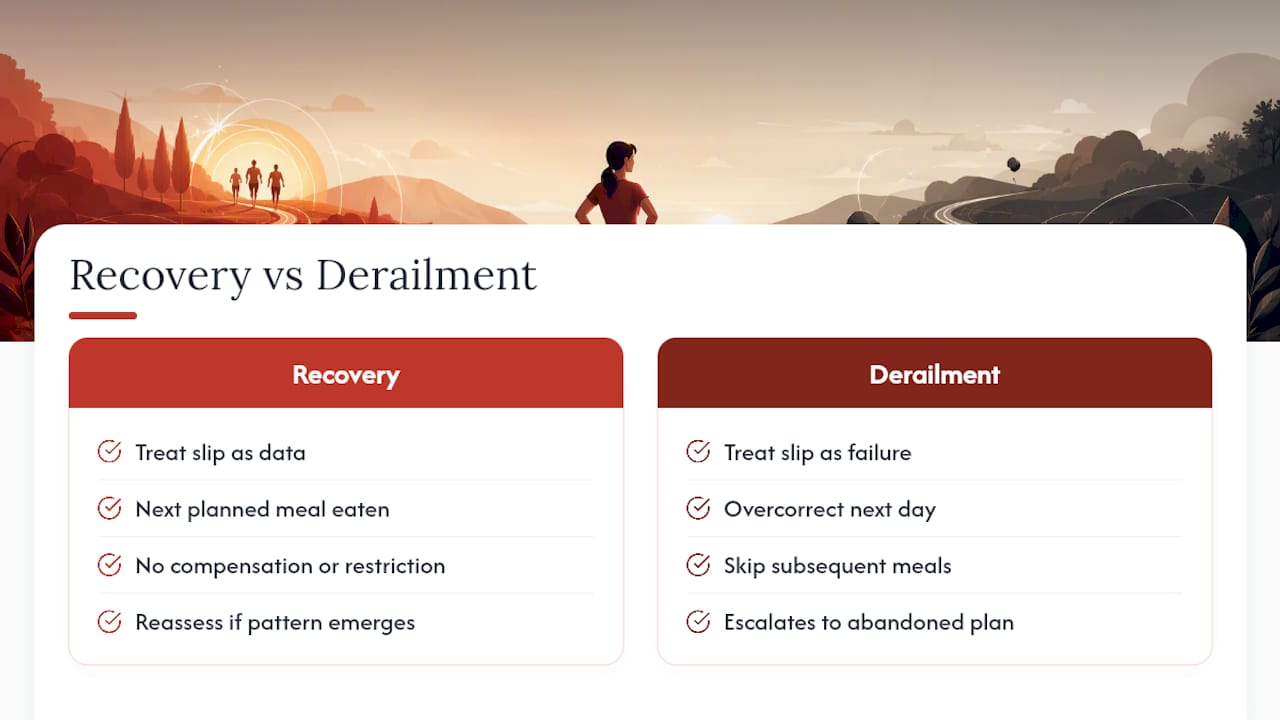
Distinguish a lapse from a pattern before reacting to either. One skipped dinner is a lapse; three skipped dinners in a row is a pattern worth revisiting at the next check-in, ideally with a barrier reassessment rather than a stricter plan. Reframe slips as data, not failure: a missed meal tells you exactly where the current plan’s structure has a gap, whether that’s an unaddressed barrier, a substitution that wasn’t specific enough, or an implementation intention that didn’t cover the actual situation that came up.
Why Adherence Is the Metric That Actually Predicts Outcomes
The best-designed meal plan produces zero clinical benefit if it isn’t followed. This sounds obvious stated plainly, but it’s the single most common gap between what clinicians prescribe and what actually shows up in follow-up bloodwork, weight trends, or glycemic control. The cohort study that reduced barriers by 37% over two years also found persistent barriers tracked directly with worse metabolic control, linking the behavioral variable to the biological outcome.
This is why barrier assessment and adherence tracking deserve as much clinical attention as macronutrient targets or calorie calculations. Adherence isn’t a secondary consideration layered on top of clinical nutrition science; it’s the mechanism through which any of that science reaches the patient at all.
This also reframes how to interpret a disappointing outcome. A client whose numbers didn’t move as expected after eight weeks isn’t necessarily a case of the wrong plan. Check adherence data first, using the multi-level dashboard from earlier in this article, before concluding the nutritional approach itself needs to change.
Building Plans Around Culture and Preference, Not Around Them
A meal plan that ignores a client’s cultural food patterns is asking them to adopt an entirely new relationship with eating on top of whatever health goal brought them in. That’s an unreasonable ask, and it shows up in the adherence data as early drop-off, particularly among clients whose cuisine or eating schedule doesn’t resemble the standard Western template most generic meal plans are built around.
The fix is straightforward in concept and requires real effort in practice: build the clinical target (sodium, carbohydrate distribution, protein targets) into the client’s existing cuisine rather than replacing that cuisine with a generic template. A lower-sodium approach to a South Asian household’s cooking looks different from a lower-sodium approach to a Southern U.S. household’s cooking, and both look different from a lower-sodium plan built around bland, unseasoned “diet food.”
Religious observance, fasting periods, and family meal structures also shape what’s realistic. A plan that doesn’t account for Ramadan, a client’s vegetarian household, or a family’s shared Sunday dinner tradition will collide with real life regardless of how sound the nutrition science behind it is. Ask about these patterns directly during intake rather than discovering them as an unexplained adherence gap three weeks in.
Keeping It Going Long After the Plan Feels Automatic
The strategies that get someone through the first six weeks aren’t automatically the strategies that keep them eating well a year later. Early adherence relies heavily on external structure: reminders, frequent check-ins, detailed logging. Long-term maintenance relies more on internalized habits and a plan flexible enough to survive without constant oversight.
The transition point usually shows up once a client has demonstrated several consecutive weeks of green scores on the adherence dashboard. That’s the signal to taper structure deliberately rather than by accident: reduce logging frequency, space out check-ins, and shift the client from following a detailed plan to running their own version of the implementation intentions they’ve internalized.
Build in periodic barrier reassessment even after the client has stabilized. Life circumstances change, jobs shift, households grow, and a maintenance plan that worked for a year can quietly stop fitting a client’s new reality. A brief quarterly check-in, even after active coaching has ended, catches drift before it becomes a full relapse into old patterns.
Where Clinicians Consistently Go Wrong
The biggest mistake I see in nutrition counseling is treating knowledge transfer as the intervention. Explaining what a healthy plate looks like isn’t the same as building the structure that gets a client to actually eat it three weeks from now, and plenty of well-informed clients still fail at follow-through because nobody addressed the logistics standing in their way.
The second mistake is over-indexing on personalization that sounds sophisticated but doesn’t move adherence. Genetic testing and phenotype-based customization make for a compelling pitch, but the evidence behind them is far thinner than the evidence behind boring fundamentals like implementation intentions and permitted flexibility.
The third mistake is ignoring the weekend. Clinicians build beautiful weekday structure and act surprised when a plan collapses on Saturday. It collapses because nobody planned for Saturday specifically.
Three fixes for your next visit: ask the barrier-reduction history question before you write a single meal, convert the client’s top barrier into a written if-then script before they leave your office, and build one explicit weekend rule into every plan from day one. Then measure, don’t guess, and adjust one variable at a time based on what the dashboard actually shows you.
— 0xmaglev
Put This Playbook to Work With Homecooked
Some digital tools integrate strategies from this article into one platform to help clients manage meal planning more easily. Features include pantry-first planning to reduce shopping friction, automated shopping lists to decrease planning burden, guided recipes with built-in timers to assist cooking skills, and multi-level progress tracking to provide detailed adherence views beyond a single pass-fail number.
If you’re a clinician looking to hand clients a tool that matches the structure you’re already building into their plan, or a nutrition client ready to put a personalized week into practice, start by exploring a sample week and its guided steps, like this cottage cheese protein bowl, to see how the timers and tracking work in practice. Then set up a full week through Homecooked and see how much of the friction disappears when the shopping list, the recipe steps, and the tracking all live in one place.
This article is general information, not a substitute for advice from a qualified doctor. Consult a qualified healthcare professional about your own circumstances before acting on anything here.
Sources
- Adherence to Diet and Meal Timing in a Randomized Controlled Feeding Study of Time-Restricted Feeding
- Systematic review and meta-analysis of remotely delivered interventions using self-monitoring or tailored feedback to change dietary behavior
FAQ
What does meal plan adherence mean?
Meal plan adherence means consistently following the eating pattern a plan specifies, measured across several distinct behaviors: eating the planned meal or an approved substitute, matching portion sizes, hitting meal timing when clinically relevant, and logging behavior consistently. A controlled-feeding trial showed adherence can reach 94% of participant-days for food consumption when the plan builds in flexibility and support rather than demanding rigid perfection.
What is the 3-3-3 rule for meals?
Definitions of the 3-3-3 rule vary across sources, and no standardized clinical version appears in the adherence research this article draws on. Rather than apply an unverified rule, focus on the evidence-backed approach covered here: three or four anchor meals you already know how to cook, paired with two or three pre-approved substitutions for flexible slots.
What is the number one vegetable to lower blood pressure?
No single vegetable qualifies as a universal top choice in the adherence and nutrition research reviewed for this article, and blood pressure management depends on overall dietary pattern rather than one food. A qualified clinician can help translate a sodium-conscious eating pattern into specific food choices that fit a client’s cultural preferences and medical history.
What are 10 guidelines for meal planning?
There’s no single canonical “10 guidelines” list in the clinical adherence literature, but the practices with real evidence behind them include: barrier assessment before writing the plan, personalizing around lifestyle rather than biology alone, building implementation intentions for high-risk moments, permitting flexibility instead of rigid rules, keeping portion and substitution rules simple, planning explicitly for weekends and travel, logging a small set of behaviors rather than everything, reviewing a multi-level metrics dashboard weekly, treating slips as data rather than failure, and tapering structure gradually once adherence stabilizes.
How does Homecooked help improve meal plan adherence?
Homecooked’s pantry-first planning, automated shopping lists, and guided recipes with built-in timers directly target the friction points, shopping, planning, and cooking skill, that research on eHealth support programs links to improved adherence. Pricing details are available on the Homecooked site.