
A printable 7-day meal plan paired with a grocery list grouped by store section is the fastest way to shop and cook for a week without backtracking, forgetting items, or buying things you already own. Below you’ll find a ready-to-use weekly menu, a print-friendly shopping checklist organized by Produce, Dairy, Meat & Seafood, Grains & Bread, Canned Goods, Frozen, and Condiments & Spices, plus a pantry staples checklist. Building this list manually typically takes 15–30 minutes for a full week of meals. Automation can reduce this time by about 95%, making list creation much faster compared to manual methods. Homecooked automates the entire process so you can export or print your personalized meal plan grocery list in one click.
Table of Contents
- Your ready-to-print weekly meal plan and grocery list
- How do you turn a weekly menu into a grocery list?
- How to organize your grocery list for a fast shopping trip
- Quick leftover re-do ideas that shrink next week’s list
- How do you scale a meal plan for 1 person, a couple, or a family?
- What does an app do that a spreadsheet can’t?
- Key Takeaways
- Why the printable approach actually works
- Homecooked makes your weekly grocery list automatic
- Useful sources and templates
Your ready-to-print weekly meal plan and grocery list
Here’s a practical 7-day dinner-focused menu you can use right now. Two nights are intentionally flexible so you can use leftovers, order in, or swap based on what’s in your fridge. For dietary swaps, see the notes below the table.

Sample 7-day dinner menu
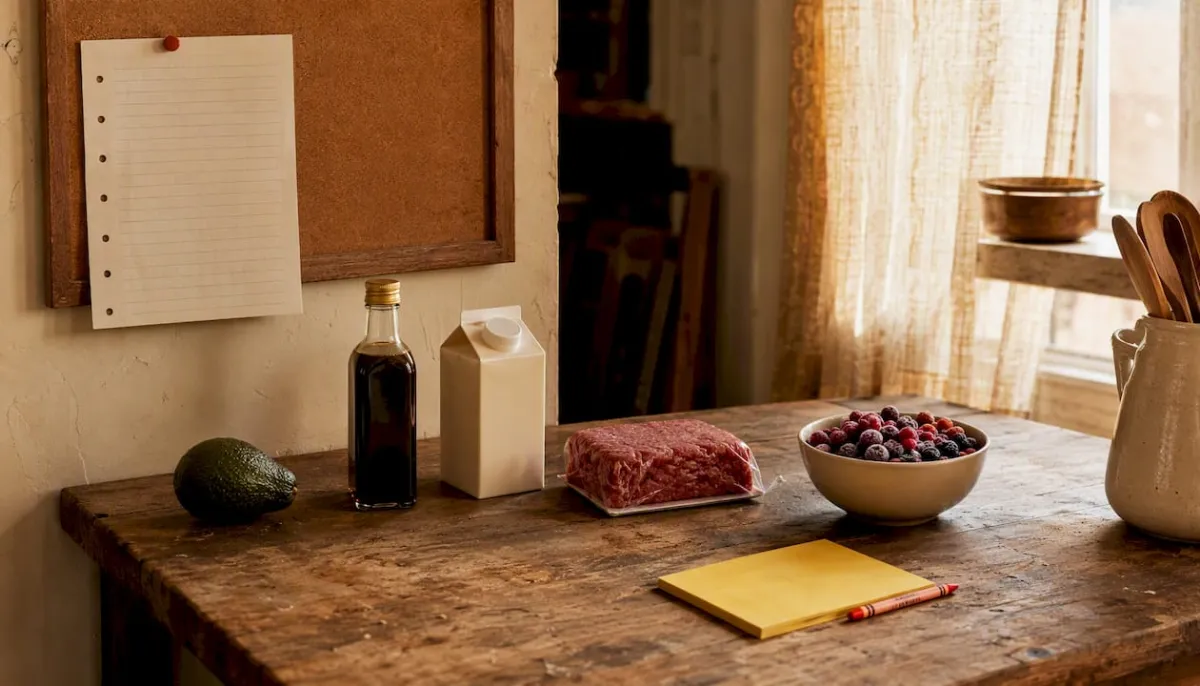
| Day | Dinner | Notes |
|---|---|---|
| Monday | Sheet-pan lemon herb chicken thighs + roasted broccoli | Gluten-free as written |
| Tuesday | Spaghetti with turkey meat sauce | Sub GF pasta for gluten-free |
| Wednesday | Black bean tacos with avocado and salsa | Vegetarian; sub corn tortillas for GF |
| Thursday | Salmon with garlic butter + steamed rice | Dairy-free if you skip the butter |
| Friday | Flexible night (leftovers or takeout) | |
| Saturday | One-pot chicken and vegetable soup | Use leftover chicken from Monday |
| Sunday | Flexible night (pantry clean-out or pantry staple recipes) |
Vegetarian swap: Replace chicken and turkey with chickpeas, lentils, or extra-firm tofu across Monday, Tuesday, and Saturday. Gluten-free swap: Use GF pasta and corn tortillas; all other meals are naturally GF.
Print-friendly grocery list by store section
Printable lists are most effective when paired with a pantry checklist so you can deselect items you already own before printing.
| Section | Items |
|---|---|
| Produce | Broccoli (1 large head), lemons (2), garlic (1 bulb), avocado (2), salsa (fresh, 1 jar), carrots (3 medium), celery (3 stalks), yellow onion (2) |
| Dairy | Butter (1 stick), shredded cheddar (optional, 1 bag) |
| Meat & Seafood | Chicken thighs (2 lb), ground turkey (1 lb), salmon fillets (1.5 lb) |
| Grains & Bread | Spaghetti (1 lb), white or brown rice (1 bag), corn or flour tortillas (1 pack) |
| Canned Goods | Black beans (2 cans), diced tomatoes (1 can), chicken broth (32 oz carton) |
| Frozen | None this week |
| Condiments & Spices | Olive oil, Italian seasoning, cumin, chili powder, garlic powder, salt, pepper |
Pantry staples checklist (check before buying): olive oil, salt, pepper, garlic powder, cumin, Italian seasoning, chili powder.
To print: Select the table above, paste into a Google Doc or Word file, and print. Homecooked’s export feature generates this format automatically from your chosen recipes.
How do you turn a weekly menu into a grocery list?
Three steps cover it every time: choose your recipes, extract and consolidate ingredients, then group everything by store section and cross-check your pantry.
-
Choose your recipes. Pick 5–7 dinners for the week, including at least one flexible night. Weekly meal planning resources can help you build a balanced mix of proteins, vegetables, and grains without repeating the same flavors back to back.
-
Extract and consolidate ingredients. Write out every ingredient from every recipe. Then merge duplicates: if Monday’s chicken needs 1 tsp garlic powder and Wednesday’s tacos need ½ tsp, your list shows 1½ tsp total. Smart tools parse quantities and units automatically, normalizing “1 cup” and “8 oz” of the same ingredient into one accurate total. You can also paste recipe URLs into a generator to extract and consolidate ingredients from multiple recipes at once.
-
Group by store section and check your pantry. Sort your consolidated list into Produce, Dairy, Meat, Pantry, Frozen, and Condiments. Before you finalize, run through your pantry staples checklist and remove anything you already have.
Pro Tip: Keep a running “pantry staples” note on your phone (olive oil, common spices, canned beans). Cross-reference it before every shop so your weekly list only includes what you actually need to buy, not what’s already on the shelf.
How to organize your grocery list for a fast shopping trip
Sorting your list by store sections — Produce, Dairy, Meat, Pantry, Frozen, Condiments — lets you move through the store in one clean pass without doubling back. Most grocery stores follow a predictable perimeter-to-center layout: fresh produce and meat line the walls, while canned goods and grains fill the center aisles.
Two alternative approaches are worth knowing. For grocery delivery orders, organizing by meal rather than by aisle makes it easier to substitute items per dish if something is out of stock. For stores with unusual layouts, you can reorder sections to match your specific store’s flow.
| Organization method | Best for | Example |
|---|---|---|
| By store section | In-store shopping | Produce → Dairy → Meat → Pantry → Frozen |
| By meal | Delivery orders | Monday dinner items grouped together |
| By store aisle | Regulars at one store | Aisle 3 (pasta), Aisle 7 (canned goods) |
Quantity notation matters. Write “1 lb ground turkey” rather than “some turkey” so you grab the right package size without guessing. Flag perishables like fresh fish and leafy greens with an asterisk (*) to remind yourself to cook those earlier in the week before they turn.
Pro Tip: Add a “Frozen” section last on your list so you pick up frozen items right before checkout. They stay cold longer and won’t thaw while you finish the rest of your shopping.
Quick leftover re-do ideas that shrink next week’s list
Repurposing leftovers is one of the most practical meal planning tips you can use. It cuts ingredient duplication across two weeks and reduces food waste without requiring a second full plan.
- Roasted chicken thighs (Monday) → Saturday soup. Pull the meat off the bone, toss it into broth with carrots, celery, and onion. No extra protein purchase needed.
- Roasted broccoli → grain bowl. Combine with leftover rice, a fried egg, and soy sauce for a fast Tuesday lunch.
- Extra rice (Thursday) → fried rice. One cup of day-old rice, two eggs, frozen peas, and soy sauce makes a complete meal in under 10 minutes.
- Leftover taco filling → burrito bowl. Spoon Wednesday’s black beans and salsa over rice with shredded cheese.
For storage, label containers with the dish name and date using masking tape and a marker. When you sit down to plan next week’s menu, check those labels first. Anything still good becomes a built-in flexible night, which means fewer items on the next shopping list.
For holiday weeks when leftovers pile up fast, holiday meal prep strategies can help you plan repurposing in advance rather than scrambling after the fact.
How do you scale a meal plan for 1 person, a couple, or a family?
Use simple multipliers based on the number of servings you need, then round to the nearest sensible package size to avoid waste.
| Household size | Multiplier | Practical example |
|---|---|---|
| 1 person | — | 1 lb chicken thighs instead of 2 lb |
| Couple (2) | 1x | Recipe as written (most serve 2) |
| Family of 2 | 2x | 2 lb salmon; buy a 2 lb fillet or two 1 lb packs |
| Family of 2+ with leftovers | — | Round up to nearest pack size |
When scaling up, round ingredient totals to match typical package sizes — if a recipe calls for 1.2 lb of ground turkey and it’s sold in 1 lb or 1.5 lb packs, buy the 1.5 lb pack and freeze the extra. For singles, single-serve packs cost more per ounce but prevent spoilage, which often saves money overall. Bulk packs make sense when you’re planning repeat meals or freezing portions for the following week.
Converting recipe units to store units is simpler than it sounds: 2 cups of dry rice equals roughly one 16 oz bag; 3 cups of chicken broth is one standard 32 oz carton with some left over.
What does an app do that a spreadsheet can’t?
A good meal planning app automates the three steps above in seconds: it extracts ingredients from recipes, merges duplicates, calculates totals, and groups everything by store section. Some tools generate a full 7-day plan plus a grouped grocery list in under a minute after you enter your family size, dietary restrictions, and budget.
Homecooked goes further than a static template. It builds your personalized meal plan based on your health goals and dietary preferences, then generates a pantry-aware grocery list automatically. Key features relevant to this workflow:
- Automated grocery lists generated directly from your weekly meal plan, with duplicates merged and quantities calculated
- Pantry tracking so items you already own are excluded before the list is finalized
- Dietary preference filters for vegetarian, gluten-free, low-carb, and other needs, applied across the whole plan
- Print and export options including one-click copy, print-ready formatting, and push to grocery delivery services
- Step-by-step guided recipes with integrated timers so the cooking side is as organized as the shopping side
Automation cuts list-building time dramatically. Manual list creation for a full week typically takes 15–30 minutes, but automated extraction is about 95% faster than doing it by hand. For a deeper look at apps that sync meal plans with grocery lists, the Homecooked blog covers the key features to look for.
Key Takeaways
A printable meal plan grocery list paired with a 3-step workflow and store-section grouping is the most reliable way to shop for a full week without waste or repeat trips.
| Point | Details |
|---|---|
| Use the sample 7-day menu | Print or copy the dinner plan above; swap proteins or grains for vegetarian or gluten-free needs. |
| Follow the 3-step workflow | Choose recipes, consolidate ingredients, then group by store section and check your pantry. |
| Group by store section | Sorting into Produce, Dairy, Meat, Pantry, Frozen, and Condiments enables a single in-store pass. |
| Scale with multipliers | Use — for one person, 1x for two, 2x for four; round to the nearest package size and freeze extras. |
| Use Homecooked to automate | Homecooked generates a pantry-aware, print-ready grocery list from your personalized meal plan in one click. |
Why the printable approach actually works
Most meal planning advice focuses on what to cook. The friction isn’t the recipes — it’s the gap between a menu and a usable shopping list. When that gap is closed before you leave the house, the whole week runs more smoothly. A grouped, print-ready list removes the in-store decision-making that leads to forgotten items and impulse buys.
The combination of a fixed weekly menu and a pre-sorted grocery list also reduces decision fatigue at the store. You’re not scanning a disorganized list and trying to remember which aisle carries tahini. You move section by section, check items off, and you’re done. Leftovers become planned ingredients rather than forgotten containers. The pantry checklist means you stop buying the third jar of cumin.
What makes this repeatable is the workflow, not the specific recipes. Once you’ve done it two or three times, building next week’s list takes just a fraction of the original time—about 95% faster with automation compared to manual methods.
Homecooked makes your weekly grocery list automatic
Skip the spreadsheet. Homecooked builds your personalized weekly meal plan based on your health goals and dietary preferences, then generates a print-ready, pantry-aware grocery list automatically. Every item is grouped by store section, duplicates are merged, and anything you already own is excluded before you print or export.
You get the same organized, section-sorted list shown in this article, updated every week to match your plan, without rebuilding it from scratch. Try the cottage cheese protein bowl as your first recipe, or start your free trial at Homecooked and let the app generate your first full week’s plan and grocery list today.
Useful sources and templates
- Food Shopping and Meal Planning — Nutrition.gov: USDA-backed guidance on building a healthy weekly shopping list
- SNAP-Ed Seasonal Produce Guide: Free USDA resource for choosing in-season produce to lower costs
- SNAP-Ed Healthy Thrifty Holiday Menus: Budget-friendly holiday meal templates with printable grocery lists
- NHLBI Smart Food Shopping Guide: Heart-healthy shopping tips organized by store section
- VA Weekly Meal Planner, Grocery List and Recipes (PDF): Printable weekly planner template with a built-in grocery list
- Homecooked: Weekly Meal Planning Made Easy: Templates and strategies for building a repeatable weekly plan
- Homecooked: Build a Smart, Zero-Waste Grocery List: Step-by-step guide to converting any meal plan into a waste-reducing shopping list
- Homecooked: Vegetarian Meal Planning — 7-Day Guide: A complete vegetarian weekly template with shopping notes