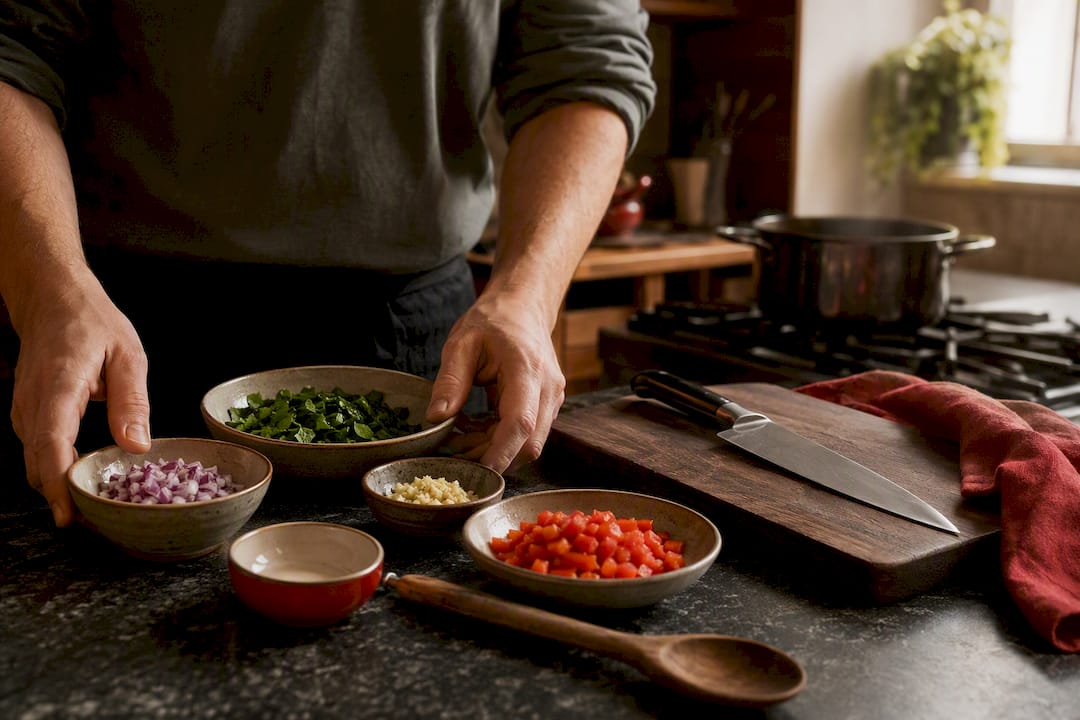
Mise en place means “everything in its place” — you prep your ingredients and tools before you turn on the heat, so cooking becomes calmer, faster, and far less error-prone. It’s both a system and a mindset: chop, measure, and arrange first, cook second. Start applying it tonight and you’ll notice the difference by your second bite.
TL;DR:
- Reading the entire recipe before starting helps prevent ingredient omissions and sets a clear prep plan, saving time and reducing mistakes.
- Grouping ingredients in a single bowl for simultaneous addition minimizes dish clutter and cuts dishwashing by more than half.
- Using inexpensive containers like deli cups or thrifted bowls is sufficient, as the process relies on sequencing rather than specialized gear.
- For weeknight meals, prepping in 10 to 15 minutes with 3 to 5 bowls is usually enough, while pastry requires 20 to 30 minutes of precise scaled and labeled ingredients.
- Building mise en place as a habit should begin with reading the recipe first, then gradually incorporating prep tools and organization once this core step becomes consistent.
Table of Contents
- What Mise En Place Means (And How to Say It)
- Why Mise En Place Matters for Home Cooks and Pros Alike
- A Simple 5-Step Mise En Place Workflow to Follow
- Tools and Low-Cost Container Options for Mise En Place
- Common Mistakes Beginners Make (And How to Fix Them)
- Two Mise En Place Examples: Weeknight Dinner vs. Pastry
- How Homecooked Builds Mise En Place Into Your Routine
- Put Mise En Place to Work Tonight
- The Real Value of Mise En Place Isn’t the Bowls
- Sources
What Mise En Place Means (And How to Say It)
You pronounce it meez-ahn-plahs, and once you say it out loud a few times it sticks. The phrase functions as a noun (“my mise is ready”), a verb (“mise your station”), and honestly, a state of mind you carry into any cooking task, big or small.
The concept traces back to the brigade system that Auguste Escoffier formalized in French professional kitchens, where each station chef prepped their own ingredients before service began. That structure still shapes how culinary schools teach the technique today: organize your ingredients, tools, and workstation before cooking starts, full stop. It’s not a fancy flourish. It’s the difference between a kitchen that runs and one that scrambles. Home cooks inherited the same logic, just scaled down to a single burner and a much smaller crowd to feed.
Why Mise En Place Matters for Home Cooks and Pros Alike
In professional kitchens, mise en place keeps service moving. A line cook with prepped components can plate a dish in minutes because nothing gets searched for mid-order. Pastry kitchens lean on it even harder, since baking punishes improvisation. Ingredients get scaled, labeled, and temperature-checked before a single bowl gets mixed.
At home, the payoff looks different but matters just as much. You avoid the classic disaster of garlic burning in the pan while you’re still dicing onion for the same dish. You stop discovering, three steps into a recipe, that you’re out of an ingredient you assumed was in the pantry. Mise en place shifts your attention from scrambling to technique, which is where the actual cooking skill lives. It also just feels better. Less panic, more rhythm, and a kitchen that smells like dinner instead of anxiety.
A Simple 5-Step Mise En Place Workflow to Follow
Restaurant kitchens and home-cook guides converge on roughly the same sequence, whether you’re making a fifteen-minute stir-fry or a weekend braise. Here’s the version worth memorizing:
- Read the recipe start to finish. Not skim. Read it, including the parts you think you already know. This is where you catch the “marinate for 2 hours” step before it’s too late.
- Pull every ingredient and tool, and check for gaps. Line everything up on the counter. If something’s missing, you find out now, not when the pan is already hot.
- Do all your chopping and prep before any heat goes on. Dice, mince, slice, peel. Get it all done while the stove is cold and you’re not racing a burner.
- Pre-measure liquids, spices, and sauces into small bowls or ramekins. Soy sauce, stock, cornstarch slurry, whatever the recipe calls for, portioned and ready to dump in on cue.
- Arrange everything near the stove in the order you’ll use it. Left to right, first to last. This alone eliminates most of the “wait, where did I put the…” moments.
Home-cook guides estimate this whole routine runs about 10 to 20 minutes for a typical weeknight recipe. That’s a small upfront cost for a meal that comes together without a single frantic moment.
Tools and Low-Cost Container Options for Mise En Place
You don’t need a rack of matching stainless bowls to do this right. The habit matters more than the gear, and plenty of budget options do the job just as well as anything sold as “prep bowls.”
- Small ramekins or custard cups for spices, minced garlic, and sauces
- Standard measuring cups for anything liquid
- A sheet pan as a portable mise tray, so you carry everything to the stove in one trip instead of five
- Reused deli containers or yogurt tubs, washed and repurposed
- Mismatched thrifted bowls, which work exactly as well as retail sets
Grouping ingredients that hit the pan at the same moment into a single bowl also cuts your dish pile dramatically. If you’re rethinking your drawer setup while you’re at it, Cozee Bay’s guide to organizing cooking utensils has some genuinely useful, low-waste ideas for keeping tools accessible without buying new organizers.
Common Mistakes Beginners Make (And How to Fix Them)
The single biggest mistake is chopping while something’s already cooking. You turn your back on the pan for thirty seconds to dice an onion, and that’s exactly when the garlic goes from golden to bitter. Do all your cutting cold, before the burner is on.
The second mistake is not checking your ingredient list until you’re halfway through a recipe. Read it fully, then gather everything, before you touch a knife.
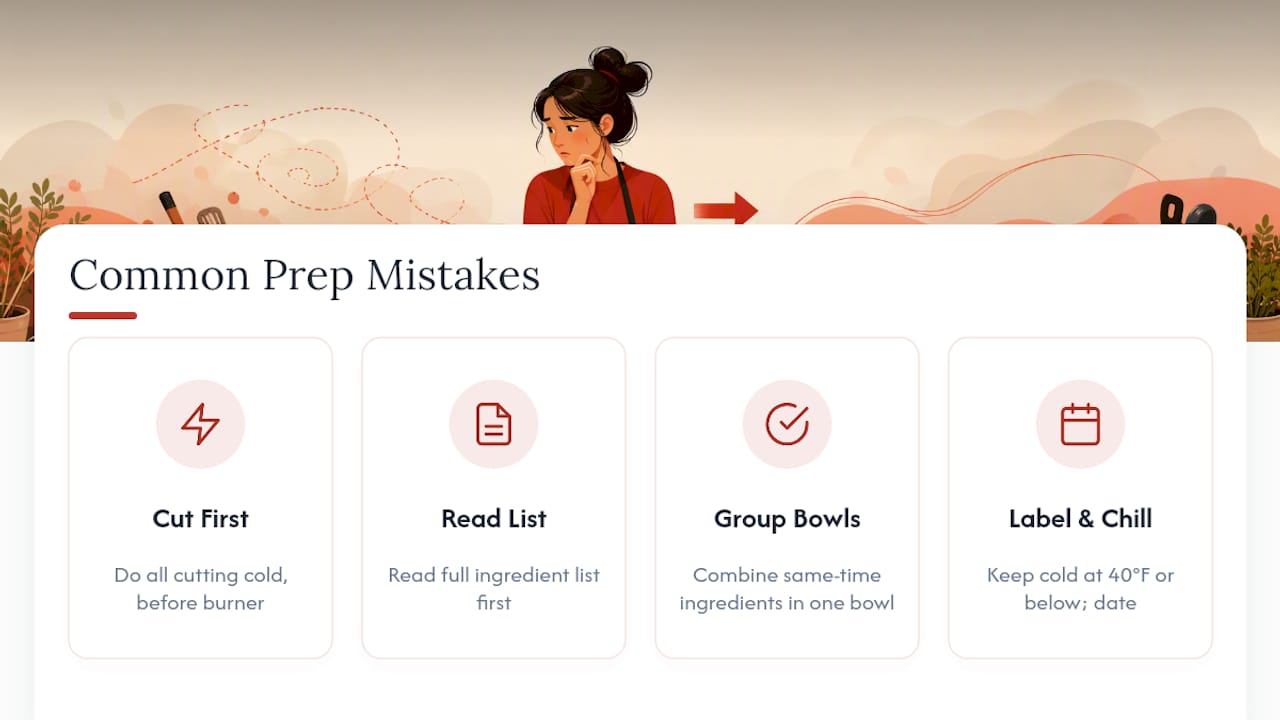
Pro Tip: Group ingredients that go into the pan at the same time into one shared bowl instead of five separate ones. It cuts your dishwashing load by more than half and keeps your prep station from looking like a chemistry set.
Labeling matters more than beginners expect, too. If you’re prepping components ahead for later in the week, refrigeration and labeling guidance recommends keeping cold items at 40°F or below and dating containers so nothing gets forgotten in the back of the fridge.
Two Mise En Place Examples: Weeknight Dinner vs. Pastry
A weeknight chicken stir-fry needs modest mise. You’re looking at three to five small bowls: one for diced chicken, one for chopped vegetables, one for minced garlic and ginger, one for the sauce mixture already combined. Total prep time runs about 10 to 15 minutes. Group your aromatics together since they hit the pan first, and keep the sauce separate since it goes in last.
Pastry mise looks stricter. A layer cake or laminated dough demands scaled, labeled components, since a missed ingredient or wrong temperature can ruin the whole bake. Butter needs to hit a specific temperature. Flour gets weighed, not scooped. Expect 20 to 30 minutes of setup before you touch a mixer.
- Weeknight skillet: 3 to 5 bowls, 10 to 15 minutes, group by cooking order
- Pastry: scaled and labeled ingredients, temperature checks, 20 to 30 minutes
When you’re genuinely short on time, simplify. Combine bowls where the order doesn’t matter, and save the full ceremony for dishes where precision actually pays off.
How Homecooked Builds Mise En Place Into Your Routine
Personalized meal plans can help reduce one of the most common mise failures before it happens: discovering a missing ingredient mid-recipe. Because each plan generates its own smart grocery list, your pantry check basically happens automatically, days before you cook.
The app’s guided recipes map directly onto the 5-step workflow above, with built-in timers that flag when to prep the next component while something else is already cooking. That’s the same logic behind parallel cooking with step timers and the smart recipes built into the platform. If you’re working from whatever’s already in your fridge, the recipes-by-ingredient tool helps you build a mise around what you actually have on hand.
Put Mise En Place to Work Tonight
Homecooked’s guided recipes build the prep sequence right into the cooking flow, with timers that tell you exactly when to chop, measure, or start the next component. The cottage cheese protein bowl recipe is a solid place to practice the habit, since its short ingredient list makes the five-step workflow easy to feel out before you try it on something more ambitious.
The Real Value of Mise En Place Isn’t the Bowls
Most advice on this topic obsesses over gear, matching prep bowls, fancy organizers, labeled spice tins, when the actual leverage is entirely behavioral. The Kitchn’s own reporting backs this up: cheap deli containers and thrifted dishes work exactly as well as anything sold specifically for mise, because the value sits in the sequencing, not the vessel.
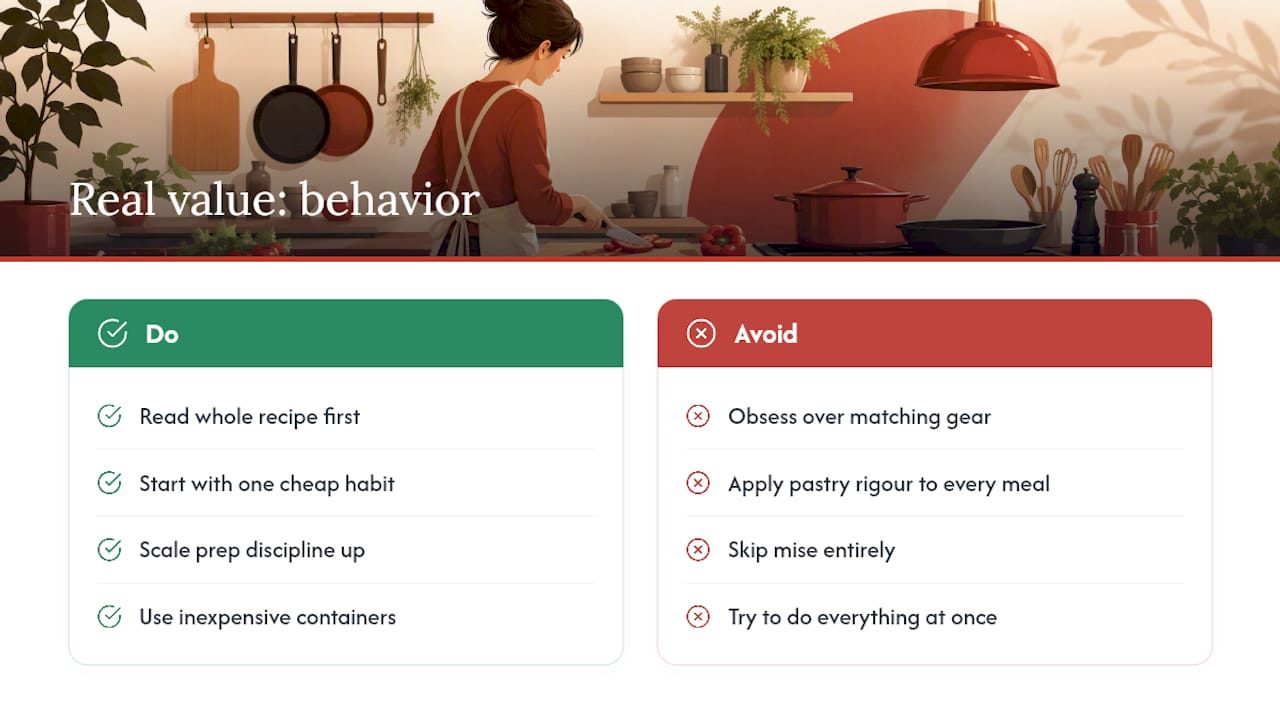
Where conventional advice falls short is treating mise en place as an all-or-nothing ritual. Pastry demands the full, rigorous version, scaled, labeled, temperature-checked. A Tuesday stir-fry does not. Beginners who try to apply pastry-level discipline to every dinner burn out on the habit within two weeks. Beginners who skip it entirely burn their garlic instead.
Start with the one habit that costs nothing and prevents the most damage: read the whole recipe before you touch a knife. Everything else, the bowls, the labeling, the sheet-pan tray, is optimization you can add once that single habit sticks. Prep discipline scales down far more easily than it scales up from zero.
— 0xmaglev
Sources
For the historical and professional grounding behind the technique, the Auguste Escoffier School’s breakdown covers how mise en place shapes both savory service and pastry precision. For a home-cook-focused walkthrough with practical container advice, The Kitchn’s guide is worth bookmarking. If you want a full step-by-step aimed squarely at weeknight cooking, WhatsInThePan’s guide lays out timing expectations clearly.
- Techniques every cook should know | Auguste Escoffier School of Culinary Arts
- Mise in Place Is the Restaurant Technique Every Home Cook Should Know | The Kitchn
- Mise en Place for Home Cooks (Step‑by‑Step Guide) | WhatsInThePan