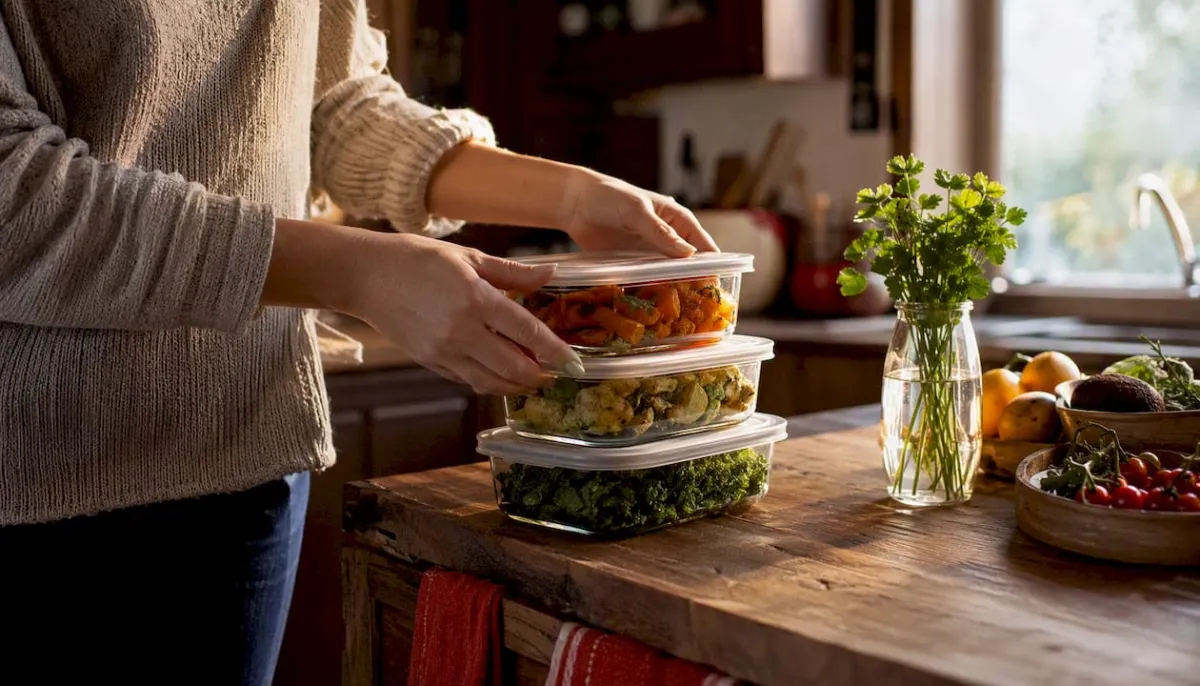
Five habits can cut your household food waste starting this week: plan meals before you shop, check your fridge and pantry first, store food in the right spot, cook or repurpose what’s about to turn, and freeze anything you won’t eat in time. The EPA estimates a family of four wastes roughly $1,500–$3,000 worth of food every year. That’s not a rounding error. It’s a car payment, a vacation, or three months of groceries.
Here’s your five-habit starter list:
- Plan meals for the week before you write a single item on your shopping list.
- Inventory first — open the fridge and pantry before you shop, every time.
- Store food correctly — right temperature, right container, right shelf.
- Rescue and repurpose — wilted greens, soft fruit, and stale bread all have a second life.
- Freeze and label — if you won’t eat it in two days, freeze it tonight with a date on the container.
Start this Sunday: block 30 minutes, take a full inventory, plan five dinners, and write your list from what you already have. Homecooked can automate the meal plan and shopping list so that routine takes ten minutes instead of thirty.
Key Takeaways
The most effective way to reduce food waste at home is to combine a weekly meal plan with correct storage, a freeze-first habit, and a clear understanding of what date labels actually mean.
| Point | Details |
|---|---|
| Weekly Sunday routine | A 30–60 minute inventory, meal plan, and prep session makes waste reduction automatic. |
| Freeze surplus immediately | Label with date and contents; freeze anything you won’t eat within two days. |
| Date labels signal quality, not safety | Check smell, texture, and appearance before discarding — most “expired” food is still safe. |
| Store food in the right spot | Keep the fridge at or below 40°F; use humidity drawers correctly; practice FIFO. |
| Homecooked automates the routine | Homecooked syncs your meal plan to a shopping list and pantry tracker, cutting overbuying at the source. |
Table of Contents
- Why does food waste cost you so much money?
- Where and how to store food so it actually lasts
- How to manage leftovers and freeze surplus safely
- What do date labels actually mean for food safety?
- A simple weekly routine to cut down on food waste for good
- Small habits compound faster than you think
- Homecooked makes this routine take minutes, not hours
- Useful sources and tools
Why does food waste cost you so much money?
About 30–40% of the U.S. food supply is thrown out each year, equal to roughly 133 billion pounds. At the household level, that translates directly to the $1,500–$3,000 annual figure above. Beyond the wallet hit, food rotting in landfills generates methane, a greenhouse gas far more potent than carbon dioxide over a short time horizon. The FAO notes that if food waste were a country, it would rank third globally for greenhouse gas emissions.
The good news: the same habits that shrink your grocery bill also shrink your carbon footprint. Planning what you’ll eat, storing it properly, and freezing the surplus are the three moves that do the most work. None of them require special equipment or a lifestyle overhaul.
Where and how to store food so it actually lasts
Correct storage prevents most early spoilage before a single bite is wasted. Keep your refrigerator at or below 40°F — the USDA identifies this as the threshold that slows bacterial growth. Raw proteins go on the lowest shelf to prevent drip contamination. Condiments and drinks belong in the door, where temperature fluctuates most. Delicate herbs last longer standing upright in a small glass of water, loosely covered, like a bouquet on your counter or in the fridge.
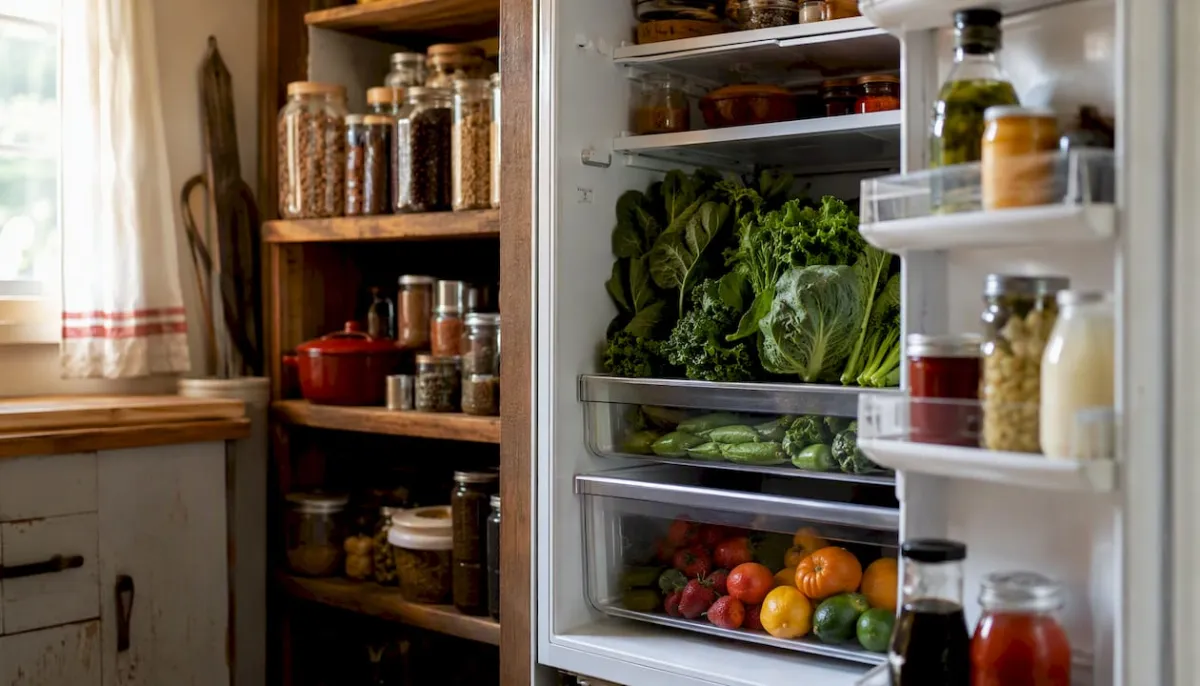
The humidity drawers matter more than most people realize. High-humidity drawers suit leafy greens and herbs; low-humidity drawers suit fruits that emit ethylene gas (apples, pears, stone fruit). Keep ethylene-sensitive produce — berries, broccoli, leafy greens — away from ethylene producers to avoid premature ripening.
| Food | Best storage location | Approximate shelf life |
|---|---|---|
| Leafy greens | High-humidity fridge drawer | 3–7 days |
| Berries | Fridge, unwashed | 3–5 days |
| Root vegetables (carrots, beets) | High-humidity fridge drawer | 2–4 weeks |
| Potatoes and onions | Cool, dark pantry (separate) | 2–4 weeks |
| Dairy (milk, yogurt) | Middle fridge shelf | Per label; check daily |
| Raw meat and poultry | Lowest fridge shelf | 1–2 days; freeze if longer |
| Bread | Counter (short term) or freezer | 2–3 days counter; 3 months frozen |
Label every container: item name, date stored. Then practice FIFO — first in, first out. Move older items to the front so they get used before newer ones. The FoodKeeper app from FoodSafety.gov covers storage times for over 650 foods and sends reminders when items are approaching their window.
How to manage leftovers and freeze surplus safely
Use the fridge for anything you’ll eat within three to four days; use the freezer for everything else. Label and date both. That one rule prevents most of the “mystery container” problem that leads to throwing food out.
| Food | Fridge (40°F or below) | Freezer (0°F or below) |
|---|---|---|
| Cooked rice or grains | 3–4 days | 1–2 months |
| Soups and stews | 3–4 days | 2–3 months |
| Cooked meat or poultry | 3–4 days | 2–6 months |
| Raw ground meat | 1–2 days | 3–4 months |
| Raw whole cuts (beef, pork) | 3–5 days | 4–12 months |
| Cooked fish | 3–4 days | 2–3 months |
Freezing tips that actually preserve quality:
- Cool food to room temperature before freezing — but don’t leave it out longer than two hours.
- Use shallow containers so food freezes faster and more evenly.
- Remove as much air as possible from bags to prevent freezer burn.
- Freeze in meal-sized portions so you thaw only what you need.
The two-hour rule is non-negotiable for safety: the FDA states that cooked food left at room temperature for more than two hours enters the danger zone where bacteria multiply rapidly. When in doubt, refrigerate or freeze immediately after the meal. Thaw frozen food in the fridge overnight, not on the counter, and reheat to an internal temperature of 165°F. The FoodKeeper app gives exact safe storage windows for hundreds of cooked and raw foods.
What do date labels actually mean for food safety?
“Best if used by,” “sell by,” and “use by” are about quality, not safety — with one exception: infant formula. The USDA is clear that these dates tell you when a product is at peak flavor or texture, not when it becomes unsafe to eat. Millions of pounds of perfectly good food get thrown out every year because people misread a quality date as an expiration date.
Before you toss anything, use your senses. Off smell, slimy texture, or visible mold are the real signals to discard food. A carton of milk that smells fine two days past its “sell by” date is almost certainly fine to drink. Deli meat that smells sour or feels tacky should go, regardless of the date on the package. Canned goods with no visible damage or swelling are safe well past their printed date.
The FDA recommends using the FoodKeeper app to look up safe storage windows for specific foods rather than relying on label dates alone. It’s a fast, free reference that removes the guesswork.
A simple weekly routine to cut down on food waste for good
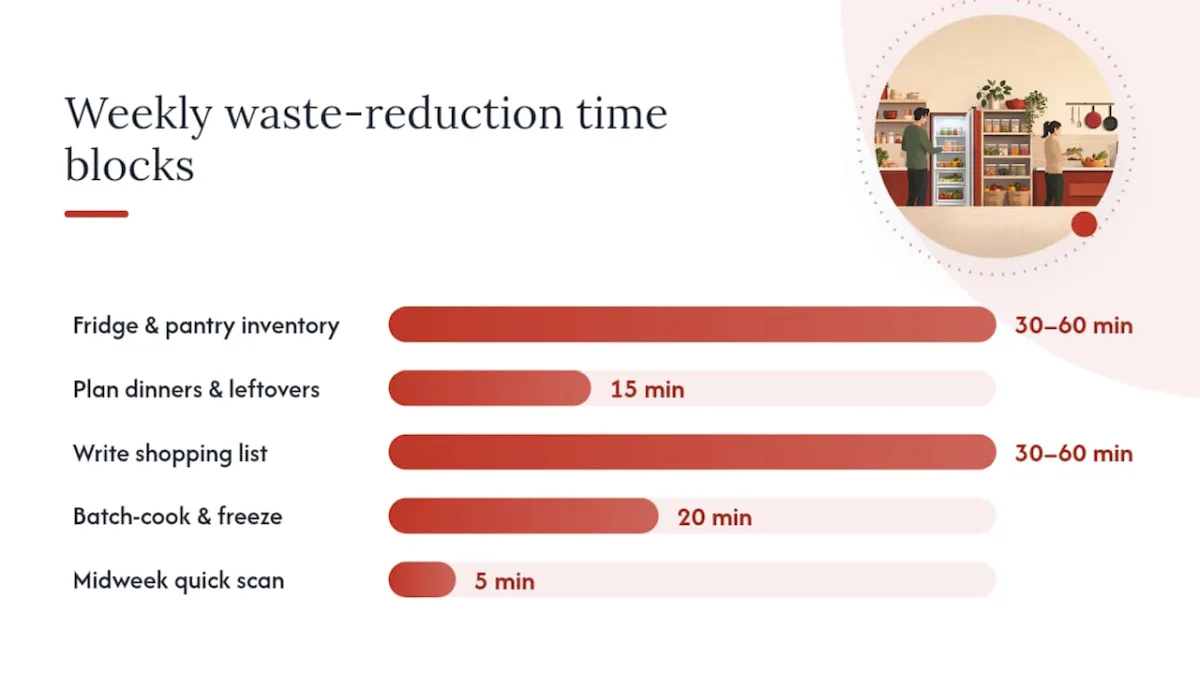
Follow this 30–60 minute Sunday routine every week and waste reduction becomes automatic rather than effortful. The EPA identifies a weekly inventory and consistent shopping cadence as among the highest-impact habits for households.
| Day/Time | Action |
|---|---|
| Sunday — 30–60 min | Take full fridge, freezer, and pantry inventory; move “use first” items to the front |
| Sunday — 15 min | Plan 5 dinners + 2 leftover nights; note any meals out |
| Sunday — 30–60 min | Write shopping list with quantities; check store ads for deals on items already on the list |
| Sunday — 20 min | Batch-cook one item (grains, roasted veg, a protein); portion and label; freeze extras |
| Mid-week — 5 min | Quick fridge scan; move anything close to turning into the “use first” bin |
| Shopping day | Shop from the list only; use online pickup to avoid impulse buys |
Track your progress simply: take a photo of your trash bin’s food scraps each week, or keep a two-line note (“threw out: half a bag of spinach, leftover pasta”). After four weeks, patterns become obvious. Maybe you always overbuy spinach. Maybe Tuesday’s dinner never gets eaten. Adjust one variable at a time. For busy cooks, a meal planning guide for busy people shows how to compress this routine even further.
Small habits compound faster than you think
The conventional wisdom on food waste reduction tends to focus on big, systemic changes: buy less, waste nothing, go zero-waste. That framing is counterproductive for most people. It sets a standard that feels impossible on a Tuesday night when you’re tired and the spinach is wilting.
What actually works is smaller and more boring: one consistent habit, repeated weekly, that removes a decision. The Sunday inventory takes ten minutes. The “use first” bin costs nothing. Freezing Tuesday’s leftovers before bed adds thirty seconds to your night. None of these feel like progress in the moment. Over a month, they add up to a noticeably lighter trash bag and a grocery bill that stops surprising you.
The families who make the biggest dent in their food waste aren’t the ones who try hardest. They’re the ones who made the habit small enough that skipping it feels stranger than doing it. Pick one habit from this guide. Try it for seven days. Measure what you throw out. That single data point, compared to the week before, is usually enough to make the habit stick.
Homecooked makes this routine take minutes, not hours
Meal planning, pantry tracking, and building a shopping list from scratch every Sunday is the right system. It’s also the part most people abandon after two weeks because it takes too long. Homecooked is built to close that gap.
The app generates a personalized weekly meal plan based on your health goals and dietary preferences, then automatically produces a shopping list with exact quantities for each recipe. The pantry tracker flags what you already have so you don’t buy duplicates. When you have odds and ends left over mid-week, Homecooked surfaces recipes that use exactly what’s in your fridge — including a cottage cheese protein bowl that works beautifully as a quick, low-waste lunch. The result is a grocery cart that matches what you’ll actually cook, which is the single most direct way to lower food costs and cut waste at the source.
Start a free trial at Homecooked and run your first automated meal plan this Sunday.
Useful sources and tools
- Preventing Wasted Food At Home | US EPA
- Tips to Reduce Food Waste — FDA
- Stretching Your Dollar at the Grocery Store | Extension | West Virginia University