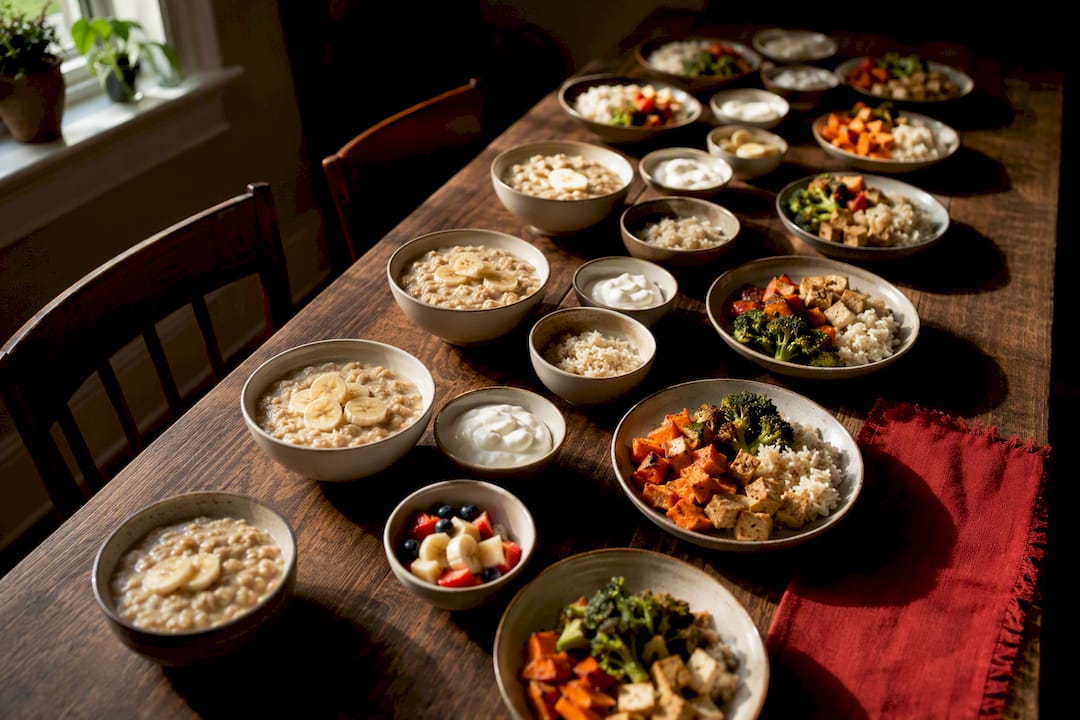
Match your carbohydrate intake to how hard the day’s run actually is, keep protein steady at around 1.6 to 2.0 grams per kilogram of body weight every single day, and prep flexible food components instead of locking yourself into seven identical meals. Test any new fuel on a training run, never on race day. Want the exact 7-day menu? Jump to the sample week and grocery list below and copy it straight into your week.
TL;DR:
- Carbohydrate intake should scale with the day’s run intensity, ranging from 3 grams per kilogram on rest days to 9 grams per kilogram on long run days, with protein steady at 1.6 to 2.0 grams per kilogram.
- Meal plans should focus on component-based prep like rice, vegetables, and proteins, adjusting portion sizes based on appetite swings rather than rigid meal structures.
- Fueling strategies include testing pre-run foods and fueling products in training, with carbohydrate intake during runs of over 75 minutes set at 30 to 60 grams per hour.
- Hydration depends on tracking urine color and adjusting intake, with electrolyte supplements recommended for long runs over 90 minutes or in hot, humid conditions.
- Long-term fueling success relies on building repeatable, flexible routines with meal prep and app-guided planning, rather than relying solely on motivation or rigid schedules.
Table of Contents
- Why Runners Meal Planning Works Differently Than a Standard Diet Plan
- What Are the Carb and Protein Targets for Each Training Day?
- A Ready-to-Use 7-Day Sample Meal Plan
- Meal-Prep Systems That Actually Hold Up Under a Training Schedule
- When Should Runners Eat Before, During, and After a Run?
- How Should Runners Handle Hydration and Electrolytes?
- Why Systems Beat Motivation for Long-Term Fueling
- Let Homecooked Turn This Plan Into Your Actual Week
- Sources
- FAQ
Why Runners Meal Planning Works Differently Than a Standard Diet Plan
Most diet advice assumes every day looks the same. Runners meal planning rejects that assumption from the start, because a 16-mile-long run and a rest day put wildly different demands on your body, even if you eat the exact same lunch on both.
The engine behind this is glycogen, the stored form of carbohydrate your muscles burn during exercise. For sessions longer than roughly 90 minutes or anything at race pace, carbohydrate availability becomes the deciding factor in how you feel at mile 10. That availability isn’t built in one pre-run bowl of oatmeal. It’s built over the 48 to 72 hours before the session, meaning your Wednesday dinner matters for Saturday’s long run just as much as Saturday’s breakfast does.
Protein works on a different clock. Rather than spiking it around workouts, sports nutrition guidance points toward a steady daily target of about 1.6 to 2.0 grams per kilogram, split across three or four meals rather than crammed into one giant dinner. That steady drip supports the muscle repair that happens continuously as you train, not just in the two hours after a hard workout.
None of this matters if the plan doesn’t survive contact with real life. Training builds appetite swings that make rigid meal plans fall apart. You might be ravenous the night after a long run and barely interested in food the next morning. A workable system has to flex around that, which is exactly why the framework here is built on components, not fixed meals:
- Carbohydrate scales with the day. Rest days need less; long runs and quality sessions need noticeably more.
- Protein stays flat. No day-type math required. Hit your daily gram target and move on.
- Meals get built from parts. Cooked rice, roasted vegetables, and a protein source get assembled differently depending on appetite and time, not thrown out because today’s “meal plan” doesn’t match today’s mood.
- Fueling gets rehearsed. Anything you plan to eat during a race or hard workout gets tested in training first.
That’s the whole framework. Everything below just puts numbers and menus on top of it.
What Are the Carb and Protein Targets for Each Training Day?
Four day types cover almost every training week: rest, easy, quality, and long run. Each one calls for a different carbohydrate range, while protein holds steady across all four.
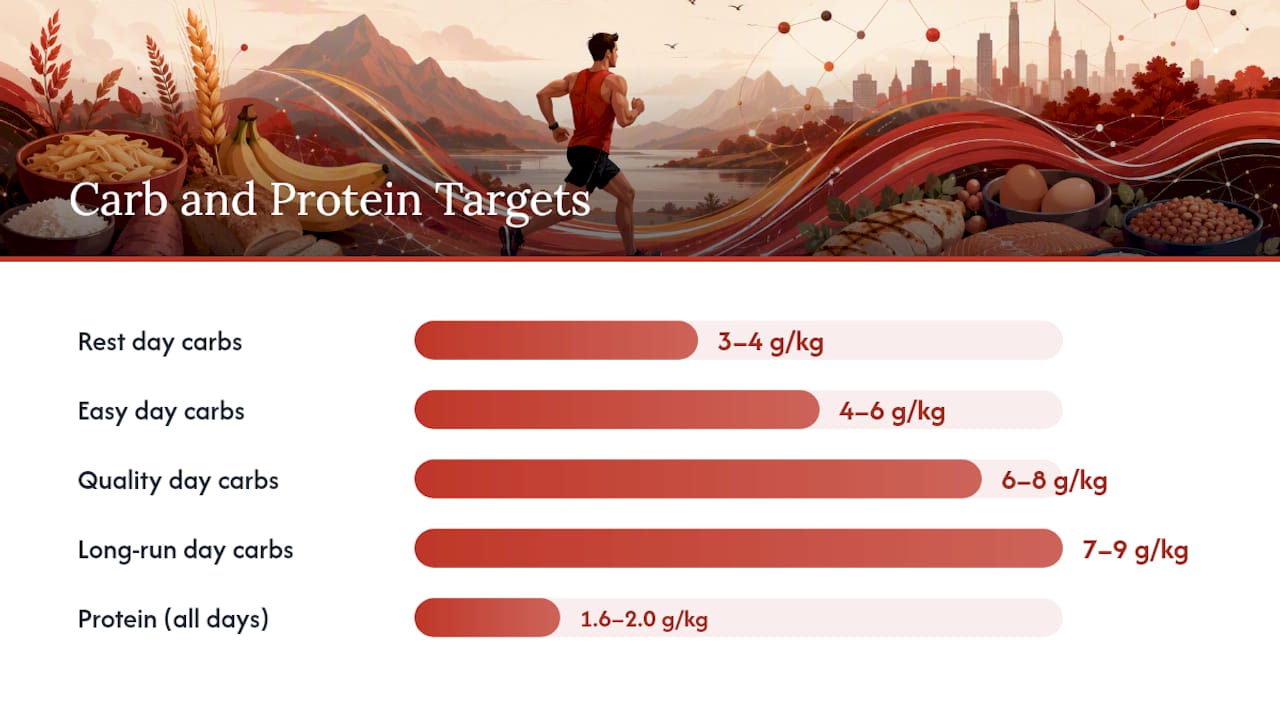
Rest days run lowest, at roughly 3 to 4 grams of carbohydrate per kilogram of body weight. Your muscles aren’t drawing down glycogen, so there’s no need to stack carbs the way you would before a long run.
Easy days climb to 4 to 6 g/kg. These are your recovery jogs and shorter aerobic runs, where you’re moving but not deeply taxing glycogen stores.
Quality days, meaning intervals, tempo runs, or anything at a hard effort, call for 6 to 8 g/kg, often with lower fat intake around the session itself since fat slows digestion when your gut is already stressed by pace.
Long-run days sit highest at 7 to 9 g/kg, and that figure includes whatever carbohydrate you consume during the run itself, not just food eaten before and after. These day-type ranges come from commonly cited sports-nutrition templates, and protein rides along at 1.6 to 2.0 g/kg regardless of which day type you’re in.
Quick reference: daily targets by training day
A 70 kg runner on a long-run day needs significantly more carbohydrate and protein compared to a rest day, where carbohydrate intake is much lower but protein remains steady.
Here’s how those ranges translate into actual grams for three common body weights:
Grams on paper don’t help much at the grocery store, so here’s the portion math. One cup of cooked rice runs about 45 grams of carbohydrate. A medium banana is close to 27 grams. A cup of cooked oats lands around 27 grams too, and a large bagel can carry 55 grams or more depending on size. A 70 kg runner aiming for 500 grams on a long-run day isn’t eating an impossible mountain of food. It’s closer to a bagel at breakfast, rice with lunch and dinner, a banana as a snack, and a sports drink or gel during the run itself.
Protein portions are simpler to eyeball. A palm-sized piece of chicken, fish, or tofu runs 25 to 35 grams. A cup of Greek yogurt adds another 20. Two eggs plus a slice of toast with peanut butter covers roughly 20 grams at breakfast. Spread four of those portions across a day and a 70 kg runner clears the 112 to 140 gram target without any single meal feeling oversized.
Pro Tip: Don’t try to hit these numbers exactly every single day. Land within 10 to 15 percent and you’re getting the training benefit. Chasing decimal-point precision on a training log wastes energy better spent on the run itself.
If tracking exact grams feels like more math than you signed up for, an app built around personalized meal plans can translate these g/kg ranges into actual recipes and portions without you doing the arithmetic every week.
A Ready-to-Use 7-Day Sample Meal Plan
This week assumes a common training pattern: one quality session, one long run, a couple of easy days, and a rest day. Swap the specific days to match your own schedule since the food matters more than the calendar label attached to it.
A practical meal-prep philosophy underlies this whole menu: repeat two or three breakfasts, rotate through four or five dinners, and build lunches from component prep rather than treating each of the 21 meals in a week as a unique cooking project. That’s the only way this survives a busy Tuesday.
-
Monday (Easy run). Breakfast: oatmeal with banana and peanut butter. Pre-run snack: half a bagel if running before eating a full breakfast. Lunch: rice bowl with roasted vegetables and grilled chicken or tofu. Dinner: pasta with marinara, lean ground turkey, and a side salad. Recovery snack: Greek yogurt with berries.
-
Tuesday (Quality session, intervals or tempo). Breakfast: two eggs, toast, and orange juice. Pre-run snack: a plain bagel or banana about 60 to 90 minutes before. Lunch: leftover pasta from Monday. Dinner: salmon or baked tofu, sweet potato, and steamed broccoli. Recovery snack: chocolate milk or a protein shake right after the session.
-
Wednesday (Easy run or rest, depending on the week). Breakfast: Greek yogurt parfait with granola and fruit. Lunch: turkey or hummus wrap with a side of pretzels. Dinner: stir-fry with rice, chicken or edamame, and mixed vegetables. Recovery snack: cottage cheese with fruit, an easy high-protein option that also works as a bedtime snack on heavier training days.
-
Thursday (Easy run, carb buildup begins for the weekend long run). Breakfast: oatmeal with banana and peanut butter, repeated from Monday on purpose. Lunch: rice bowl, same base as Monday with a different protein. Dinner: a plant-forward bowl for variety, similar to a plant-protein rice bowl, which works well for anyone rotating in a vegetarian night. Recovery snack: trail mix and a piece of fruit.
-
Friday (Rest day, carb-loading continues). Breakfast: bagel with cream cheese or nut butter, plus fruit. Lunch: leftover stir-fry or a grain bowl. Dinner: something familiar and easy to digest, like a rice and chicken bowl or a Korean-style bibimbap. Snack: dried fruit and nuts.
-
Saturday (Long run day). Breakfast: low-fiber option two to three hours before, such as a bagel with honey or white toast with jam. During the run: sports drink or gel, timed roughly every 30 to 45 minutes on runs past 75 minutes. Post-run: chocolate milk within 30 minutes, followed by a full meal within the hour, rice with chicken and vegetables works well. Dinner: pasta with a lean protein. Evening snack: yogurt or cottage cheese.
-
Sunday (Rest or very easy recovery jog). Breakfast: whatever sounds good, this is a lower-stakes day nutritionally. Lunch: leftovers from Saturday’s dinner. Dinner: something simple to prep for the week ahead, and if you’ve got a sweet tooth this is a fine day for a slice of homemade apple pie as a weekend treat rather than a guilt item.
Vegetarian and dairy-free swaps slot in easily. Replace chicken or salmon with tofu, tempeh, lentils, or edamame gram for gram on protein. Swap dairy milk for a fortified soy or oat milk in recovery shakes, since fortified plant milks typically match cow’s milk on protein per serving. Greek yogurt becomes a plant-based yogurt with a protein boost from a scoop of protein powder if the swap alone falls short on protein.
Grocery list, organized by store layout so you’re not doubling back across the store:
- Produce: bananas, berries, broccoli, mixed vegetables for stir-fry, sweet potatoes, a salad mix, fresh fruit for snacks.
- Dairy and eggs: Greek yogurt, cottage cheese, eggs, milk or a fortified plant alternative, cream cheese.
- Meat, fish, and plant protein: chicken breast, salmon, lean ground turkey, tofu, tempeh, or edamame depending on your week’s rotation.
- Grains and bread: rice, pasta, oats, bagels, sliced bread, granola.
- Pantry staples to keep stocked: peanut butter, honey, marinara sauce, soy sauce, olive oil, nuts, dried fruit, sports drink mix or gels.
- Frozen: mixed vegetables and frozen fruit as backups for weeks when fresh produce runs out before your next shop.
Writing the list in that order instead of by recipe can cut a rushed 50-minute grocery trip closer to 20 minutes, which matters more than it sounds like on a week when you’re also trying to fit in a long run.
Meal-Prep Systems That Actually Hold Up Under a Training Schedule
The single most useful habit in this whole plan is cooking dinner double and packing tomorrow’s lunch before you sit down to eat tonight’s dinner. That one move, proven out by runners who’ve stuck with meal-prep routines for years, eliminates the most common failure point: standing in front of the fridge at noon with no plan and reaching for whatever’s fastest.
Prep components, not sealed meals. Cook a big batch of rice, roast a tray of vegetables, and grill or bake a protein source in bulk on Sunday or Monday. Then assemble different combinations through the week instead of eating the identical rice bowl five days straight. Component prep also solves the appetite-swing problem from earlier: hungrier day, bigger portion from the same batch; less hungry day, smaller portion, nothing wasted.
Trying to overhaul your entire week’s cooking in one ambitious Sunday session is where most meal-prep plans die. A slower ramp works better long term:
- Week 1: Just double two dinners and pack the leftover as lunch. That’s the entire assignment.
- Week 2: Add a repeatable breakfast, oatmeal or eggs, made in a batch or prepped the night before.
- Week 3: Add a pre-run snack routine so you’re not improvising fuel choices on quality or long-run mornings.
- Week 4: Start prepping training-specific items, gels or sports drink portioned into bottles, recovery shakes premixed and ready in the fridge.
That gradual build matters more than it seems. Progressive ramping outperforms an ambitious one-off cook session because it turns each step into a habit before adding the next one, rather than asking you to change everything at once and burning out by week two.
A few appliances earn their counter space here. A rice cooker or Instant Pot handles grains hands-off while you’re outrunning. A sheet pan and oven roast a week’s worth of vegetables in one 25-minute batch. A slow cooker turns cheap protein cuts into shredded chicken or pulled pork that works across five different meals.

Pro Tip: Cooked rice and grains hold safely in the fridge for about four days and freeze well for up to three months. Cooked chicken or ground meat is good for three to four days refrigerated. When in doubt, freeze it, thawed leftovers beat a gamble on day-five chicken the night before a long run.
If keeping component batches, timers, and rotating grocery needs straight in your head sounds like its own part-time job, that’s precisely the gap a meal-prep-focused planning guide or a guided app can close.
When Should Runners Eat Before, During, and After a Run?
Timing matters as much as total grams, especially in the hours right around a workout. Get it wrong and you’re either running on empty or dealing with cramping and GI distress at mile 6.
-
Two to three hours before a run: eat a full meal that’s higher in carbohydrate and lower in fat and fiber. Think a bagel with a bit of jam, rice with a small amount of chicken, or oatmeal with banana. This window gives your stomach time to mostly empty before you start moving.
-
Thirty to sixty minutes before, if you didn’t eat a full meal earlier: stick to something small and simple, like half a banana, a few crackers, or a small glass of juice. Pre-run food this close to exercise should stay low in fat, fiber, and protein, since all three slow digestion right when your gut wants to be doing the opposite.
-
During runs longer than 60 to 75 minutes: aim for 30 to 60 grams of carbohydrate per hour, spaced out rather than dumped all at once. That might mean a gel every 30 to 45 minutes, sips of a sports drink every couple of miles, or a mix of both. Trained runners who’ve built up their gut’s tolerance can push toward the higher end of that range; if you’re new to fueling on the run, start low and build up over several long runs.
-
Within 30 to 60 minutes after finishing: combine roughly 20 to 40 grams of protein with 40 to 60 grams of carbohydrate. Chocolate milk hits both numbers almost perfectly in one drink. A protein shake with a banana works too, as does a rice bowl with chicken if you’re hungry enough for solid food right away.
Athletes who wait several hours to eat after a hard or long session are working against their own recovery. The combination of carbohydrate and protein in that post-run window supports both glycogen refilling and the muscle repair that starts almost immediately after you stop running.
GI trouble on the run almost always traces back to one of three culprits: too much fat or fiber too close to start time, an untested new fuel product, or drinking too much plain water without any sodium or carbohydrate to go with it. The fix is boring but effective: strip fat and fiber from anything eaten within two hours of running, test every new gel, chew, or drink during an easy training run instead of debuting it on race day, and if mornings are rough on your stomach, lean on liquid calories, a smoothie or juice digests faster than a bagel when nerves or an early alarm have your gut already unsettled.
How Should Runners Handle Hydration and Electrolytes?
Daily hydration matters more than any single pre-run chug of water. A simple check works well: if your urine runs pale yellow most of the day, you’re likely in reasonable shape; consistently dark urine is a signal to drink more throughout the day, not just before you run.
Sweat rate varies enormously between runners, so a fixed “drink X ounces per hour” rule fails plenty of people. Heavier sweaters running in heat lose far more sodium and fluid than someone doing an easy 4-mile jog in cool weather. Sports drinks earn their place specifically on runs past an hour, where they supply carbohydrate for fuel and sodium for what you’re losing through sweat in one product, instead of forcing you to manage water and fuel as two separate problems.
Reach for added electrolytes in three specific situations:
- Long runs past 90 minutes, especially in warm or humid conditions.
- Any session where you notice salt residue crusted on your skin or clothing afterward, a visible sign of heavy sodium loss.
- Multiple training sessions in one day, common during peak marathon-block weeks, where fluid losses stack up faster than casual sipping replaces them.
On supplements, keep the list short and evidence-grounded. Caffeine has a genuinely useful, well-documented performance benefit for many runners when taken 30 to 60 minutes before a hard effort. Iron and vitamin D deserve real attention too, since distance runners run a higher risk of low iron stores, particularly women, and vitamin D gaps are common in anyone training heavily through darker winter months. Neither is something to guess about. A blood test and a conversation with a doctor beats self-prescribing a supplement bottle based on a running forum post.
Why Systems Beat Motivation for Long-Term Fueling
Most runners don’t fail at meal planning because they lack nutrition knowledge. They fail because they built a plan that only works when life cooperates, and life rarely cooperates for more than a few weeks straight.
The system laid out here works because it’s built on repeatable rhythms instead of daily decisions. Once cooking dinner double and prepping components becomes automatic, you’re no longer negotiating with yourself every evening about whether to cook. That’s not a small thing. Decision fatigue is real, and every meal you don’t have to plan from scratch is energy left over for the parts of training that actually require willpower, like getting out the door for a 6 a.m. run.
Flexibility matters just as much as structure. Travel, a family event, or a cold that knocks you out for four days shouldn’t collapse the whole plan. Scale carbs down on days you’re not training, lean on the same protein and vegetable components regardless of where you are, and don’t try to make up missed runs by eating differently. The framework flexes; that’s the entire point of building it around swappable components instead of a rigid seven-day script carved in stone.
— 0xmaglev
Let Homecooked Turn This Plan Into Your Actual Week
Homecooked is built for exactly the gap between “I know the g/kg targets” and “I actually cooked the right meal on a Tuesday night.” Instead of doing the day-type math from the tables above by hand every week, the app builds personalized meal plans around your training schedule, dietary preferences, and pantry, then generates the shopping list for you.

Turning the 7-day sample plan above into something app-ready takes four steps. Enter your weekly training schedule, quality day, long run, rest day, and the rest. Choose meal templates that match your carb needs for each day type. Let the app auto-generate a shopping list organized the way you’d actually walk the store. Then use the guided recipes with built-in timers to batch-cook components on prep day, so rice, protein, and vegetables are ready to assemble into whatever combination sounds good that night.
Pantry-first substitutions mean a recipe adjusts around what you already have instead of sending you back to the store for one missing ingredient, and progress tracking keeps tabs on how your plan holds up across a full training block. Visit the Homecooked landing page to start a free trial and try building your first training week.
Sources
For readers who want to go deeper on the science and systems behind this plan, these sources cover the technical detail this guide draws from:
- Carbohydrate intake for training and racing
- Runner’s diet — Johns Hopkins Medicine
- 7-Day meal plan for runners (PlanEat AI)
- Marathon training diet and meal plan
- Meal planning for runners: a practical weekly system
FAQ
What Is the 3-3-3 Rule for Meal Prep?
There’s no single, universally recognized “3-3-3 rule” for meal prep in sports nutrition, definitions vary depending on the source. Some use it loosely to mean three prepped meals, three snacks, and three days of variety before repeating, but treat any version of this rule as a rough organizing idea rather than a fixed standard.
What Is the 4-2-1 Rule for Athletes?
This isn’t a standardized athlete-nutrition guideline with one agreed definition, and no major sports-nutrition source ties it to a specific carb, protein, or hydration formula. Skip trying to apply it and use the day-type carb ranges (3 to 9 g/kg depending on training day) covered above instead, since those come from named, sourced templates.
What Is the 80% Rule in Running?
It’s a training-load concept rather than a nutrition rule, though it does map onto this plan: your easy days, which make up most of your week, call for moderate carb intake (4 to 6 g/kg), while the harder 20 percent of sessions justify the higher carb ranges.
What Is a Good 7-Day Meal Plan for Runners?
A good 7-day plan matches carbohydrate intake to each day’s training demand, rest days lower, long runs and quality sessions higher, while keeping daily protein steady at 1.6 to 2.0 grams per kilogram of body weight. The sample week above gives a full breakfast-to-recovery-snack breakdown built around repeatable meals and component prep, and apps like Homecooked can adapt that same structure to your specific training calendar and dietary needs.
How Much Should Runners Eat During a Long Run?
During runs longer than about an hour, aim for 30 to 60 grams of carbohydrate per hour through a mix of gels, chews, or sports drink, spaced out every 30 to 45 minutes rather than consumed all at once. Always test a fueling product in training before relying on it during a race, since gut tolerance for in-run fuel varies significantly from runner to runner.