
Pick the fastest logging method you will actually stick with, snap a photo or type a two word note, and track just one or two things: mood and timing work well. Do this for two weeks, then read it back. That single review session tells you more about your patterns than a month of guessing ever could, and it works whether you use an app or a napkin.
TL;DR:
- Tracking just one or two metrics, such as mood and timing, for two weeks reveals meaningful eating patterns that can guide small, targeted changes.
- Using simple logging methods like photos or short notes ensures consistency and speed, increasing the likelihood of long-term habit formation.
- A weekly review of seven days’ data helps identify recurring triggers, timing clusters, and patterns that inform effective adjustments.
- Focus on analyzing your top three most frequent triggers or habits rather than trying to log everything at once during initial tracking.
- Transitioning from manual tracking to an app like Homecooked automates pattern translation into personalized meal plans and shopping lists, making sustainable change easier.
Table of Contents
- Why Tracking Eating Habits Actually Works
- What to Record Each Time You Eat
- Practical Methods to Log What You Eat
- Your First Two Weeks: A Low-Effort Starter Plan
- The Weekly Review: Turning Your Log Into Real Changes
- How an App Like Homecooked Turns Logging Into a Real Meal Plan
- Keeping the Habit Alive Without Burning Out
- What My Own Food Diary Taught Me
- Ready to Stop Tracking Manually and Start Cooking From the Pattern
- Sources
- FAQ
Why Tracking Eating Habits Actually Works
Nobody needs a nutrition degree to benefit from writing down what they eat. The value comes from something simpler: seeing your own patterns instead of relying on memory, which is notoriously bad at counting snacks and portion creep.
The American Heart Association points out that a food diary gives you a snapshot of your daily and weekly intake, and reviewing that record regularly helps you spot the choices that are working against your goals. Harvard Health backs this up from a different angle: a diary helps you understand your own eating patterns and pinpoint the specific foods or times of day that tend to cause trouble, whether that trouble is a 3 p.m. energy crash or a late-night raid on the pantry.
Statistic Callout: Controlled studies reviewed on PubMed found that people who kept a food record had better weight-control outcomes than those who did not track at all. The mechanism isn’t magic. It’s awareness.
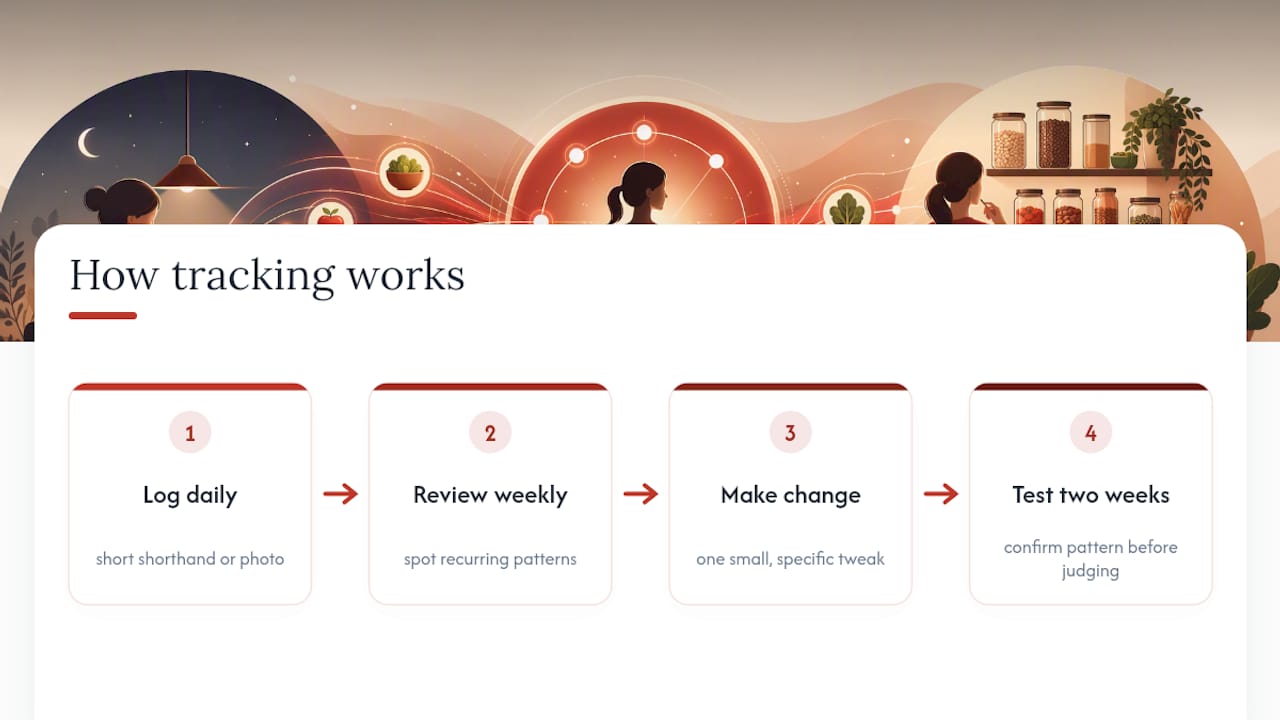
Here’s the chain reaction that makes tracking work: you write something down, you notice a pattern across several days, and that pattern points to one small, specific change. Nobody overhauls their entire diet from a single day’s log. It’s the accumulation, the third Tuesday in a row you skipped breakfast and then overate at lunch, that turns into an actual insight.
Set your expectations accordingly. A logging session takes a short amount of time if you use shorthand or a photo. The review, where the real learning happens, takes a brief period once a week. That’s the whole time commitment. Anyone promising instant transformation from three days of tracking is overselling it. Give it two full weeks before you judge whether a pattern is real or just a busy week.
What to Record Each Time You Eat
A useful log doesn’t need to look like a lab notebook. The CDC’s printable food diary keeps things intentionally simple: food, portion, time, and a short note. That’s the template worth copying, and you can run it on paper, in a notes app, or inside a dedicated eating habit tracker.
Here’s what to capture every time, at minimum:
- Food or drink: name it plainly. “Chicken burrito bowl” beats a vague “lunch.”
- Portion: small, medium, or large works fine, or just snap a photo and skip estimating entirely.
- Time: the hour matters more than the minute. Clusters reveal themselves at the hour level.
- Mood or hunger: a simple 1 to 5 scale before you eat tells you whether you’re eating from hunger or from stress, boredom, or habit.
- Location or context: desk, car, couch, restaurant. Context is often the actual trigger, not the food itself.
- Water: a rough tally, even just tick marks, catches the dehydration that masquerades as hunger.
Once that basic habit is steady, a few optional fields add depth without adding much friction:
- Brand or restaurant name, useful if you’re chasing down a specific ingredient sensitivity.
- Calories or macros, worth adding only if you have a defined goal like muscle gain or a medically supervised eating plan.
- Symptoms, like bloating or fatigue, if you suspect a food connection.
Each field earns its place by answering a different question. Portion and time answer “when and how much.” Mood and context answer “why.” Water answers a question most people never think to ask. Resist the urge to add every optional field on day one. The Heart Association’s own guidance leans on adding context notes, like what you were doing or how you felt, specifically because that’s what surfaces triggers like the vending machine run that has nothing to do with real hunger.
Practical Methods to Log What You Eat
There is no single correct way to log a meal. The right method is whichever one survives contact with your actual schedule.
- Photo-first logging. Snap a picture before you eat. This is the fastest possible method and works especially well for mixed meals, like a stir-fry or a buffet plate, where naming every ingredient would take longer than eating did. The catch: a photo alone underestimates or overestimates portions unless you add a ten-second review step afterward, where you glance back and jot a rough size estimate.
- Quick text shorthand. Type two or three words into your phone: “burrito, 2, stressed” might mean burrito, medium portion, mood level 2. This method protects your privacy since nothing lives in a shared app, and it takes less time than unlocking most apps in the first place.
- Barcode scanning. For packaged and branded foods, a barcode scan gives you exact nutrition data without any guesswork. This is the right call when accuracy matters more than speed, like when you’re troubleshooting a specific ingredient reaction.
- Paper journal. Low-tech, doesn’t sync anywhere, can’t be hacked. A paper log is a completely legitimate long-term method, not a fallback for people who dislike apps.
- Voice notes or end-of-day recap. When your hands are busy (cooking, driving, holding a toddler), talk it out into a voice memo or reconstruct the whole day from memory before bed. It’s less precise, but a rough daily recap beats a perfect log you never finish.
Pro Tip: Whatever method you choose, build in a five-second pause before eating rather than after. Logging before the first bite curbs the “I’ll remember it later” trap that quietly kills most tracking habits by day four.
Your First Two Weeks: A Low-Effort Starter Plan
Trying to track everything at once is the fastest way to quit by Thursday. Pick two metrics tied to what you actually want to learn, and ignore the rest for now.
Some pairings that work well: energy and meal timing if you’re chasing afternoon crashes, mood and food choice if stress eating is the suspect, or weight and portion size if the goal is straightforward weight management.
- Days 1 to 3: Log every meal with your two chosen metrics only. Don’t judge anything yet, just collect.
- Days 4 to 7: Add one nightly note, a single sentence: “Rough day, ate more at dinner” or “Skipped lunch, wasn’t hungry.” This takes under a minute and adds context numbers alone can’t give you.
- Days 8 to 10: Keep logging exactly the same way. Resist adding new fields even if you’re tempted, consistency beats completeness in these early days.
- Days 11 to 14: Read back through the full two weeks in one sitting. Look for anything that repeats three or more times.
At the two-week checkpoint, success doesn’t mean you’ve lost weight or fixed anything. Success means you found at least one repeating pattern, like consistent 3 p.m. hunger or a mood dip after certain meals. That single insight is the entire point of the experiment.
The Weekly Review: Turning Your Log Into Real Changes
A log that never gets reviewed is just a diary nobody reads. The weekly review is where tracking earns its keep, and it’s genuinely quick once you know what to look for.
Set aside fifteen minutes, ideally the same time each week, and run through this checklist:
- Tally repeat triggers: did the same food, mood, or situation show up three or more times?
- Map timing clusters: are certain hours consistently linked to overeating, low energy, or skipped meals?
- Check hydration gaps: did water intake drop on the same days something else went sideways?
- Scan for nutrient shortfalls: are vegetables, protein, or fiber missing on specific days rather than every day?
- Note your most frequent foods: repetition isn’t bad, but it tells you where a small swap has the biggest reach.
A weekly view, rather than a single day, is what actually reveals a pattern, since any one day can be thrown off by a birthday party or a bad night’s sleep. Seven days smooths that noise out.
Here’s what this looks like in practice. Say your log shows a vending machine snack around 3 p.m. on four of five workdays, paired with a mood score of 2. That’s not a willpower problem, it’s a predictable energy dip with an easy fix: prep a protein-forward snack, like hard-boiled eggs or a yogurt cup, and bring it from home. Or maybe hydration tanks every Wednesday, the day you have back-to-back meetings. The fix there is a water bottle on your desk before the first call, not a new diet.

Once you’ve spotted the pattern, translate it directly into your next grocery list or weekly plan. If afternoon snacking is the recurring flag, that becomes three items on your shopping list. If dinner variety keeps sliding into the same two meals, pull your weekly plan into a fresh structure built around what you actually noticed, not what sounded good in theory on Sunday.
How an App Like Homecooked Turns Logging Into a Real Meal Plan
Manual logging teaches you the pattern. An app closes the loop by turning that pattern into a shopping list and a recipe without you doing the translation work yourself.
Some apps are built around a pantry-first structure: you note what’s already on hand and what you’ve been eating, and the app builds personalized meal plans around your actual health goals and stated preferences, rather than a generic template. That mirrors the weekly-review checklist directly. Here’s how the fields line up:
- Meal and pantry logging maps to the “frequent foods” and “nutrient shortfall” checks from your weekly review.
- Progress tracking maps to the timing-cluster and mood-pattern checks, since trends show up automatically instead of requiring you to tally them by hand.
- Automated shopping lists map directly to the “translate insight into action” step, the part most manual trackers skip because it’s tedious.
- Guided recipes with built-in timers map to the moment you’ve identified a swap you want to make, like trading a vending machine snack for a homemade protein bowl, and need a straightforward way to actually cook it.
If you’ve been logging on paper or in a notes app for a few weeks and keep landing on the same few insights, that’s usually the signal you’ve outgrown manual tracking. A smart grocery list built from your meal plan does automatically what you were doing by hand every Sunday night, minus the spreadsheet.
Keeping the Habit Alive Without Burning Out
Most tracking habits don’t fail because the method was wrong. They fail because week three feels like homework. A few adjustments keep it sustainable for months instead of days.
- Batch your entries. Log breakfast and lunch together at 2 p.m. instead of interrupting your morning twice.
- Use templated shorthand. If “coffee, black, 7am, 4” always means the same thing, you stop thinking and just type.
- Rotate your focus metrics. Track mood for two weeks, then switch to hydration for two weeks. Constant novelty beats staring at the same static log.
- Go photo-only during a busy week. A lighter version of tracking beats zero tracking, and it’s easy to add detail back once life calms down.
- Deepen data only for short, deliberate stretches. Add macros for a focused five-day experiment, then drop back to the basics.
Missing a day or three is not a reason to start over. Pick the log back up at your next meal, no note explaining the gap required. The two-week experiment format works precisely because it tolerates a rough patch. One missed day out of fourteen barely dents the pattern you’re trying to spot.
Pro Tip: Keep a single running note titled “skip it” for fields you tried and abandoned. Reviewing what didn’t work is just as useful as reviewing what did, and it stops you from re-adding the same tedious field three months from now.
What My Own Food Diary Taught Me
I started logging mostly out of curiosity, expecting to learn something about calories. Instead, the pattern that jumped out had nothing to do with food at all: nearly every “unplanned” snack in my log happened between 3 and 4 p.m., and the mood note next to it almost always said some version of “tired” or “bored,” never “hungry.”
The fix wasn’t a diet change. It was moving my afternoon walk from 5 p.m. to 3:30, right before the slump usually hit. Four weeks later, the same time slot in my log showed water or tea instead of a snack on most days, not all, but most.
That’s really the whole case for tracking. It doesn’t hand you a verdict on day one. It hands you a question worth asking, then lets a couple of weeks of honest data answer it. Treat the log as a curiosity project rather than a report card, and you’ll actually keep doing it long enough for a real pattern to show up.
— 0xmaglev
Ready to Stop Tracking Manually and Start Cooking From the Pattern
You’ve done the hard part: figuring out what actually trips you up. Homecooked is the tool that takes it from there, turning your tracked patterns straight into a personalized meal plan instead of leaving you to redesign your week from scratch every Sunday.
Where a manual log or a general tracking app stops at showing you the pattern, Certain pantry-first meal planning apps build meal plans around your health goals and what’s already in your kitchen, then generate the shopping list and guide you with recipes that include built-in timers so the fix actually gets cooked, not just noted. If your log points to more protein at breakfast, a recipe like the cottage cheese protein bowl is the kind of guided fix that’s one tap away instead of another research project. For readers who’d rather skip the tracking entirely some weeks, ordering freshly prepared meals is a reasonable stopgap, but it won’t teach you the pattern behind your own habits the way a short log does first.
Run your own two-week experiment, then bring what you find to Homecooked and let the app turn that insight into next week’s dinners.
This article is general information, not a substitute for advice from a qualified doctor. Consult a qualified healthcare professional about your own circumstances before acting on anything here.
Sources
- Keeping a Food Diary: Tracking What You Eat and Drink
- My Food Diary (CDC printable)
- Why keep a food diary? (Harvard Health Blog)
- PubMed abstract on food record efficacy
FAQ
What Is the 3-3-3 Rule for Eating?
There’s no single, universally recognized “3-3-3 rule” backed by major nutrition research bodies. Definitions circulating online vary widely, from meal timing patterns to portion guidance, so treat any specific version you encounter as informal advice rather than an established clinical standard.
What Is the Best Way to Track What You Eat?
The best method is whichever one you’ll actually keep doing for two straight weeks, whether that’s a photo, a two-word text shorthand, or a paper diary. The American Heart Association frames the goal as a weekly snapshot, not daily perfection, so consistency beats precision every time.
Is the 4-4-9 Rule Accurate?
The 4-4-9 rule refers to calorie counting math: carbohydrates and protein each provide about 4 calories per gram, and fat provides a higher calorie amount per gram. It’s a standard nutrition-label calculation rather than a tracking method, and it’s accurate as a rough conversion, though it doesn’t account for fiber or individual digestion differences.
What Is the Best App to Track My Eating Habits?
It depends on what happens after you log. If you want an eating habit tracker that also turns your patterns into actual meals and a grocery list, Homecooked builds personalized plans around pantry items and your specific health goals rather than leaving you to interpret the data yourself. Current pricing is available on the Homecooked site.
How Long Should I Track Before I See Results?
Two weeks is enough to spot at least one real pattern, since a single day can be thrown off by an unusual event but a full week smooths that out. Review your log at the same time each week rather than daily, since the pattern only becomes visible across multiple days, not within a single meal.